
Open this photo in gallery:
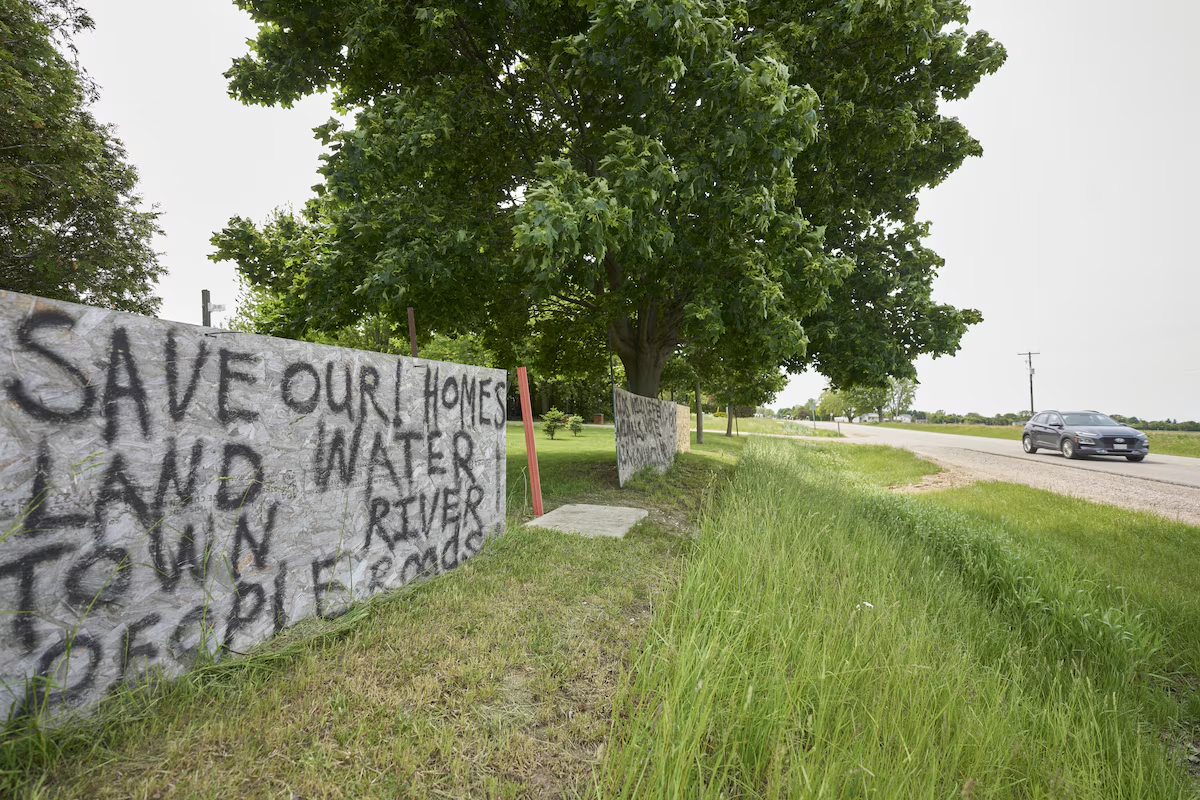
Signs are displayed outside Dresden, Ont. in June 2025 to protest a proposed landfill site down the road.Geoff Robins/The Globe and Mail
Ontario Environment Minister Todd McCarthy says he is open to changes to his proposal to eliminate a municipal veto on new landfills, despite initially insisting the move is necessary, as the province stares down a shortage of places to put its garbage.
When Mr. McCarthy first unveiled his plan last month, as part of an omnibus bill aimed at reducing red tape, he said Ontario has less than 10 years of landfill space left. He warned that a new 50-per-cent U.S. tariff imposed by President Donald Trump on trash that crosses the border would make the situation worse, adding that Ontario sends 40 per cent of its commercial waste to Michigan and New York State.
The proposal, which has alarmed some rural municipal leaders and environmentalists, would remove a section from the province’s Environmental Assessment Act that requires landfill proponents to show they have the support of the host municipality and others within 3.5 kilometres of the site.
The provision was inserted into the legislation by the same Progressive Conservative government just six years ago, when it sided with a swath of rural municipalities that opposed being stuck with big-city waste against their will.
Open this photo in gallery:
Provincial Environment Minister Todd McCarthy says he’s open to tweaks to his proposal.Laura Proctor/The Canadian Press
In an interview with The Globe and Mail, Mr. McCarthy said striking the section would be a “housekeeping amendment,” a term that generally refers to an insignificant change in legislation – despite saying when he introduced the bill that it was key to streamlining the approval of new landfills. He also said he is open to “tweaks.”
“Technically, that veto is being removed. That’s a proposal,” he said, adding that once the bill goes before a legislative committee “some consideration will be given to different alternatives.”
Mr. McCarthy said municipalities will retain input and their existing permitting powers, which can be overridden by the province’s land tribunal. But he said he expects there will be enough willing communities for both new landfills and new “energy-from-waste” incinerators, for which he is also proposing an easier approval process. That’s also a flashpoint for environmentalists, who warn of pollution and greenhouse gas emissions.
Mr. McCarthy’s previous public statements about the landfill veto have also sent mixed messages. When asked by reporters late last month if he would force a municipality to accept a landfill site, he left the door open. But the next day, he repeatedly declared that no municipality would be forced to accept trash.
Open this photo in gallery:
Bryan Smith and other activists fought against approval to transform the Carmeuse Beachville Operations quarry into a landfill about a decade ago.Nicole Osborne/The Globe and Mail
The latest back-and-forth is taking place in the shadow of a move the provincial government made just last year, when it passed special legislation to override local opposition and allow proponents seeking to revive and expand a landfill site in the Southwestern Ontario town of Dresden to skip the environmental assessment process.
From the archives: An Ontario town dreads garbage day as province plows ahead with landfill
The PC government’s original promise of a local veto followed an anti-dump battle that began more than a decade ago, when a proposal to put 17.4 million tonnes of waste in a quarry just two kilometres from the heart of small town Ingersoll, Ont., became a rallying cry for rural municipalities.
Local leaders, activists and a coalition of 150 municipalities pushed for a formal veto. Mr. Ford and his party then campaigned in 2018 on giving communities one – and got around to amending the Environmental Assessment Act to include it in 2020.
The potential reversal is the latest in a spate of policies from the Ford government that have alarmed environmentalists. It has also caught the attention of local politicians in Oxford County, which was ground zero for the landfill battle that prompted the veto clause in the first place.
The county issued a statement on Nov. 2, signed by 12 local mayors and mayors-elect, reaffirming their belief that municipalities should retain the right to say no to landfills. They warn that the changes “would leave municipalities without leverage or meaningful voice at the table, with little to no opportunity to negotiate the necessary terms to safeguard their communities.”
Marcus Ryan, the outgoing warden of Oxford County and mayor of Zorra Township, said he and other local politicians intend to meet with Mr. McCarthy to see if the veto can be preserved. He blames the proposed change on lobbying by the waste industry, which has advocated against the veto.
“We wish it wasn’t happening,” he said, adding that there is no indication the owners of the quarry in Oxford intend to revive their landfill proposal. “But this is the world of government. And our level of government will talk to their level of government and we’ll see if we can work it out.”
Open this photo in gallery:
Members of the OPAL Alliance are among those pushing back against the change.Nicole Osborne/The Globe and Mail
Bryan Smith, chair of the Oxford Coalition for Social Justice, who helped lead the fight against the landfill, said the provincial government appears to be talking out of both sides of its mouth.
“What they are writing and what they are saying are two different things,” he said, warning that citizens’ groups and local politicians would restage their fight if the government goes ahead.
Ford faces Ontario legislature after long summer break, pledges more landfillsFord faces Ontario legislature after long summer break, pledges more landfills
Long-time local Oxford PC MPP Ernie Hardeman had previously championed the municipal veto. Now, he says he hopes a new system can be worked out at the committee stage that would preserve a say for municipalities, yet still make it easier to create new landfills.
He said it doesn’t make sense that municipalities can decide where a Tim Hortons goes, but not a landfill, and that being unable to say no leaves them with very little leverage in negotiating with landfill companies.
But he also said the clause that he worked to insert into the Environmental Assessment Act in 2020 went too far by extending the veto to some neighbouring municipalities, not just the prospective host.
“Hopefully we’re going to see some amendments,” he said. “I think the challenge is we know landfill has to be somewhere.”
Waste to Resource Ontario, which represents the waste industry, warned in a statement sent by the group’s manager of member services and events, Lauryn Weinberger, that the province faces a landfill capacity crisis.
The group said the province must act now to find new sites and increase diversion and recycling, as new landfills take eight to 10 years to become operational. The statement said if the U.S. border were to close completely for trash, Ontario could run out of space by 2034.