
Open this photo in gallery:
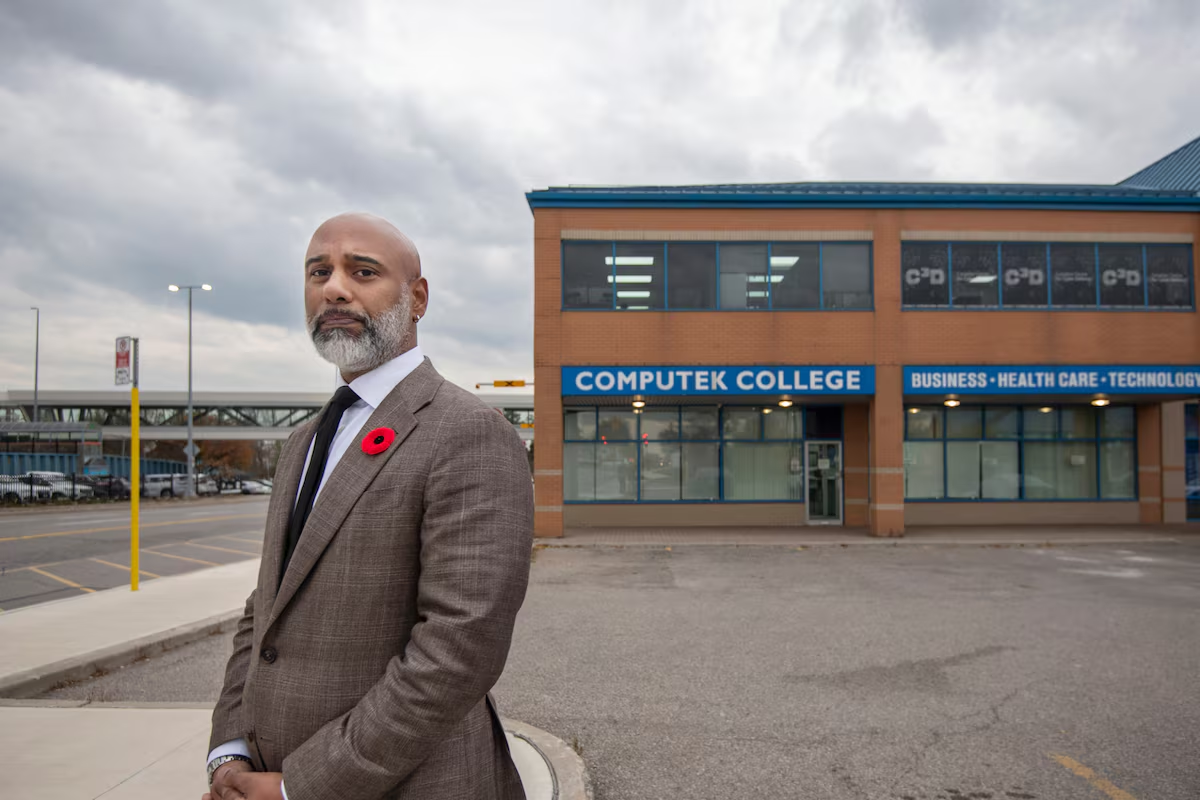
Muraly Srinarayanathas, owner of Computek College, laid off 25 of his staff and worries he’ll have to suspend classes next.Fred Lum/The Globe and Mail
Anderson College has laid off just more than 100 staff and paused classes for about 300 recently enrolled students. Computek College laid off 25 employees this week. The Academy of Applied Pharmaceutical Sciences has laid off 10 people so far.
And the owners of all three say they fear worse is to come if the Ontario government doesn’t lift a blanket freeze on loan disbursements to schools and students in the private career college sector sooner than its previously announced timeline of next year.
“We are operating, as you can imagine, at a huge loss,” said Laleh Bighash, president of the Academy of Applied Pharmaceutical Sciences, a private college in the Greater Toronto Area that trains university graduates for careers in the pharmaceutical and food-safety industries. If the pause endures, she added, the school can survive for “maybe weeks, maybe maximum a month, but we wouldn’t be able to operate beyond that.”
OSAP freeze alarms private colleges as minister feels the heat
Layoffs, class suspensions and other consequences are mounting for Ontario’s private career colleges as they struggle to stay afloat without their main source of revenue: tuition fees paid through the Ontario Student Assistance Program, the province’s needs-based student aid program.
The Progressive Conservative government has said it had no choice but to pause OSAP disbursements after a preliminary audit identified “serious concerns” with the integrity of student aid in the private postsecondary sector. Some of those concerns were forwarded to the Ontario Provincial Police.
Open this photo in gallery:
Ontario Premier Doug Ford says his government is “moving as quickly as we possibly can” to reform OSAP rules.Arlyn McAdorey/The Canadian Press
Private career colleges offer quick diplomas for jobs such as personal support workers, early childhood assistants, community service workers, medical office assistants and dental hygienists, among others. They generally charge higher tuition than their publicly-funded counterparts because they aren’t subsidized by taxpayers.
They also tend to attract low-income students, such as new Canadians and working parents. As a result, their students rely heavily on government loans to cover tuition and to help defray their living costs. Normally, OSAP sends tuition fees directly to postsecondary institutions, but that didn’t happen for private colleges this fall.
At least one private college in Toronto, the Harris Institute for music industry education, said the OSAP pause played a part in its decision to close, while another, Trillium College, has responded by suspending classes at all five of its campuses.
Ontario’s OSAP pause hits paramedic students
The freeze is also chilling business for career college marketers and suppliers, some of whom are sitting on niche textbooks and branded uniforms their clients can no longer afford.
“My clients, they’re not under investigation. But they’ve been cut off anyways,” said Eddy Della Mora, owner of Campus Bookstore, a business that sells books and clothing to private colleges. His sales were down 96 per cent in October compared to the same month last year.
Premier Doug Ford said earlier this week that his government is “moving as quickly as we possibly can” to reform OSAP rules for the private postsecondary sector. Nolan Quinn, the Minister of Colleges, Universities, Research Excellence and Security, is scheduled to make an announcement about the program on Thursday.
“We’re going to catch these bad actors, and they need to go to jail,” Mr. Ford said at an unrelated news event on Monday. “Simple as that. We need to get the money back and invest it into good actors.”
Ontario received hundreds of tips, complaints about private career colleges before OSAP ban, documents show
In May, the province issued notices of OSAP non-renewal to six GTA career colleges that had recorded unusually large spikes in OSAP-funded students in online-only courses. Three of those schools took the government to court, a move that put provincial inspection reports and other internal documents on the public record.
Inspectors allege they found suspicious activities such as asynchronous courses being completed in a day or two and exams written in less than five minutes, often from IP addresses outside North America, which suggest third parties may have completed the coursework. They also noted that thousands of OSAP applications for the schools came from a handful of IP addresses.
None of the allegations have been proven in court.
Open this photo in gallery:
People take part in a rally over OSAP cuts outside Queen’s Park in Toronto in March 2024.Allison Jones/The Canadian Press
In August, the province brought in KPMG to conduct the wider audit that triggered the freeze.
It’s not yet clear how many private postsecondary institutions have laid off staff or suspended classes, according to Career Colleges Ontario, an association that represents about 280 career college campuses. Spokeswoman Taylor Buck said the organization is actively gathering data from its members about the ramifications.
“We continue to hear from students about the very real impact this is having on their education and their ability to cover basic living expenses. If funding is not restored quickly, we expect more institutions will have to pause programs or close, putting even more students at risk of disrupted education,” she said by e-mail.
Muraly Srinarayanathas, the owner and chairman of Computek College, laid off 25 of his 120 staff starting on Monday. The school, which offers mainly health, business and technology programs at its campuses in Scarborough, Markham and Ajax, has avoided suspending classes for now.
But Mr. Srinarayanathas worries about having to take that step, and having to consider another round of layoffs. And he worries just as much about the students and the workplaces they serve, including nursing homes, hospitals and daycares.
“I think it’s going to be horrific,” especially for health-care employers, he said.
Students are paying the price for Ontario’s neglect of private colleges
At Anderson College, which has 10 campuses in the GTA and in southern Ontario, students in at least one class broke into tears when they learned their course was being suspended, according to Heather Yang, the college’s president and chief executive officer.
Late last month, Anderson paused classes for students newly enrolled in August and September.
“They were working hard. They studied really well despite uncertainty,” Ms. Yang said. “They bonded with their classmates. They bonded with their instructors, and to just have this news announced, through no fault of their own. It’s just very devastating.”
Bianca Giacoboni, a spokeswoman for Mr. Quinn, emphasized in a statement on Wednesday that the preliminary findings of the independent audit compelled the government to enact the pause to “protect taxpayer dollars and hold bad actors accountable.”
She added that, “We recognize the impact that this pause is having on hard-working students and good institutions. We are pursuing options for low-interest, third-party loans facilitated by financial institutions for students, while concurrently working as quickly as possible to get good actors back into the OSAP system.”
She also said the day-to-day operations of postsecondary institutions, including private colleges, are the responsibilities of those institutions.