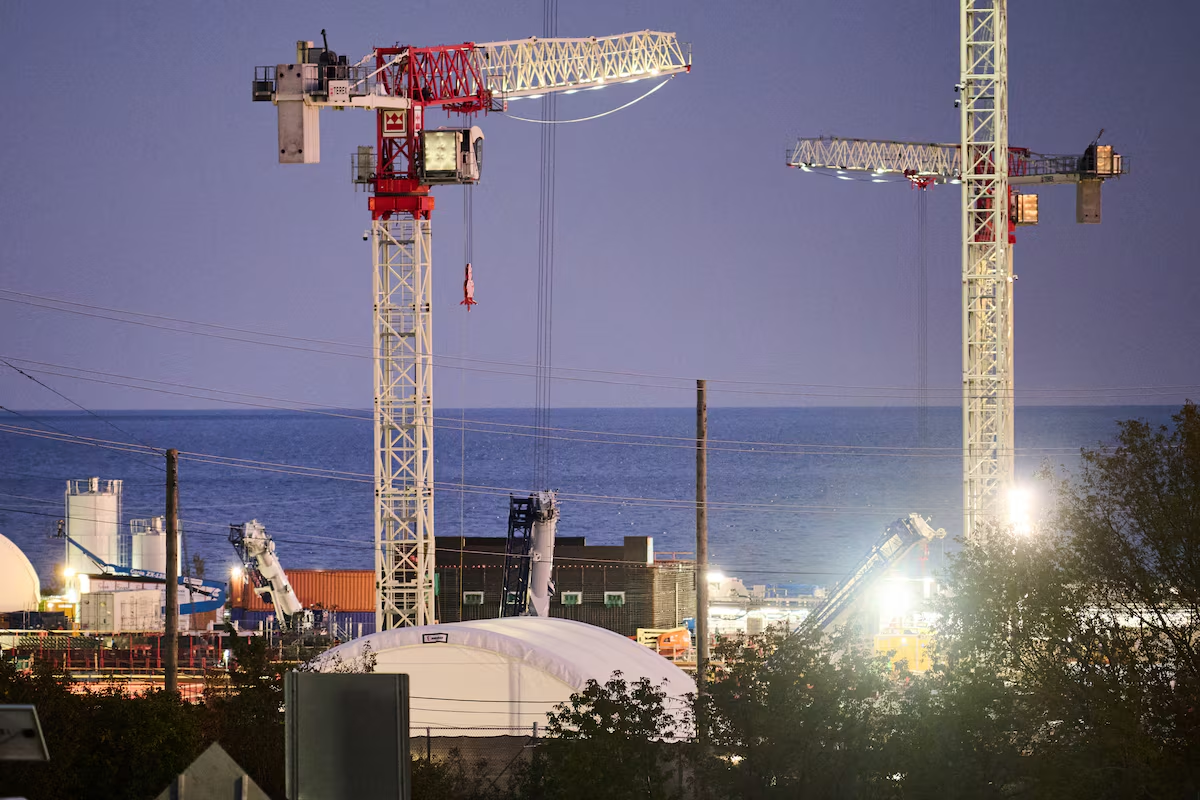

Open this photo in gallery:
Construction continues at the Darlington New Nuclear Project’s planned site for four small modular reactors in Clarington, Ont., last month.Sammy Kogan/The Globe and Mail
The first nuclear power plant to begin construction in Canada since the 1980s has suffered cost overruns and delays, leading Ontario Power Generation to undertake a comprehensive assessment, the Crown corporation said.
The first of four small modular reactors planned for construction at the Darlington Nuclear Generating Station is “no longer expected to achieve the forecast in-service date of October 2030,” Torys LLP lawyer Charles Keizer, who represents the utility, wrote in a Tuesday letter to the Ontario Energy Board.
In its quarterly financial statements, also released Tuesday, OPG reported that the first nuclear unit wouldn’t “be completed within the previously disclosed estimated cost of $7.7-billion.”
The extent of the overruns were not disclosed. The utility said its assessment would determine those details and is expected to be completed by mid-2027.
The Darlington New Nuclear Project, with a total budget of $20.9-billion, involves building four BWRX-300 reactors and accompanying infrastructure adjacent to the existing generating station in Clarington, Ont. The project is being watched globally because it’s the first small modular reactor to begin construction in a Group of Seven country.
“We have identified risks that will impact Unit 1’s schedule and budget,” Nicolle Butcher, OPG’s president and chief executive officer, wrote in a statement.
“As we continue construction, we are working to fully assess those impacts, and establish mitigation measures and a cost and schedule outlook that we can stand behind.”
Global conflict pushes countries to focus on domestic energy security, report finds
OPG reported that the overruns reflected the “ongoing engineering” work of its partner, GE Vernova Hitachi Nuclear Energy, which is responsible for designing the BWRX-300 reactor and other aspects of the facility.
In a statement, GE Vernova Hitachi spokesperson Jonathan Allen pointed to other factors outside his company’s control.
“While engineering and design maturity are important considerations, as OPG’s update recognizes, there are multiple interconnected contributions across engineering, procurement and construction, as well as evolving market conditions, including inflation and geopolitical risks.”
Each BWRX-300 would have a generation capacity of 300 megawatts, enough to power a city of roughly 300,000 people. In addition to GE Vernova Hitachi, OPG’s partners include construction company Aecon Group Inc., and architect-engineer AtkinsRéalis Group Inc.
The pace of nuclear development has been slow in G7 countries for decades. Other BWRX-300s are also planned for construction in the United States, the United Kingdom and, outside of the G7, in Poland, among other countries. But Canada’s would be the first, and such projects are notorious for suffering setbacks.
In depth: To get its first new nuclear reactor in decades, Canada must beat the clock – and the odds
Construction of the first BWRX-300 officially began in late April when the foundation of the reactor building was installed. OPG spokesperson Neal Kelly said work on the buildings that will house the reactor and turbines has started, along with infrastructure that would support all four units. The reactor’s pressure vessel is being assembled at a plant owned by BWX Technologies Inc. in Cambridge, Ont.
It’s a signature project for the government of Premier Doug Ford, which supported the BWRX-300’s selection in 2021, expanded the project in 2023 to four units and authorized construction in 2025. Ontario’s Independent Electricity System Operator, which operates the province’s power grid, included the four reactors in its plans for satisfying the expected demand for power over the next quarter-century.
Ontario Energy Minister Stephen Lecce wrote in a Tuesday statement that the project had “delivered massive industrial wins for our manufacturing base,” including $362.7-million in contracts.
“We expect GE Vernova Hitachi and project partners to deliver on their commitments and maintain rigorous project oversight to ensure maximum value for the Canadian supply chain,” he added.
“Ontario has asked OPG to use this additional time to assess how it can boost domestic contracts and work to drive even more jobs and manufacturing to the country.”
Jack Gibbons, chair of the Ontario Clean Air Alliance and a vocal opponent of nuclear power, called on the government to cancel the project.
“History is repeating itself,” he said.
“Every nuclear project in Ontario’s history has been late and over budget. It doesn’t make sense to build new, high-cost, slow-to-deploy nuclear reactors when wind and solar projects can be built in two years or less at one-third the cost.”
Editor’s note: A previous version of this article misattributed Ontario Energy Minister Stephen Lecce’s statement to a spokesperson.