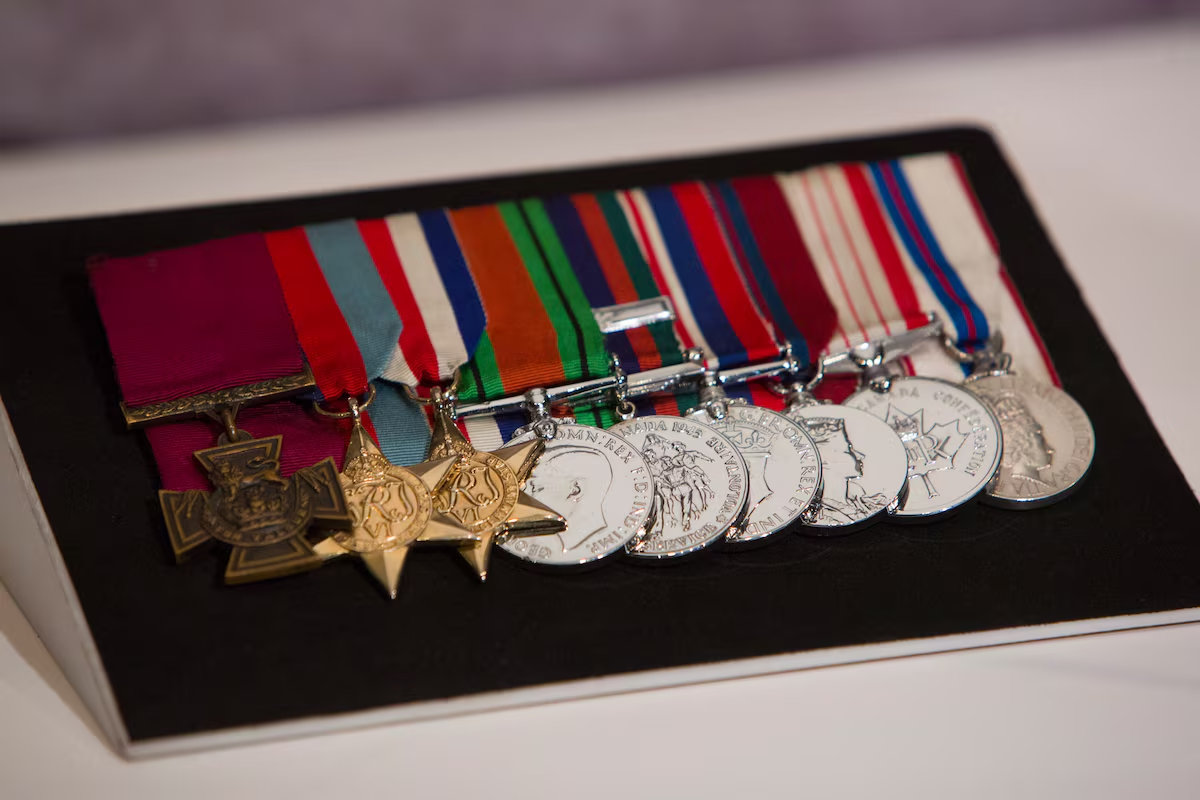

Open this photo in gallery:
Medals on display at the Canadian War Museum in Ottawa in 2018.David Kawai/The Canadian Press
The history of Canada’s military medals is as storied as the country itself. Thousands of medals have been awarded for both military members and civilians since the country’s inception, and continue to be handed out today.
“The orders, decorations and medals that are awarded to Canadian military personnel are just one of the ways in which we honour the service and sacrifice of those who protect our country both at home and abroad,” said Caitlin Pilkington, a collection specialist for medals, ceremonial and photos at the Canadian War Museum.
“They can recognize outstanding achievements, acts of bravery and courage or service in a particular conflict or operation, but they can also commemorate important events in Canadian history or acknowledge long service and devotion to duty.”
This Remembrance Day, we’re showcasing some of the rare medals service members and civilians can earn, and what they represent.
Volunteer cleaners of Canada’s war graves keep the names of the fallen fresh
How a small poppy project bloomed into a community event and nearly 11,000 handmade flowers
The Victoria Cross
Open this photo in gallery:
The Victoria Cross is awarded to a service member who commits a daring act of bravery in the presence of the enemy.FRED CHARTRAND/The Canadian Press
The Victoria Cross, or VC, is the highest military award in the Canadian honour system. It’s awarded to a service member who commits a daring act of bravery in the presence of the enemy, and is the rarest medal to be awarded.
The VC has two iterations: the British version, established in 1856 near the end of the Crimean War and eliminated in 1972, and the Canadian version, which was established in 1993.
The Canadian honour system was completely overhauled by the federal government in 1972 to make the military awards independent from the British, Ms. Pilkington said.
The thought process at the time was that awards that were being given to Canadians should be distinctly Canadian, she said.
Ms. Pilkington added that the nomination process for the VC takes 12 to 18 months.
Ninety-nine service members received the British VC for conflicts from the Crimean War through to the Second World War. The Canadian version has never been awarded.
In May, parliamentary secretary to the minister of national defence Sherry Romanado said that the federal government would establish a review board to re-evaluate cases of Afghanistan war veterans who may have met the VC award criteria. The announcement comes after years of pressure from veterans and members of parliament to review dozens of veterans’ cases.
Cross of Valour
Open this photo in gallery:
The Cross of Valour is awarded for a conspicuous act of bravery in circumstances of extreme peril, but off the battlefield.
The Cross of Valour, or CV, is the second-rarest military honour awarded. It’s also the highest civilian honour that can be bestowed.
The CV is awarded for a conspicuous act of bravery in circumstances of extreme peril, but off the battlefield.
“For some of the medals that are still awarded or that are currently awarded, there is a distinction made between actions that are done in the presence of the enemy and actions that are done away from the front lines,” Pilkington said.
It’s been awarded 21 times since the medal was established with the Canadian honour system overhaul in 1972.
The CV can be awarded to Canadian citizens and non-citizens, and anyone can be nominated on the Governor-General’s website. A nomination must occur within two years of the act of bravery, and is reviewed by the Canadian Decorations Advisory Committee.
Meritorious Service Cross
Open this photo in gallery:
Astronaut Chris Hadfield admires his Meritorious Service Cross after it was presented by Governor-General David Johnston in St-Hubert, Que., in 2013.Paul Chiasson/The Canadian Press
The Meritorious Service Cross, or MSC, like the Cross of Valour, can be awarded to both military members and civilians. It is awarded for high standards of performance that considerably benefit the Canadian Forces.
“For a lot of these medals, the criteria is left quite broad, so that there’s opportunity for more people to be eligible for them,” Ms. Pilkington said.
The military version of the MSC was created in 1984, and the civilian version in 1991. Astronaut Chris Hadfield became the first Canadian to hold both the civilian and military versions of the medal in 2013, for “his extraordinary achievements and the record number of experiments conducted” on the International Space Station.
Sacrifice Medal
Open this photo in gallery:
The Sacrifice Medal is given to military members who suffered wounds or death in hostile actions starting on Oct. 7, 2001, after Canada entered Afghanistan.
The Sacrifice Medal, or SM, is one of the newest medals awarded to Canadian military members, and was established in 2008. It’s given to military members who suffered wounds or death in hostile actions starting on Oct. 7, 2001, after Canada entered Afghanistan.
The SM replaces the wound stripe, which would be worn on the uniform to signify that military member had been wounded in action, Ms. Pilkington said.
A SM can also be awarded to members of the forces who took their own lives from mental-health disorders caused from their service.
A 2017 Globe and Mail investigation found that more than 70 Canadian soldiers and veterans who served in the Afghanistan operation later took their own lives.
General Campaign Star
Open this photo in gallery:
The Expedition version of the General Campaign Star.Department of National Defence / Ministère de la Défense nationale/Supplied
A General Campaign Star, or GCS, is a medal issued for service in a specific campaign, and was first established in 2004. It can be awarded to those on the front lines and in support roles in the presence of the enemy.
There are two types of GCS: Allied Forces and Expedition. Allied Forces is awarded to fighter pilots or crew members in “Operation Allied Force” – an aerial bombing campaign in Kosovo – in 1999, Ms. Pilkington said.
Missions can have multiple campaigns where a GCS can be awarded – the Second World War had nine different campaign stars based on where the solider was stationed, Ms. Pilkington said.
Canadian Forces’ Decoration
Open this photo in gallery:
Members receive the Canadian Forces’ Decoration medal after 12 years of service.POOL
The Canadian Forces’ Decoration, or CD, is a service medal for the Canadian Forces. Members receive the medal after 12 years of service, and an added gold bar to the ribbon of the medal for every additional 10 years of qualifying service.
The CD was created by King George VI in the aftermath of the Second World War. The effigy of the monarch on the medal has changed three times with each ascension to the throne: King George VI, Queen Elizabeth II and now King Charles III.
With a report from The Canadian Press