
Care Between the Lines is a summer series, which will introduce you to volunteers in health care who fill gaps and provide compassion in a system that can be isolating and scary.
There are many ways in which Dr. Petunia Ashley Ottersby is not like the other MDs at London Children’s Hospital in Ontario.
Sure, she wears scrubs, and she brightens the days of patients in her care. But consider her specialty: Dr. Ottersby is a “bellybuttonologist.” It’s right there on her name tag.
She’s also a red-headed puppet, brought to manic, enthusiastic life by Sue Van Duynhoven, a ventriloquist and one of the longest-tenured volunteers at the pediatric facility, which is part of London Health Sciences Centre.
On a recent Tuesday morning, Dr. Ottersby and Ms. Van Duynhoven had their work cut out for them. Their first audience was with a trio of sisters: Aubree Brown, 13, Isla Chabot Hopper, 6, and Coral Chabot Hopper, 4.
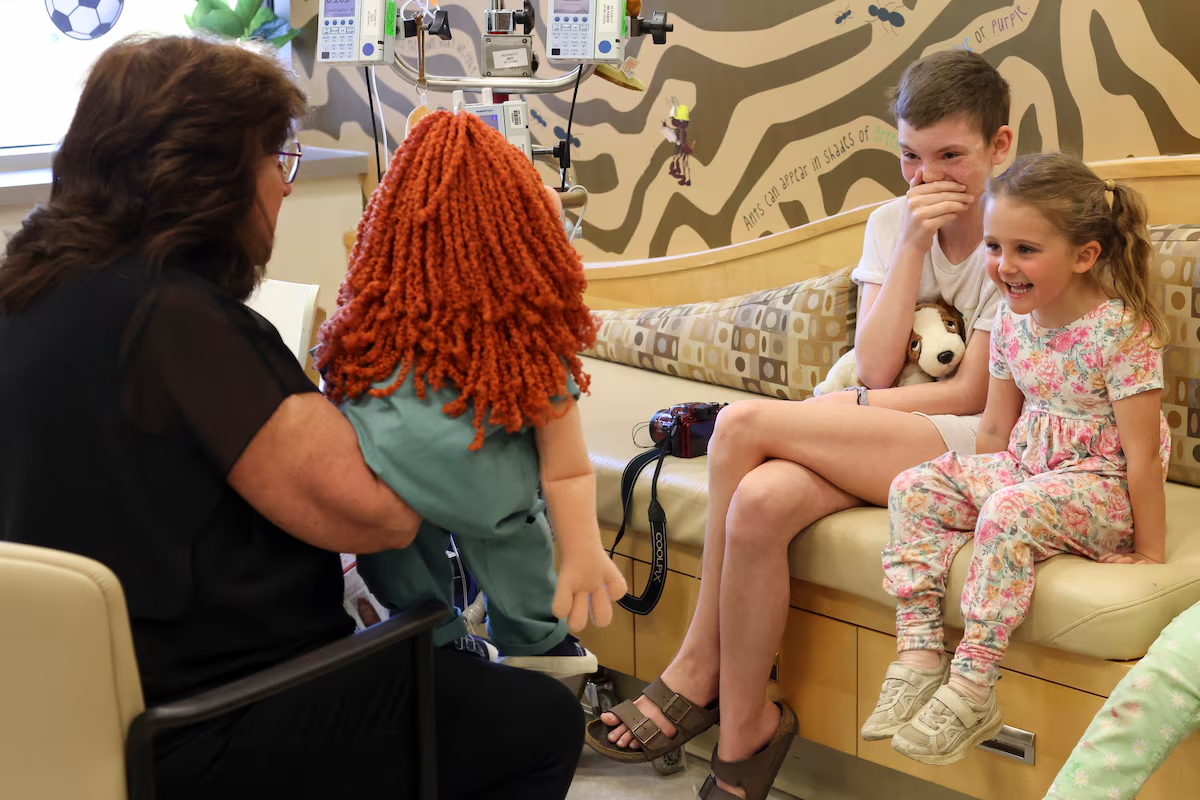
Coral exploded with glee at every word that seemed to come out of Dr. Ottersby’s mouth. “You’re just a puppet! You have no eyeballs!” she squealed as Dr. Ottersby insisted she was, in fact, a doctor, who could attach new belly buttons to patients with Velcro and duct tape.
Open this photo in gallery:
Isla, left, and Coral Chabot Hopper react to Sue Van Duynhoven’s ventriloquism.Nicole Osborne/The Globe and Mail
Aubree, the patient, was a cooler customer. She was in hospital receiving chemotherapy for leukemia. She smiled wryly and rolled her eyes a few times at her bouncing sisters as Ms. Van Duynhoven tried to calibrate her improvisations for a delirious kindergartener and a quiet teen at the same time.
Eventually, Aubree warmed up, telling Dr. Ottersby and a second puppet, a white-whiskered old-timer named Grandpa, about her pet snake, Waffles, her piano-playing and her photography hobby.
“What I want to do is remind them who they are,” Ms. Van Duynhoven said of the children she visits. “Because they have so many things happening to them right now, and everything’s out of the norm.”
Like many volunteers in Canadian hospitals, Ms. Van Duynhoven provides comfort and care to patients in the moments when doctors, nurses and other staff are swamped. Ms. Van Duynhoven and her puppets help fill the emotional gaps in health care, prodding children to giggle and forget their illnesses.
London Children’s Hospital has other regular entertainers, including music and art therapists, but they are paid. Even the therapeutic clown is paid. Ms. Van Duynhoven, on the other hand, has been sharing her talents with sick children for free for 24 years, save for the stretches when COVID-19 lockdowns and her own bouts with breast cancer in 2019 and 2024 kept her away.
Open this photo in gallery:
Aubree Brown, left, and Coral Chabot Hopper enjoy a visit from Ms. Van Duynhoven and her puppet, Petunia.Nicole Osborne/The Globe and Mail
In that time, many patients have developed unique personal relationships with Ms. Van Duynhoven’s cast of cloth characters, said Michelle Hart, a child-life specialist at London Children’s for 29 years. That’s especially true for children with chronic diseases who spend long stretches in the hospital, she added.
“The puppet is somebody that they can talk to without any inhibition,” Ms. Hart said. “They can openly talk about themselves. The puppet is not going to judge.”
Ms. Van Duynhoven has bittersweet memories of one girl who grew attached to Horace, a horse puppet with a “bad Southern accent.” The girl’s mother asked if Horace could go home with her daughter for sleepovers, then for Christmas.
“I said, ‘I’m okay with that,’ because I’d already decided this puppet was her puppet. Period,” Ms. Van Duynhoven recalled.
When the girl died, Horace was buried with her. “It was such a weird, wonderful, magical, horrible feeling, all at the same time,” Ms. Van Duynhoven said. “I still miss that child. She was an amazing human being.”
Open this photo in gallery:
Ms. Van Duynhoven is one of the longest-tenured volunteers at London Children’s Hospital.Nicole Osborne/The Globe and Mail
Ms. Van Duynhoven is often surprised at how certain puppets connect with certain kids.
She has “easily” 45 puppets in her repertoire. There’s Grandpa’s wife – Grandma, naturally – Kudo the penguin, Scrappy the puppy, a skateboarder with dreadlocks called Ralphie, and Vladimir, a vampire. Boo Bear was popular until an infectious disease doctor declared his furry coat an infection risk and banned him from the premises.
Stuffed animals were among the first objects Ms. Van Duynhoven made “talk” when she discovered, as a child, that she had the gift of throwing her voice.
She kept the skill to herself while growing up in what she described as a deeply dysfunctional home in St. Thomas, Ont., a town of about 50,000 south of London.
Her mother had an untreated mental illness and her father had issues, too, she said. “It was not a fun place to grow up in, and that may be part of the reason why inanimate objects became alive to me. They became the only things that I could actually trust.”
The Ms. Van Duynhoven of today, a married mother of two and a grandmother, is so fast-talking and cheerful that it’s hard to fathom anything dark in her past. She wears purple, wire-rimmed glasses and parts her dark feathered hair in the middle. She has her puppets banter with everyone she meets, including this reporter who later stumbled awkwardly through an interview with Grandpa.
Open this photo in gallery:
Ms. Van Duynhoven and her puppet, Grandpa.Nicole Osborne/The Globe and Mail
Ms. Van Duynhoven says her unhappy childhood gives her insight into the hearts of hurting kids. Her cancer experience is a bond she shares with some them, too.
She is also keenly aware of the struggles of parents, forced to watch their kids bear pain they wish they could shoulder themselves.
After performing for Aubree and her sisters in a brightly coloured patient lounge, Ms. Van Duynhoven and Grandpa visited a six-year-old boy whose mother sat cross-legged at the end of his bed. His head was wrapped in a bandage with leads attached to a screen covered in squiggly lines.
Grandpa had the boy laughing uproariously. Before long, his mom was giggling, too.
Meaghan Innes, the manager of volunteers at LHSC, saw first-hand how the ventriloquist’s performance could move adults during a recognition event for long-time volunteers. The hospital has anywhere from 500 to 650, depending on the season, but few have been there as long as Ms. Van Duynhoven.
She sang a song – through a puppet, of course – about the importance of volunteering.
“I don’t think there was a dry eye in the place,” Ms. Innes said. “It was so beautiful, and there was not a child there.”