
Open this photo in gallery:
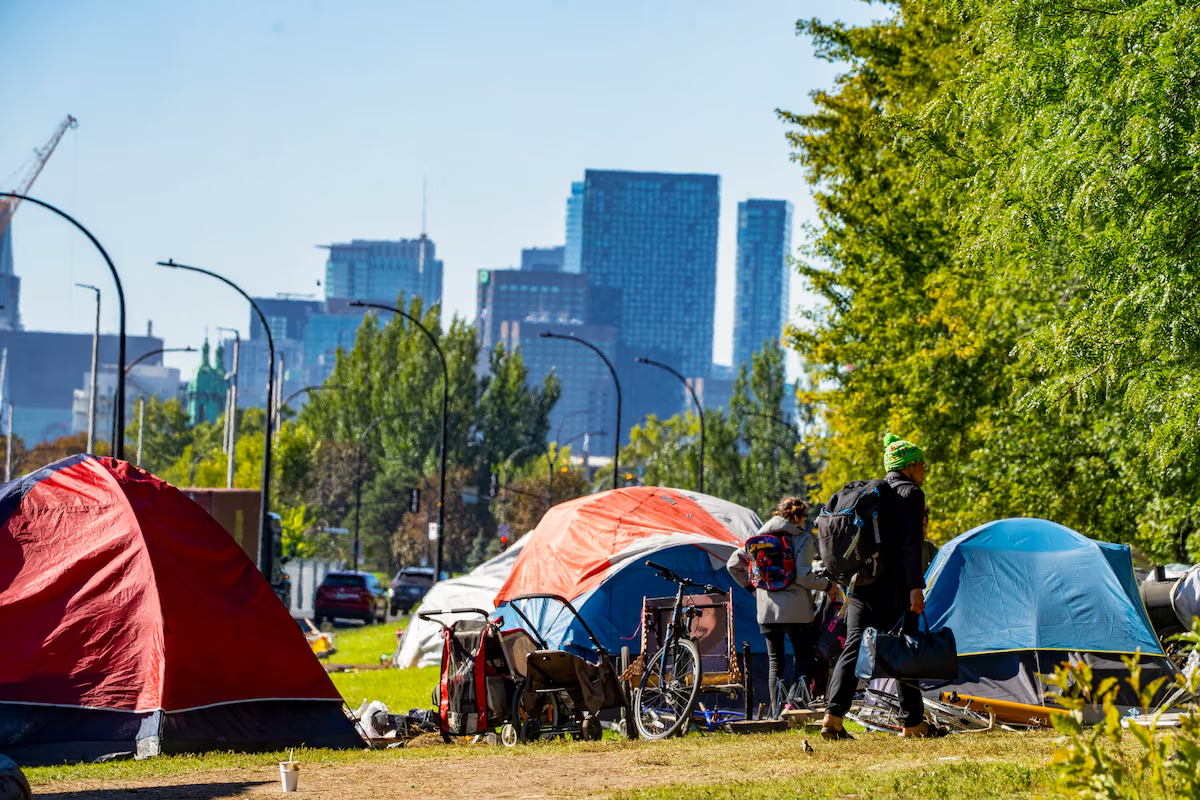
An unhoused encampment is seen on Notre Dame Street in Montreal. Provincial and municipal buy-in will be key, Carney said during a press conference last Friday in Winnipeg.Christinne Muschi/The Canadian Press
Save the date: Nov. 5, 2036.
That’s the deadline for ending homelessness in Canada laid out in last week’s federal budget, which proposes nearly $30-billion in spending to put a roof over every Canadian within a decade.
Governments here and abroad have tried – and mostly failed – to slap a best-before date on homelessness in the past, making Prime Minister Mark Carney’s pledge appear quixotic on its face. But housing researchers and advocates for the homeless say the latest plan is a worthy gamble, though one that will need more details, and more money, to be fully realized.
“What we see here is a substantial down payment, but I don’t think this by itself will be enough,” said Tim Richter, president and chief executive officer of the Canadian Alliance to End Homelessness (CAEH), of Ottawa’s recent financial commitment. “I expect this is an initial investment, and you’ll expect to see some provincial investment as part of the negotiations.”
The 2036 plan includes $10-billion in funding for 25,000 supportive and transitional homes through Build Canada Homes, Ottawa’s new housing agency. Another $12-billion will go to low-income rental assistance and the Reaching Home program, which funds community-based initiatives across the country.
The final plank focuses on health, with $5-billion to build facilities that address housing, health and other social-service needs under one roof, as well as $2-billion to construct and refurbish community mental-health and addictions treatment centres.
Ottawa has already identified its model city for the program, Winnipeg, where it has committed up to $800-million for 2,000 homes, plus another $200-million on a new mental-health and addictions centre. The housing will consist of both transitional units, which act as a temporary bridge for people moving away from the streets or shelters, and supportive units, which feature on-site assistance for health and well-being.
Provincial and municipal buy-in will be key, Mr. Carney said during a press conference last Friday in Winnipeg. Manitoba will operate the homes and pay for half the cost of the new mental-health centre.
The funding plan seems to mark an “important shift” in Ottawa’s housing strategy, said Abe Oudshoorn, associate professor in the school of nursing at Western University. A 2017 housing plan – the 10-year, $115-billion National Housing Strategy – yielded plenty of low-interest loans to for-profit developers building market rentals, but it did little to curb homelessness. Mr. Carney’s plan focuses on direct spending for people with the highest housing needs.
Federal budget plows money into power grids, but connecting them remains unclear
“I do think that’s important language and an important shift in what the feds might be doing on housing, and I do think that will work,” Dr. Oudshoorn said.
The 2017 strategy targeted a 50-per-cent reduction in chronic homelessness between 2016 and 2028. In 2023, the government doubled down on the timeline, vowing to eradicate chronic homelessness – typically referring to people who’ve been without stable housing for at least six months in the past year – by 2030.
Instead, homelessness has nearly doubled across Canada since 2018, to almost 65,000 people.
A 2024 from the Parliamentary Budget Officer found both goals were misaligned with actual funding, and said an extra $3.5-billion a year – a seven-fold budget increase – would be required to meet the 50-per-cent goal.
Few know the promise and peril of such timelines like federal Housing Minister Gregor Robertson, who, during his 2008 Vancouver mayoralty campaign, vowed to end street homelessness by 2015. Instead, the number of people living on the streets in the City of Vancouver has grown steadily, from around 1,400 in 2005 to 2,715 last year.
“We set the goal, but the federal and provincial governments were not co-ordinating, were not investing, at the scale that was needed to solve the challenge in Vancouver,” said Mr. Robertson at the Friday press conference.
Finland has targeted eradicating homelessness by 2027. Between 2012 and 2023, the country managed to reduce its homeless population by more than half with a housing-first policy that views a permanent home as a basic human right.
But a change of government brought cuts to social services and a subsequent surge in people without homes over the last two years.
Opinion: Ending homelessness must be a nation-building project
In Britain, Prime Minister Andy Burnham has pledged to get rough sleepers off the streets by Christmas, drawing from his experience as Mayor of Greater Manchester, where a similar promise yielded mixed results.
Canada has a few basic problems to address first. For one, the country doesn’t keep close tabs on homeless numbers.
“It’s really hard to say we’re going to end homelessness when we still have no idea nationally how many people don’t have homes across Canada,” said Carolyn Whitzman, professor and researcher at the University of Toronto’s School of Cities.
Dr. Whitzman recently prepared a report for the Federal Housing Advocate, an independent, non-partisan watchdog, in which she estimated governments would need to create 50,000 low-cost supportive housing units a year to end homelessness by 2040.
The budget provides for far less than that. Still, Dr. Whitzman is optimistic.
“The federal government is a super-tanker, and now at least the super-tanker is headed in the right direction,” she said. “Now we just need the other levels of government to do the same.”
With a report from Jeff Gray