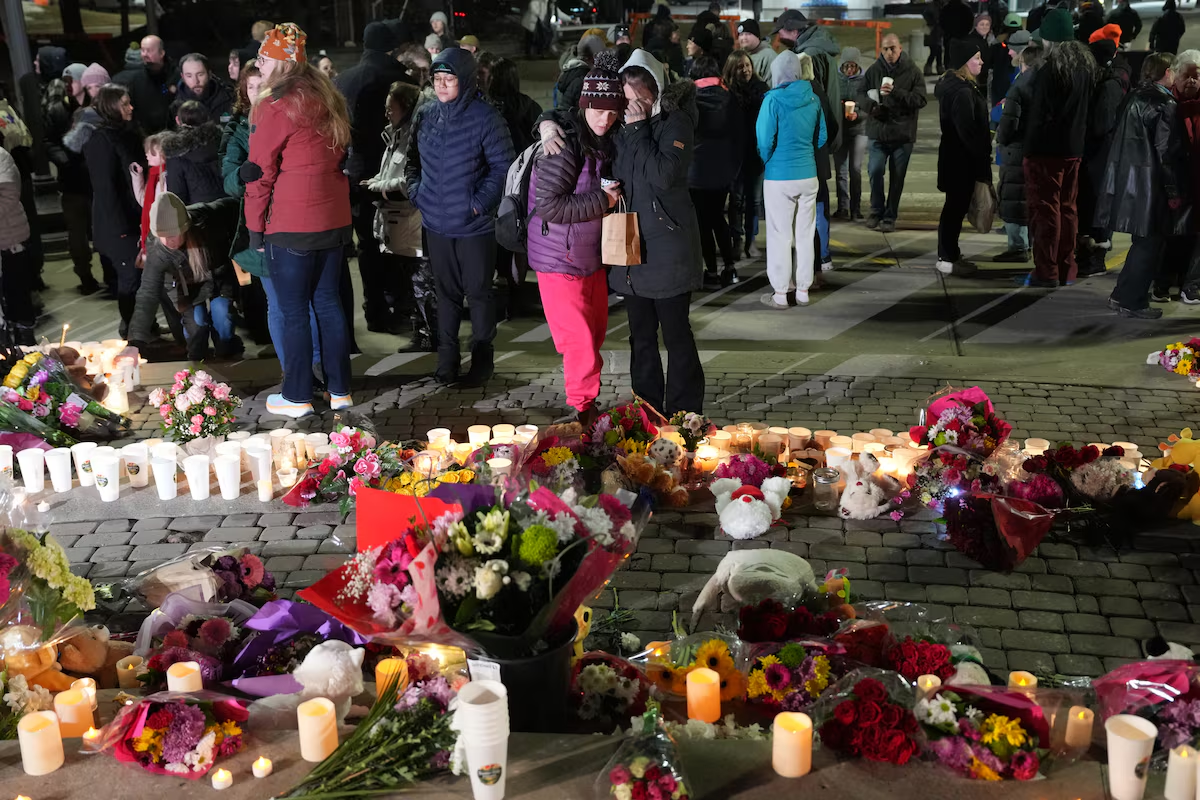

Open this photo in gallery:
People attend a vigil in February for the victims of a mass shooting in Tumbler Ridge, B.C.Christinne Muschi/The Canadian Press
Claims for damages against OpenAI and its chief executive Sam Altman in the Tumbler Ridge mass shooting lawsuits should be heard in a San Francisco court, argue lawyers for the affected families in a new legal filing.
The filing, submitted late Nov. 5 in United States District Court, is from the lead plaintiff, the husband of an educational assistant who was killed. It is among about three dozen related lawsuits from the many families affected by the killings.
Lawyers from Chicago-based Edelson PC allege that “British Columbia does not provide an adequate forum” and that “California is an appropriate forum for claims that a California company acted negligently while operating in California.”
OpenAI is headquartered in San Francisco, but the tech company argued in a submission filed on Sept. 2 that the lawsuits should be dismissed and heard in British Columbia instead because the plaintiffs live there and the B.C. government has a “uniquely strong sovereign interest in having these actions resolved at home.”
Opinion: Canada needs to modernize school violence prevention
The Tumbler Ridge mass shooting happened on Feb. 10. Jesse Van Rootselaar killed her mother and half-brother before stalking through Tumbler Ridge Secondary School in the small northern B.C. town. In total, the shooter killed six children and two adults before dying by suicide.
In the lead lawsuit, from Mark Stacey, the husband of Shannda Aviugana-Durand, lawyers seek to blame OpenAI’s alleged negligence over its failure to warn Canadian police of the danger indicated in the shooter’s use of the company’s ChatGPT product.
“In the weeks that followed the attack, a sickening truth emerged: ChatGPT played a role in the mass shooting and OpenAI could have, and should have, prevented it,” the lawsuit filed on April 29 alleges, calling on the U.S. court for a jury trial. (Vancouver-based Rice Parsons Leoni & Elliott LLP is also representing affected families.)
The suit further alleges OpenAI aided and abetted a mass shooting and cites a design defect of its chatbot.
Lawyers for Mr. Stacey declined comment. OpenAI and its lawyers did not immediately respond to a request for comment on Friday.
The Editorial Board: Don’t leave AI safety to the tech bros
The first big legal step in the cases is the debate before U.S. District Court Judge Jacqueline Scott Corley in San Francisco over jurisdiction.
The lawyers for the families said jurisdiction is clearly in San Francisco because the case is about “choices OpenAI made” there. Three-quarters of the company’s 2,500 workers are in California. Only 11 are in Canada.
In the latest Nov. 5 filing, some information is redacted. The filing alleges: “Jesse Van Rootselaar asked ChatGPT to [redacted]. During the ensuing exchange, Van Rootselaar admitted to [redacted] … OpenAI did not act on this information.”
The lawyers further said “the vagaries of Canadian law” mean a case in B.C. would offer “essentially no remedy” to the parents of the dead children. They added that plaintiffs would struggle to compile evidence in a B.C. court because provincial law has no provisions to compel pretrial testimony or documents from “unwilling witnesses” outside the province.
OpenAI, in its Sept. 2 filing to dismiss the U.S. lawsuits, said a B.C. court makes sense in part because of questions about the province’s mental-health system repeatedly releasing the shooter from involuntary hospitalizations without ongoing supervision and about Canadian police permitting the shooter to retain firearms.
Opinion: Canada has the information to help prevent the next mass shooting
Outside experts and people involved in the case say key reasons to take on the company in the U.S. include OpenAI being headquartered in San Francisco and the potential for larger damages. While a survivor of the shooting, such as 13-year-old Maya Gebala, could win a large cash award in a Canadian court, pain-and-suffering damages are limited because of a long-standing Supreme Court of Canada precedent.
Lawyers need to think about a potential victory, said Marina Pavlovic, a University of Ottawa law professor who specializes in private international law.
“I could teach my entire course on this case. I talk to students about strategy. You start at the end: Where are the assets? You build a case around the assets. If these were my clients, this is what I would suggest.”
Outgoing B.C. attorney-general Niki Sharma said the provincial government filed its lawsuit on Sept. 21 in San Francisco, rather than British Columbia, to back the Tumbler Ridge families whose legal teams had already launched their cases in the United States.
“There’s a lot of value in bringing the fight to where the headquarters of the company is,” she said.
Ms. Sharma, who will soon sit as an NDP Opposition MLA after her government was defeated in last month’s provincial election, added that her goals while in government had also included “accountability and changing behaviour” in cases of public-interest litigation.
B.C. has long been a leader in Canada in corporate negligence cases, from tobacco to opioids. In the OpenAI case, Ms. Sharma said a victory in the San Francisco court could help force changes in U.S. government regulation and oversight of artificial intelligence products, alongside damages and recovered costs for families, the province and the regional school district that includes Tumbler Ridge.
The United States is widely known as a litigious country where civil cases can lead to multimillion-dollar damages, whereas Canada is not. The U.S. Constitution enshrines the right to a jury trial in such cases but jury trials in civil lawsuits have long been rare in Canada.
The Editorial Board: The right to know about Tumbler Ridge
A demarcation of how the justice systems in the two countries settle civil cases was decided at the Supreme Court of Canada in 1978. The Andrews case maintained an opening for pecuniary damages – where an injured or harmed person can be paid for things such as the loss of future income – but strictly limited non-pecuniary damages, colloquially known as pain and suffering.
The case involved James Andrews of Edmonton, who became a quadriplegic after a traffic collision when he was 21. The Supreme Court, after conflicting rulings in the lower courts, settled on total damages before some adjustments of $817,000, of which $100,000 was for non-pecuniary pain and suffering.
Justice Brian Dickson, who later became chief justice, said the $100,000 “should be regarded as an upper limit of non-pecuniary loss in cases of this nature.” The “Andrews cap,” adjusted for inflation, is currently at about $460,000.
He warned against sizable awards for pain and suffering because there was no “objective yardstick” to measure such claims in monetary terms, and cited such awards in the U.S. that had “soared to dramatically high levels in recent years.”
With reports from Stephanie Chambers