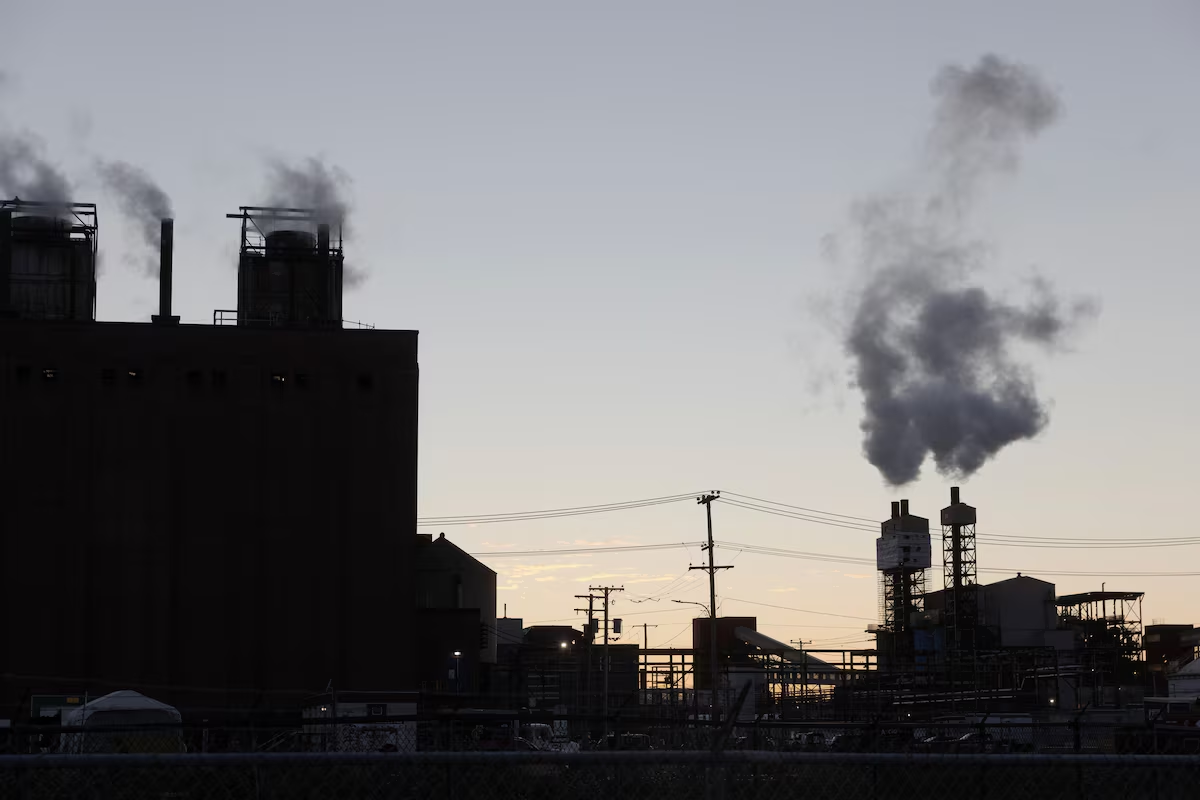

When the American tycoon Arthur Vining Davis built a company town for his aluminum plant in the Saguenay region of Quebec in 1926, he left his imprint on every part of it. Arvida would even be christened with the first syllables of his three names.
The community was a marvel from the beginning, known as “the City Built in 135 Days” after Mr. Davis’s firm, Alcoa, flung up hundreds of houses for workers almost overnight.
The speed of Arvida’s construction belied its humanity, with attractive homes in a variety of architectural styles that labourers could eventually own, large plots without fences to encourage fraternization, and winding, tree-lined streets that evoked a commuter-train suburb.
Open this photo in gallery:
Many Arvida homes have kept their classic features since the town’s hasty construction on the Saguenay River, a power source for aluminum manufacturing.
As the community celebrates its 100th anniversary, the town’s remarkably well-preserved neighbourhoods still resemble a Disneyfied vision of midcentury America deep in rural Quebec.
Its picturesque houses, guarded from changing fashions by provincial heritage laws, are often inhabited by descendants of the original workers.
It is just as Mr. Davis would have wanted it.
Only now, Arvida is shadowed by the whims of another American tycoon, this one occupying the Oval Office. The 50-per-cent tariffs imposed on Canadian aluminum by U.S. President Donald Trump are the talk of a town still dependent on the plant, now owned by the British-Australian mining giant Rio Tinto.
Mr. Trump’s stated desire to manufacture all of his country’s aluminum at home would devastate a place that was founded on American vision and capital, throwing into relief the sudden souring of Canada-U.S. relations under his administration.
Local authorities are trying to use Arvida’s centenary as a reminder of what the two countries built together, including a renewed push for recognition as a UNESCO World Heritage Site. The federal government, meanwhile, is trying to further Canadianize an industry that has long been dependent on the U.S., splashing out nearly $200-million on projects in the Quebec aluminum sector last week in the name of “Canadian sovereignty.”
“In the current political context, I think it would be good for Trump to see that our aluminum saved the world,” said Marianne Salesse-Côté, director-general of the Arvida Heritage Museum, housed in a soaring Catholic church built decades ago with money deducted directly from workers’ paycheques.
Despite being nestled deep in a “North Canada steppe,” as The New York Times once remarked, Arvida owes its existence to Americans.
Mr. Davis, a pioneer in the commercial uses of aluminum who became the fifth-richest man in the U.S., conceived Arvida and hired American architects to build it.
Although Alcan was spun off as a Canadian company in 1928 amid an anti-trust investigation south of the border, and many of the worker houses were in a French-Canadian vernacular style, American executives continued to run the company and, effectively, the town.
Locals mostly accepted the bargain. Unlike in other corporate communities at the time, the housing stock was well-built and attractive, with modern amenities such as central heating. Instead of setting up a company store selling goods on credit, Alcan encouraged real banks and shops to establish themselves in town. Company-owned cinemas, skating rinks and bowling alleys provided wholesome entertainment.
In an era of dubious planned cities erected in the image of their eccentric founders, this was a success story. By the time Henry Ford’s rubber colony of Fordlandia had devolved into anarchy and been sold to the Brazilian government in the 1940s, Arvida was at its zenith.
“It was a social utopia,” said Ms. Salesse-Côté. “The dream of Arthur Vining Davis was to have his workers stay a long time.”
Open this photo in gallery:
Arthur Vining Davis, whose portrait hangs in the Arvida library, made sure there were company-owned amenities to keep the workers close to home.Renaud Philippe/The Globe and Mail
Alcan’s progressive paternalism had its limits. Worker safety precautions were virtually non-existent, and labour relations could be bruising. A sudden strike in 1941 made the federal government suspect enemy sabotage.
By the Second World War, Arvida was not just a company town, but a strategic cog in the war effort. It had become home to the world’s largest aluminum plant, employing 12,000 workers and cranking out 90 per cent of the aluminum used by the Commonwealth air forces. The factory was surrounded by anti-aircraft guns and protected by some 3,000 servicemen in case of Nazi attack.
“Without Arvida, we might not have had a happy ending,” said Ms. Salesse-Côté.
Arvida and its aluminum plant in 1958. Though its wartime production blitz was long over by then, the plant remained a powerhouse of the Canadian metal industry.
Supplied
The company’s wartime role heralded a growing reputation as a model corporate citizen. In 1951, Alcan built a $500-million smelter in Kitimat, B.C., the country’s largest public-private partnership at the time. As chief executive in the late 1970s, Montrealer David Culver doubled down on the city as company headquarters while other firms fled a separatist government.
But for all of Arvida’s patriotic bona fides, its business model remained deeply dependent on American markets. Over the course of the 20th century, government policies began requiring the domestic transformation of certain natural resources before exportation, producing more Canadian jobs in the paper industry, for example, according to Marc-Urbain Proulx, professor of regional economics at the Université du Québec à Chicoutimi. “We never dared to do that with aluminum,” he said. “We still export raw ingots to the United States.”
The relative lack of capacity for transforming aluminum in Canada has left the domestic industry more vulnerable to U.S. tariffs. Some residents of Arvida – now part of the amalgamated city of Saguenay – feel uncomfortably exposed to Donald Trump’s hostility. “There’s a lot of anxiety,” said Ms. Salesse-Côté. “People in the community are always asking, ‘How’s Rio Tinto going? Are we going to lose jobs?’”
Open this photo in gallery:
U.S. manufacturers that depend on aluminum, like this craft brewery in Sacramento, have tried to adapt to the continuing tariffs.Justin Sullivan/Getty Images
The answer, for now, is no. U.S. demand for Canadian aluminum is steady despite the tariffs, with Russian and Saudi sources sidelined because of global conflicts.
As for the President’s dreams of onshoring U.S. production, no one knows better than the residents of Saguenay how much electricity, capital and expertise is needed to build a smelter from scratch.
“Good luck, Trump,” said Saguenay Mayor Luc Boivin.
“Building a smelter, it takes years. The energy, they’ve given to data centres, they don’t have any more for aluminum. Right now the Americans are shooting themselves in the foot. They’re paying a tax and increasing the cost of living.”
Rio Tinto insists it’s not going anywhere. In an e-mailed statement, the company’s chief executive for aluminum and lithium, Jérôme Pécresse, pointed to its $1.5-billion investment in expanding low-carbon smelting at the Arvida complex announced in May.
“Canada is at the heart of our global aluminum strategy, and with the expertise of our teams in Quebec, we intend to keep Saguenay–Lac-Saint-Jean a global aluminum hub for the next century. We are not just celebrating 100 years of history, we are also laying the foundations for generations to come.”
Open this photo in gallery:
Rio Tinto’s Saguenay workers got a pep talk from the Prime Minister this summer, when he was stumping for a by-election candidate in Chicoutimi–Le Fjord.Jacques Boissinot/The Canadian Press
In the midst of the centenary celebrations, which have included Lego recreations of the town’s famous aluminum bridge and CF-18 flyovers, the federal government has taken a renewed interest in making the country’s aluminum industry more autonomous. Industry Minister Mélanie Joly spoke just last week about reviving plans for an aluminum-rolling mill in Canada, so the country could transform its own metal into sheets on a large scale.
“We want to be able to produce our aluminum cans here at home,” she said in announcing $193-million in funding for the industry. “We want to be able to produce our aircraft and aerospace parts here at home.”
That is in line with the Carney government’s broader efforts to make the Canadian economy less dependent on the U.S. – to shift away from Canada’s long-standing role as a “basin of natural resources for the Americans,” as Mr. Proulx said.
The mayor of Saguenay is all for it. He thinks the 100th anniversary has come at a good time, deepening local pride in the middle of a trade war. Arvida may have been built by the U.S., but it is determined not to be undone by the country. “I think there’s a consciousness of the value of our industry and the need to protect it,” said Mr. Boivin.
With a report from The Canadian Press
Open this photo in gallery:
Touched by tariffs: More from The Globe and Mail
The Decibel podcast
Thanks to Tuesday’s U.S. election, Democrats are taking charge in Congress again. What will that mean for the trade war? International affairs columnist Doug Saunders spoke with The Decibel about the ripple effects. Subscribe for more episodes.
The trade war so far
Canada, U.S. expected to resume formal trade talks, source says
Canadian musicians touring U.S. face surging costs, political tensions
An ‘avalanche’ of foreign steel dumping in Canada? Stelco owner’s gripes don’t hold up to scrutiny