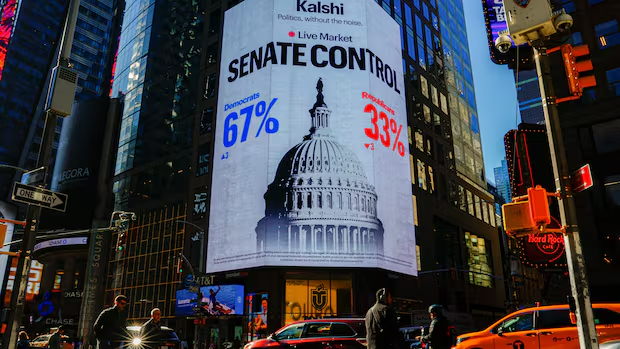
Both Kalshi and Polymarket were quick to celebrate big wins on midterm election night, touting what they say was accurate forecasting.
With billions waged on these prediction markets, which allowed traders to bet on candidate victories and control of the Senate and House, their accuracy was pushed into the spotlight. Media companies such as CNN and MSNBC shared prediction-market odds in their midterm coverage, while rappers such as YG and actors such as Heidi Montag weighed in on their midterm bets on election night.
According to Kalshi’s midterm election recap, $2.5 billion US was traded on midterm markets, nearly double the $1.3 billion US reported during the 2024 election cycle. Polymarket recorded nearly $700 million US in wagers during this election cycle across its U.S. and international platforms, according to Reuters.
Polymarket said on X that the prediction-market platform was “right” and claimed that “98.4 per cent of resolved midterm races went to the Polymarket favorite the day before Election Day.”
Kalshi made a similar claim, saying candidates favoured on its platform won or lead 98 per cent of races before polls closed on election day.
Valerie Cross, head of emerging verticals at NEXTPredict.io, which monitored Kalshi and Polymarket on election night, said that while those figures aren’t necessarily wrong, “it’s easy to overread.”
She added that the figures reflect how prediction markets were able to incorporate “early returns, exit polls and county counts quickly, and mostly moved in the right direction.”
“They were also early to flag upsets, because raw vote counts can make a race look closer than the odds imply,” she said.
WATCH | Record betting on U.S. midterms raises questions about whether prediction markets influence voters:
What happens when election betting goes mainstream
Kalshi and Polymarket election prediction markets are seeing record trades ahead of the 2026 U.S. midterms. For The National, CBC’s Ashley Fraser explores how betting odds can influence American voters and if the platforms risk distorting public perception.
Predicting a blue tsunami
But while the platforms might have been mostly accurate about who would win, they didn’t predict some of the most surprising races of the night.
An analysis by Betting Intelligence of more than 400 races identified 14 upsets, all won by Democrats.
One was the South Carolina Senate race, where prediction markets had favoured Republican candidate Darline Graham to win, giving her about a 70 per cent chance before Democrat Annie Andrews unexpectedly won.
Other upsets included Democrat Gina Hinojosa’s victory over incumbent Republican Gov. Greg Abbott in Texas. Markets had put Hinojosa’s chances at 40.1 per cent the day before the election.
The firm concluded that both polls and markets “identified the eventual winner equally often, and both underestimated Democratic candidates.”
David Szakyoni, co-founder of the Anti-Corruption Data Collective, which analyzes prediction markets based on publicly available data, said the markets “appear to respond to the vote counts and polling data, rather than providing something distinct.”
Rajiv Sethi, an economist at Columbia University, said neither polls nor prediction markets were able to “predict the scale” of Democratic wins on election night.
He instead pointed to races where both polls and markets were wrong as a way to better understand their effect, such as the extremely close Mississippi senate race.

(CBC)
The race has not yet been called by The Associated Press, with Democrat Scott Colom leading Republican Sen. Cindy Hyde-Smith by 1,803 votes as of Thursday afternoon.
Neither the polls nor the markets predicted the nail-biting margin between the two candidates, but Sethi said prediction markets gave Colom a slightly better chance than the polls suggested, pointing to their ability to react to candidate blunders or successes in the campaign.
“[Polls] can’t pick up the really unusual novel things which markets can. That is the strength of market.”
But even if markets can react more quickly they still rely on polling data as part of their forecasts.
“The markets respond to the models. If the models didn’t exist, the markets would be pricing things quite differently.”
Before the networks
Cross agreed that the markets can’t always be pitted against polls.
“They measure different things at different times, and they depend on each other more than the headlines suggest.”
She said, however, “For an early read on who’s likely to win on Election Day, nothing really beats prediction markets.”
“Traders are incorporating all the available information into their forecasts,” Cross said. “At 8:12 p.m., with about 31 per cent counted in South Carolina, Andrews led 52 per cent to 46 per cent, and NBC said it was too early to call.”
Polymarket CEO Shayne Copland said on X, “It’s now routinely hours between when prediction markets call it versus the TV networks.”
WATCH | Prediction markets are booming, but experts warn of gambling, insider trading and manipulation:
Prediction markets let you bet on anything — but is it just gambling?
Prediction markets like Kalshi and Polymarket have exploded in popularity, processing billions in daily trades. For The National, CBC’s Nora Young breaks down how they work and why experts say it’s just another form of gambling that comes with risks of insider trading and manipulation.
Kalshi CEO Terek Mansour made a similar argument, saying, “For generations, election night meant turning on the TV and waiting for a handful of people to tell you what happened. Prediction markets change that.”
According to Betting Intelligence, in most close races, prediction markets reached 97 per cent probability for the eventual winner about an hour before The Associated Press called the race. None of the candidates that reached that threshold lost.
Despite those early calls, Szakonyki said he’s “not convinced that prediction markets added much value to the electoral conversation in this cycle.”
Cross, however, said the volume of trading leaves little doubt about the level of interest.
“Midterms usually draw a fraction of the attention a presidential race gets. If a midterm can produce these numbers, 2028 could be several times larger.”