
Open this photo in gallery:
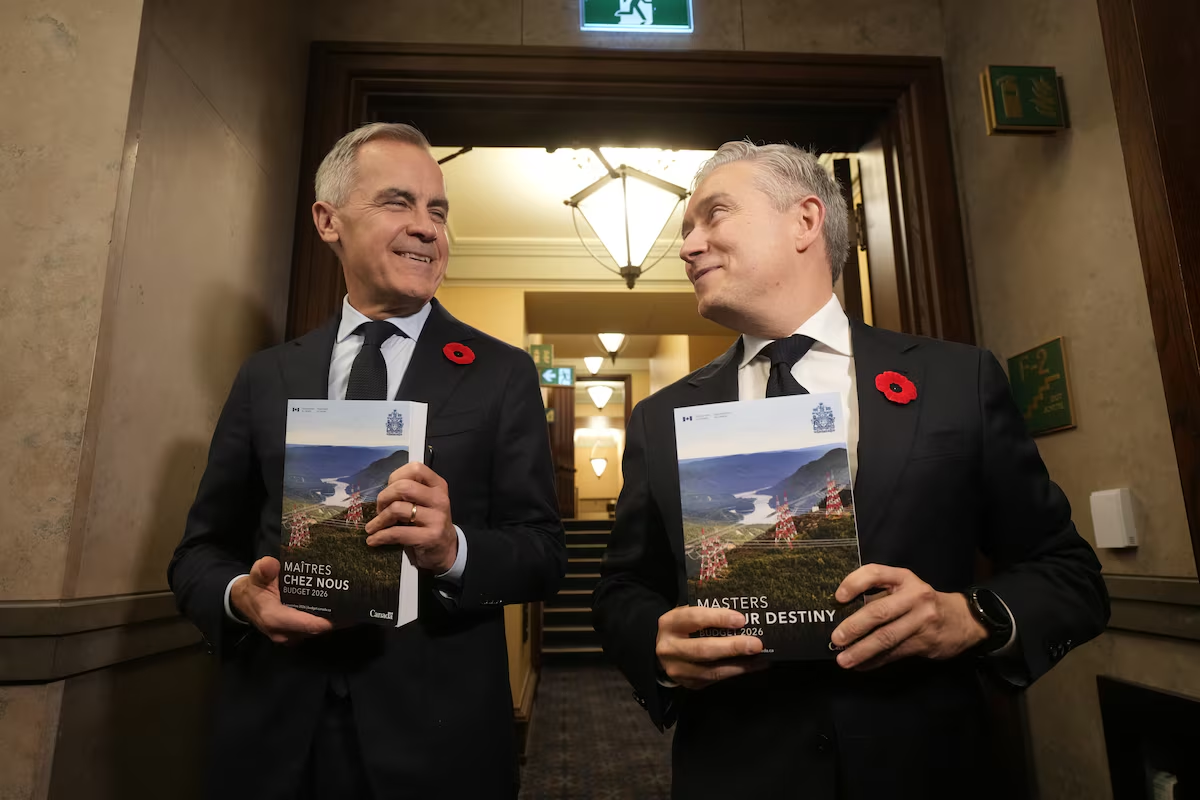
Prime Minister Mark Carney and Finance and National Revenue Minister François-Philippe Champagne are seen on Parliament Hill before the federal budget in Ottawa on Thursday.Adrian Wyld/The Canadian Press
The Liberal government is using a federal balance sheet bolstered by stronger-than-expected revenues to pursue a long-term investment agenda, betting that increased borrowing will deliver future economic gains.
Through tax cuts and other business supports, the budget aims to boost private-sector investment and major nation-building projects, including doubling the capacity of Canada’s energy grid.
It also announces tens of billions of dollars for housing, First Nations infrastructure and other social supports, including a one-time top-up to the Canada Groceries and Essentials Benefit (CGEB).
Finance Minister François-Philippe Champagne’s 2026 budget reveals a major revenue windfall since Ottawa’s spring update, driven largely by soaring global oil prices. The government plans to spend nearly all of it, leaving its bottom line largely unchanged with a deficit of $62.3-billion in 2026-27 and projected annual deficits in the $50-billion to $60-billion range over the next five years.
The budget is the second delivered since Mark Carney became Prime Minister. It adds details to his major policy priorities, including plans to use Crown corporations and federal investment funds to “catalyze an investment supercycle.”
The government says economic growth could improve if its investment plans deliver as hoped. But the annual cost of servicing a growing debt load is projected to climb to $85.5-billion by 2030-31 from $60.2-billion this year, a trend that the Parliamentary Budget Officer has flagged as a concern.
In his speech to the House of Commons, Mr. Champagne portrayed the budget as a comprehensive response to global uncertainty driven by international conflicts and trade tensions with the United States.
The Liberal government is arguing that tax changes, cultural supports and billions of dollars aimed at stoking investment in Budget 2026 will give Canada the freedom to shape its own…Full Caption
“In the face of adversity, we’re seizing opportunities and working together to rebuild stronger,” he said, according to his prepared remarks. “I sincerely believe that in a few years, Canadians will see this moment as another turning point in our history.”
Ottawa benefited from a stronger economic starting point than expected in the spring economic update, as well as a slightly stronger growth outlook.
This time last year, economic growth was flatlining, and many economists expected Canada’s tariff-battered economy to fall into recession. Growth picked up through the middle of this year, while a surge in global oil prices, driven by the war in the Middle East, boosted Canada’s nominal GDP – the largest measure of the country’s tax base.
With that stronger baseline, the budget projects an average of $23.9-billion more in annual revenues over the next five years than the spring update, with more coming from corporate and personal income taxes as well as goods and services taxes. It also trimmed its outlook for direct program expenses by an average of $12.4-billion per year over the forecast horizon, as a result of ongoing efforts to shrink the size of the civil service and find other efficiencies.
All told, the federal budget outlines $151.5-billion in new spending over five years compared with the spring economic update. That is more than offset by a $158.3-billion improvement in the government’s revenue and expense forecasts.
The projected federal debt-to-GDP ratio was revised down by almost about 1.5 percentage points over the forecast horizon compared to the spring update. It remains essentially flat at around 40 per cent over the next five years.
The deficit-to-GDP ratio rises to 1.8 per cent this year from 1.2 per cent last year, which is at odds with the government’s pledge to maintain a declining ratio. It then falls to 1.3 per cent from 1.8 per cent over the following five years.
Ottawa says it has met its other fiscal anchor – balancing the operating budget so that all borrowing is for capital spending – one year ahead of schedule. The government says the plan “keeps us on track to meet both fiscal anchors.”
Business investment and infrastructure
The budget continues the Carney government’s push to boost business investment, expand infrastructure and attract foreign capital.
The biggest-ticket item is the $36-billion “Productivity Mega Deduction,” announced in September, which allows companies to write off the cost of capital investments upfront.
Ottawa also announced a “Canada Growth Incentive,” allowing entrepreneurs who sell their businesses to avoid up to $15-million in capital-gains taxes.
Changes to the Scientific Research and Experimental Development tax credit aim to support the commercialization of Canadian intellectual property. Other business tax changes are intended to make the system less cumbersome.
Six ways Ottawa’s plan could affect your wallet
“Some of the changes are more important or less important than others, but as a package, I think it’s constructive and productive,” said Brian Ernewein, senior tax adviser at KPMG Canada. “It’s not tax reform, and there’s been a number in the business and tax community who have been looking for that…But it’s still good news.”
Ottawa plans to merge Export Development Canada and the Business Development Bank of Canada, two Crown corporations that support businesses and invest alongside the private sector. It will also create a standalone Crown corporation to house its new sovereign wealth fund, the Canada Strong Fund.
The budget commits $8.7-billion over five years to measures aimed at expanding Canada’s electrical grid. It also announces measures to support the mining and forestry industries.
Affordability, housing and First Nations infrastructure
“Building a stronger, more independent economy will deliver lasting benefits to all Canadians, but these structural gains will take time to be fully realized,” Mr. Carney and Mr. Champagne wrote in a joint budget cover letter. “That’s why we are helping families facing affordability pressures with a boost today and bridge to tomorrow.”
The heart of the affordability package is another one-time top-up to the CGEB, previously known as the GST/HST credit, as well as funding for housing and First Nations infrastructure.
Policy analysts widely view the CGEB as an efficient way to deliver income support because it is based on reported income and paid directly to recipients.
In January, Ottawa announced a 25-per-cent increase to the benefit for five years and approved a one-time payment issued in June. The budget adds a top-up, to be issued in early 2027.
The budget also commits $45-billion over 10 years to housing programs, including a pledge to end homelessness within a decade. The government estimates that 65,000 Canadians are homeless. Federal efforts will begin by focusing on permanent housing for the more than 2,000 people who are homeless in Winnipeg.
Ottawa will work with other levels of government and private partners to support mental health and addictions programs, as well as add transitional and supportive homes.
New spending on First Nations issues includes $32-billion over 10 years for housing and infrastructure.
The budget also announces enhancements to the Canada Caregiver Credit and the Build Canada Workers Benefit, both of which provide income support.
Culture, immigration and defence
The budget pledges $4-billion over five years to support Canadian culture, describing “cultural sovereignty” as a pillar of national sovereignty.
The funding includes money to repair aging infrastructure and improve collections at national museums and galleries, with the aim of expanding access.
The budget makes admission to national museums permanently free for people under 25 and proposes a national digital library.
The budget’s update to the Immigration Levels Plan leaves Ottawa’s targets essentially unchanged: 370,000 new temporary resident arrivals and 380,000 permanent resident admissions in each of 2027, 2028 and 2029.
Scotiabank economist Rebekah Young said one risk for the government is that if its investment plans take off, it could create bottlenecks and labour shortages.
“We could have an economy that is, if not overheating, that’s at maximum capacity,” she said in an interview.
On defence, the budget sets out year-by-year plans to meet Canada’s NATO commitments through 2030-31.
“At a time when the world is more dangerous and divided, Canada is rebuilding its Armed Forces,” Mr. Champagne told the House of Commons, according to his prepared remarks.
AI infrastructure
The budget offers little new funding or policy for artificial intelligence. It accounts for the $2.0-billion Ottawa has already pledged to its updated national AI strategy, released in June, which includes financing, technology literacy and safety programs.
Ottawa does, however, promise financial guarantees to developers of AI infrastructure, using its balance sheet to expand the domestic supply of processing power needed to train and run AI models and applications.
Small-business concerns
Although Mr. Champagne promoted the budget earlier this week as one that would benefit small business, it leaves some of the Canadian Federation of Independent Business’s main requests unaddressed.
CFIB president Dan Kelly had urged the government to introduce an across-the-board tax cut for small business.
“There’s lots of talk of mega projects, but right now I feel mega disappointed,” he said in an interview.
He said the vast majority of his members won’t benefit from the investment credits announced in the budget. “This may provide some incentives for new investments in businesses, and that’s good for the long term. But in terms of short-term relief or a light at the end of the tunnel, I don’t see it.”
With reports from Stephanie Levitz and Murad Hemmadi