
Open this photo in gallery:
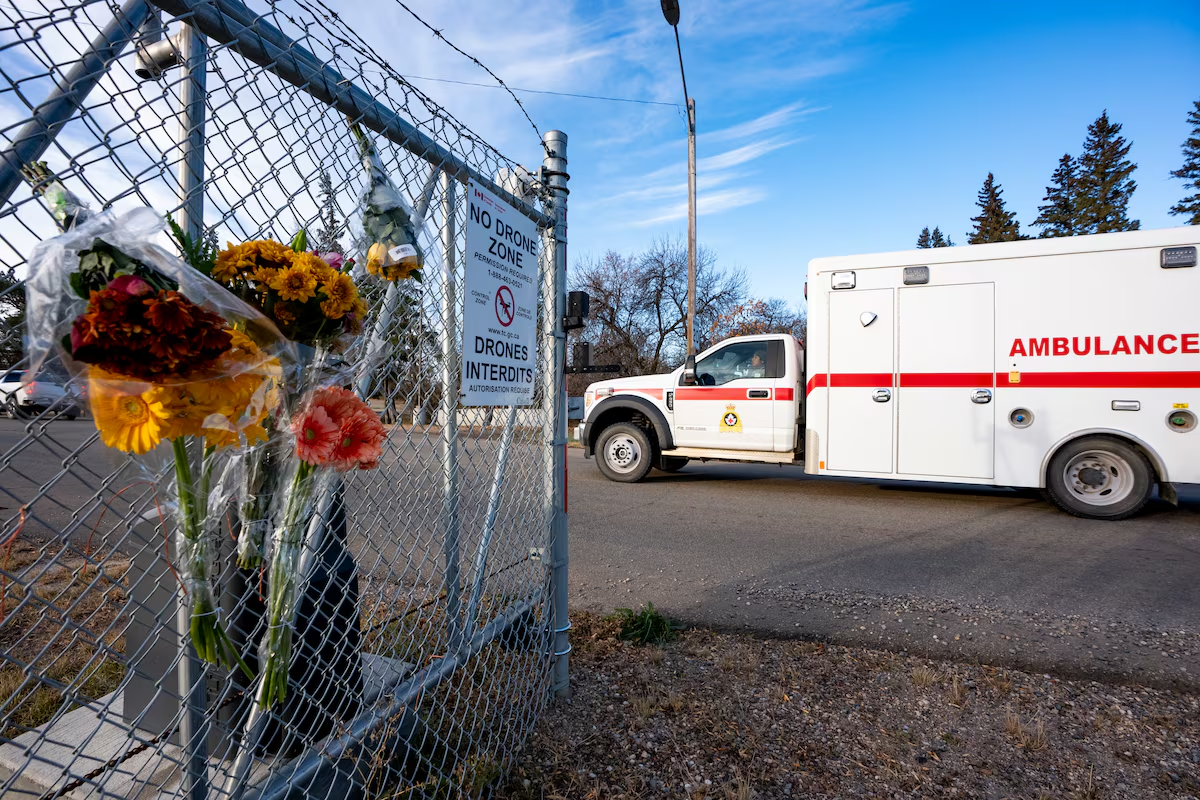
An ambulance enters CFB Wainwright with flowers on the front gates on Oct. 20.Christopher Katsarov/The Canadian Press
Twenty-five people remain in hospital almost three weeks after a devastating fire killed four soldiers and injured dozens at a Canadian Forces base outside Wainwright, Alta., according to the Department of National Defence.
In a statement released Wednesday, the military said 14 people have so far been released from hospital, while four of the injured have been transferred to health care facilities closer to their home communities in Ontario and B.C.
“Recovery will look different for each injured person and their family. Some may face a long journey ahead, but they will not face it alone,” said the statement, which was not attributed to a specific person.
“Ongoing support and services remain available to injured personnel, their families, and all CAF members as they continue to navigate the effects of this tragedy.”
Disaster struck on Oct. 17 when soldiers from The Princess Patricia’s Canadian Light Infantry were caught and overcome by a wildfire while conducting training at Canadian Forces Base Wainwright. Four soldiers were killed and 39 injured.
Saskatchewan soldier killed in CFB Wainwright fire remembered as close friend, loving son
At a news conference last month, Brigadier-General Vanessa Hanrahan said the fire had started hours earlier on CFB Wainwright’s automatic grenade launcher range and was monitored continuously for hours. She did not say whether the firing of live ammunition or explosive rounds ignited the fire.
Brig.-Gen. Hanrahan is the Canadian Forces Provost Marshal, the top soldier in charge of Canada’s military police, and the force is conducting one of several concurrent investigations into the fire. The military is holding its own board of inquiry, and Alberta’s Chief Medical Examiner is also investigating.
The Department of National Defence has said little about the fire itself, citing the investigation. Major-General Wade Rutland, Commander of the Army’s 1st Canadian Division, told reporters in late October that troops had been aware of the fire burning roughly one kilometre away for several hours, but that the fire was “not originally assessed as a threat.”
“Canadians and families are rightly asking how that assessment was reached, what information it was based on, and whether different decisions should have been made. Those are amongst the central questions the investigation must answer,” Maj.-Gen. Rutland said last month.
In just minutes, tiny Wainwright hospital became scene of horrors and heroism
The wildfire risk in Wainwright on Oct. 17 was high. Data from the Canadian Wildland Fire Information System showed a measure called the Fire Weather Index, which gauges the expected intensity of a potential fire, was rated as “extreme.” Environment Canada issued warnings of high winds for Wainwright that day and data showed forest and grassland vegetation as very dry.
Maj.-Gen. Rutland, citing the investigation, would not comment on whether the scale of those risks was adequately communicated to troops on the ground.
Internal communications obtained by The Globe and Mail showed the military was told the “fire index,” a measure of risk, “was low” for CFB Wainwright that day. The DND has not responded to The Globe’s questions about this apparent disparity, or whether the “fire index” referenced in the memo is the same as the CWFIS Fire Weather Index.