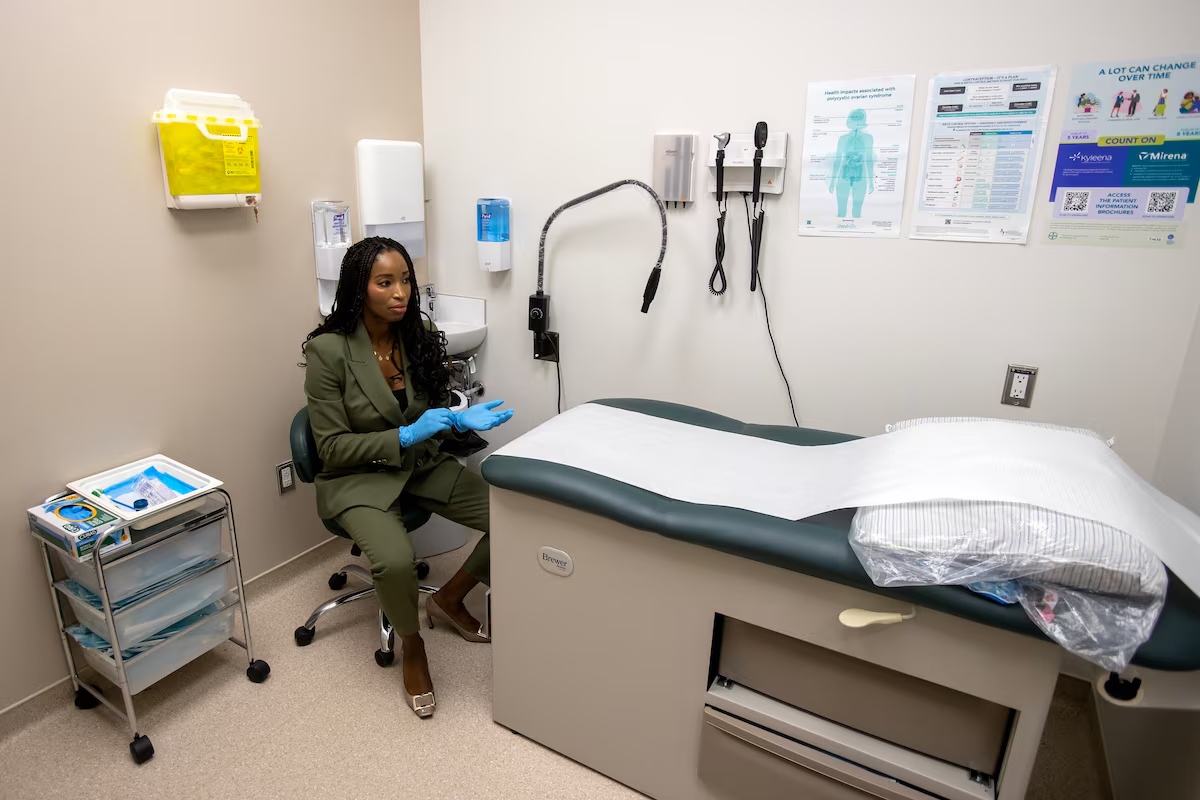

Angela Rimmer has spent thousands of dollars out of pocket to treat her menopause symptoms.
She’s had no other choice, she says: Her symptoms of brain fog, difficulty sleeping, night sweats, hot flashes, mood changes and exhaustion have been debilitating. As a single mother with four children in the London, Ont., area, she needed help to keep working as a full-time dental assistant and being a caregiver at home.
Initially misdiagnosed by a family doctor, who wanted to prescribe antidepressants, she turned to two different private clinics instead, seeking menopause hormone therapy. She spent $600 for an initial assessment at one clinic, plus $200 for each six-month follow-up appointment, $70 for lab tests, and about $120 per month in prescriptions. She doesn’t have private health insurance, and the province doesn’t cover the treatments. To date, she figures she’s spent more than $5,000.
“I just wish that I didn’t have to access this through private. I wish that it was in the public system, because we’re having to pay so much,” says Ms. Rimmer, 42.
Private care, she says, has been costly and time consuming to find. Access to care, including hormone therapy, which has helped her, “should be readily available for the women who need it without having to reach so far into their pocketbooks at this time in our lives, when we should be saving for retirement and for our kids’ schooling.”
Across the country, more than five million women are between the ages of 40 and 60, and the majority of them will experience menopause symptoms, which can vary from mild to overwhelming. Symptoms range from fatigue to headaches, anxiety, muscle aches and heart palpitations.
Four in 10 Canadian women don’t know where to go to get treatment for their symptoms, according to an Ipsos survey this year for GreenShield. A third of respondents said they waited more than two years to get effective menopause care. And those seeking care face barriers: a shortage of family physicians, doctors who lack training in menopause, long wait times to see specialists, a dearth of research funding in this area and an explosion of misleading online information.
Desperate for treatment, some women are turning to private or virtual clinics. Some are run by physicians or nurse practitioners, while others are operated by naturopaths or tech entrepreneurs. The standard of care varies, women’s health experts say, and so do the prices. Many remedies on offer are costly. Not all are effective or safe.
The proliferation of such clinics is raising questions about why a transition experienced by millions of Canadians is not better managed in the public system. Effective treatments exist that alleviate symptoms, and most cases aren’t so complex that they can’t be handled by a family doctor.
Currently, however, just two provinces – British Columbia and Manitoba – cover the costs of menopausal hormone therapy. Newer, nonhormonal medications such as Veozah or Lynkuet, which alleviate hot flashes and night sweats, are approved by Health Canada but aren’t fully covered by the public system.
Open this photo in gallery:
Veozah, a prescription drug to manage hot flashes and other symptoms, is still relatively new on the Canadian market.Supplied by Astellas Pharma via AP
As The Globe and Mail recently reported, Canada is behind other countries – such as Britain and Australia – in taking steps to improve access to care.
In June, the Society of Obstetricians and Gynaecologists of Canada warned that a two-tiered health system is emerging in which women are forced to pay for basic health care that should be free.
Access to menopause care should be universally available to all Canadians, the Menopause Foundation of Canada says. It started a national campaign last month, urging governments to bolster support for women experiencing menopause.
The foundation says gaps in access are widest for Indigenous, Black and racialized women, along with those living in rural communities, gender-diverse people and those with lower incomes. “Access to safe, evidence-based menopause care should never depend on a person’s ability to pay,” the foundation said in a report that sets out priorities for equitable care.
Jen Gunter, a prominent women’s health advocate, gynecologist and author of The Menopause Manifesto, is among those calling for expanded access.
“Whether you live in Flin Flon, Manitoba or in downtown Toronto, you should be able to get access to excellent first-line menopause care,” just like people should have access to care for other issues such as blood pressure, says Dr. Gunter. “These are things that should be available to everybody.”
Monika Kerschl-Sales hears about menopause all the time.
She is co-owner of Thairapy Beauty Bar in Lindsay, Ont. Hundreds of women in the region sit in her stylist chair and have shared their struggles in getting care. She herself remembers having low moods, fatigue, hot flashes, night sweats and brain fog when she began to experience perimenopause, the phase before menopause when many women start having symptoms. She didn’t feel like herself and couldn’t bring her A-game to work.
She’s feeling better now, and says hormone replacement therapy has been life-changing – but to access it, she has paid thousands of dollars out of pocket. A few years ago, she was spending up to $500 a month on supplements (there is limited evidence showing menopause supplements work, and some may have adverse side effects). And she now spends $200 a visit at a private clinic, every three months.
“I’m fortunate to have access to private care, but I know from conversations I’ve had with others that not everyone is in the same position,” says Ms. Kerschl-Sales, 55. “Every woman deserves access to proper menopause care, regardless of her financial circumstances.”
In Dundas, Ont., Lindsay Deefholts says she started suffering from fatigue and brain fog in her forties.
Now 50, the global communications and advocacy consultant feels grateful – she found a family doctor who listened carefully to symptoms and prescribed Veozah, a nonhormonal treatment she takes for hot flashes. Though private health insurance covers some of the cost, she still has to pay $117.74 out of pocket every two months for a prescription.
Dozens of private and virtual clinics are springing up to serve demand from people who have been fed up trying to access care through the public system, such as Modern Menopause, Felix and The Menopause Practice.
It can cost $100 to $400 for an initial assessment at such clinics. Further charges for follow-up appointments, products, therapies or monthly membership programs can run thousands of dollars per year. These include services such as access to a life coach, therapist or customized health plan. Many promise little or no wait times for a consult.
Private clinics are growing as practitioners see business opportunities or a better way to serve patients.
Michelle Jacobson, an OB-GYN and menopause specialist, co-founded Coven Women’s Health, a private virtual clinic, last year out of frustration with the public system. “I had a front-row seat to the dumpster fire that is care delivery in Canada and in Ontario, and my patients, when I was working at a different hospital, were waiting two years, sometimes more, from referral to see me. And that was because there was really a paucity of menopause specialists across Canada, and that continues.”
When patients finally got to see her, there was limited time to spend with them, she says. The way she sees it, “we don’t have a universal health care system.”
Coven, where she is medical director, currently serves people in Ontario, and it has plans to expand. Its menopause care includes access to hormonal prescriptions, dietitians, a health coach and psychotherapy. An initial appointment is $99; patients can then opt for different programs, which range from $299 to $1,399 (the latter includes eight sessions). It’s more comprehensive, holistic care than the public system can offer, Dr. Jacobson says.
National stats are lacking, but one recent study in B.C. found that average out-of-pocket costs on extended health services, among people with no private insurance, amounted to $1,305 in the past year (about a quarter of Canadians don’t have private health insurance).
These services include spending on mental-health professionals, naturopaths, dietitians and kinesiologists.
“Cost was a significant barrier for our participants,” says Lori Brotto, a professor in UBC’s department of obstetrics and gynecology who led the study.
Another problem is that patients feel that they are not getting adequate care from their providers, says Dr. Brotto, who also works as a psychologist. “They say that they were told, ‘This is a natural stage of life. All women go through it,’ and kind of dismissed in that way,” she says.
Women are also travelling long distances for care. On average, the B.C. study found, the distance travelled for menopause care, one-way, was about 282 kilometres, with an average travel time of more than three hours.
“It’s not in keeping with the mandates of our health acts,” says Dr. Brotto.
Open this photo in gallery:
Lori Brotto is a professor in UBC’s department of obstetrics and gynecology.Supplied
In Manitoba, Omolayo Famuyide, a physician and founder of the Layo Centre, a publicly funded women’s health clinic in Winnipeg, says she sees long travel times, too. Some patients are driving from as far as Thompson, about an eight-hour trip north, or from Kenora, Ont., a 2.5-hour drive, she says.
Wait times for an appointment are nine to 12 months, says Dr. Famuyide, who is a certified menopause practitioner – a credential that means a health care professional has passed a competency exam on menopause care issued by The Menopause Society, a U.S.-based organization.
“In the last two years, our wait times have grown significantly,” with an increasing number of referrals for women in perimenopause.
There are ways of alleviating the bottlenecks in the public system, she says – if only governments start paying more attention.
Wendy Wolfman has been treating people with menopause symptoms for more than 30 years.
For much of that time, she saw how their suffering was trivialized. But she has recently seen a shift toward women’s experiences and symptoms being more validated, and says there’s been an explosion in women who are seeking care as they feel more empowered to talk about their symptoms.
The wait-list at her clinic at Mount Sinai Hospital in Toronto is 18 months to two years. She says many people don’t need a specialist or a private clinic, though.
“Many family doctors or nurse practitioners could handle many of the situations we see if they were properly educated and had the clinical experience,” says Dr. Wolfman, who is director of the Weston and O’Born Centre for Mature Women’s Health.
She believes that an experienced clinician could handle many situations virtually, and offer in-person appointments if necessary.
Dr. Wolfman says menopause care can be time consuming, but she firmly believes it should be offered within the public system “because this is a normal part of female aging. Every woman who lives long enough will go through menopause. Every woman.”
Health Canada says it advises consumers to check if health products are authorized. It says unauthorized products haven’t been assessed for safety, efficacy or quality “and may pose a range of serious health risks.” It notes that the delivery of health care – including treatment guidelines – is regulated by provinces and territories.
Ontario’s Health Ministry says it supports access to free, publicly funded drugs, including for menopause, through its drug benefit program. It says it released Canada’s first quality standard for menopause care, last year, to support clinicians in providing evidence-based care.
What’s concerning, Dr. Wolfman says, is that she hears from some patients who are receiving advice from some private virtual clinics that medical professionals would not recommend.
“I have concerns about the people who call themselves menopause experts, many of whom are not experts and many of whom have no clinical experience in the area.”
Some patients have been told to take a barrage of supplements, or high doses of hormone therapy in cases where this would pose additional health risks. Some women are also paying more than they need to for lab tests that may not be necessary, she says. “I would tell people that [if] anybody wants to sell something, be very suspicious,” Dr. Wolfman says.
The Menopause Foundation of Canada offers information on how to assess private clinics, noting, for example, that frequent testing is not generally clinically useful, and cautioning people about unregulated hormone therapy products.
Dr. Jacobson, of Coven Women’s Health, advises people to be wary of misleading claims, particularly around nonmedication health care products. “The misinformation piece that frustrates me is when people sell things, just for the sake of selling them, without really getting what I consider to be informed consent.”
She’s concerned that some of the clinics pushing these claims are tarnishing the reputation of others. “I believe that I’m doing something different here, and I think that we get painted with a lot of the same brush as some of the clinics that I think are a lot less ethical.”
Open this photo in gallery:
Events like the Atlantic Menopause Show cater to Canadian women seeking information about their symptoms, and the range of public and private options to treat them.Carolina Andrade/The Globe and Mail
Virtual clinics are simply meeting a demand, some providers say.
In Calgary, Hoda Soboh, co-founder and CEO of Effica Health, says her clinic is helping to solve the access problem. She is an entrepreneur who started the company with Dr. Nese Yuksel, a professor emeritus of pharmaceutical sciences, after experiencing first-hand the gaps and frustrations in getting menopause care.
The virtual menopause clinic started offering privately paid services in May. It now takes referrals for assessments in Alberta, Ontario and B.C. that are publicly insured (meaning patients don’t have to pay out of pocket), as well as offering memberships for $169 a month for access to preventive care services such as appointments with a dietitian or a mental-health counsellor.
“At the end of the day, everybody has a right to make a decision,” Ms. Soboh says.
But the growth of private care has a direct, negative impact on the public system, says Dr. Gunter, the health advocate, author and gynecologist.
“Studies tell us that private care takes away from public care,” she says, because it takes an already limited number of physicians, nurses and administrators out of public health care, exacerbating shortages that lead to longer public wait times. “It creates a two-tier system and makes care worse for the people who can’t pay, and I think that’s un-Canadian.”
Open this photo in gallery:
‘Whether you live in Flin Flon, Manitoba or in downtown Toronto, you should be able to get access to excellent first-line menopause care,’ says Jen Gunter, an OB-GYN and women’s health advocate.Chris Young/The Canadian Press
Doctors point to other measures that could bolster care in the public system. These include improving remuneration and adding specific billing codes for those providing menopause treatment, so that they’re adequately compensated for their time.
Governments should also provide more research funding on mature women’s health, doctors say. Just 7 per cent of health research grants in Canada goes to female-specific research, according to one 2025 study.
In a brief last month, the Canadian Institutes of Health Research said that menopause remains “substantially underresearched” relative to its prevalence and consequences. After all, fully half of Canadians can expect to go through it as a natural life transition.
Many women who are accessing private services would rather receive care through the public system – not just because provincial health insurance would come into play, but because they feel the absence of public care is fundamentally unfair.
For Angela Rimmer, the dental-care worker in Ontario who signed up with two private clinics, it’s rubbing salt into the wound.
“How many women our age have all this stress on us – and then we have to go through this?”
Ms. Rimmer is urging decision-makers to improve coverage, and says she is sharing her experiences publicly because she wants to end the stigma and silence around menopause.
She hopes that if women talk about it openly, the next generation – including her two daughters – will have better access to care.
Women’s lives and labours: More from The Globe and Mail
Open this photo in gallery:
Illustration by Hanna Barczyk
More on menopause in Canada
How is stigma around menopause symptoms affecting women and the economy? We answered your questions
Clues to higher incidence of dementia in women may lie in menopause
Athlete Clara Hughes is done being hot and bothered
A dermatologist explains how perimenopause and menopause change your skin-care needs
From brain fog to mood swings: Do supplements help women?
The Decibel podcast
Helping Canadians to conceive is a lucrative and growing business, but for would-be parents, navigating it is neither simple nor cheap. Reporter Kathryn Blaze Baum wrote a book about the fertility industry, and spoke with The Decibel about her experience with in-vitro fertilization. Subscribe for more episodes.