

Open this photo in gallery:
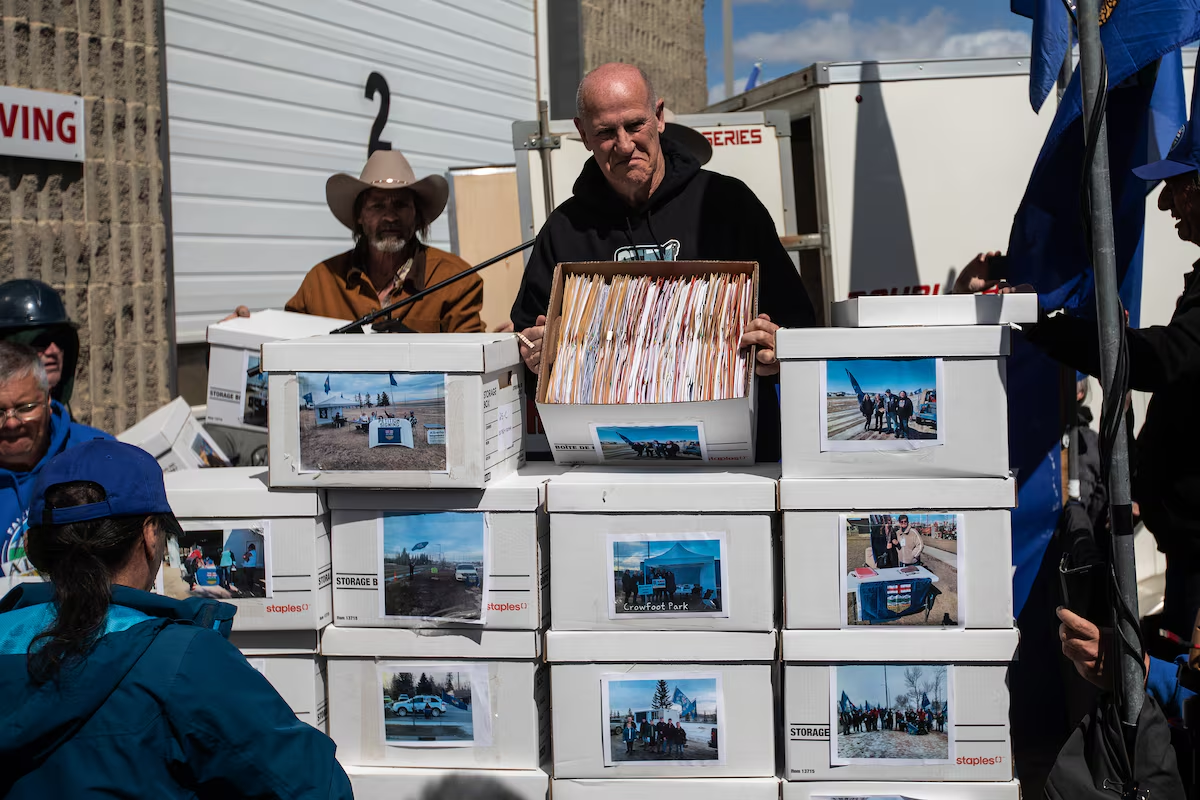
Alberta separatist leader Mitch Sylvestre in Edmonton in May with boxes of signatures in support of an independence referendum.JASON FRANSON/The Canadian Press
An Alberta Court of Appeal judge said Thursday she has misgivings about a lower-court decision that blocked a petition aimed at forcing a binding referendum on whether the province should leave Canada.
Justice Alice Woolley said her remarks do not indicate how she will rule on the efforts by Alberta separatists to have the lower-court decision overturned. But she said she has “disquiet” with some of the reasoning used by Court of King’s Bench Justice Shaina Leonard to strike down the pro-independence petition, which organizers say collected 301,000 signatures during a four-month campaign.
In May, Justice Leonard blocked Elections Alberta from certifying the petition, saying the province failed to consult with First Nations to address how separation could affect treaty rights.
Justice Woolley, at a virtual hearing on Thursday, said she had qualms with Justice Leonard’s assumption that approving a citizen-led petition would trigger mandatory steps for the government to implement the results of an independence referendum. Justice Leonard ruled in May that the consequences of separation would violate constitutionally protected treaty rights.
Opinion: How Alberta’s First Nations should respond to the referendum on secession
That ruling, published less than two weeks after separatists delivered boxes of signatures to Elections Alberta, has prohibited the agency from counting the signatures. It has since kept them under 24-hour surveillance until all court proceedings end.
Thursday’s hearing marked the latest episode in legal wrangling that has thwarted Alberta separatists’ efforts to force a provincewide referendum on secession.
Independence leader Mitch Sylvestre argued Justice Woolley should overturn the lower-court decision because it harms the democratic right of Albertans to use a legal petition to communicate their wishes to elected representatives.
Alberta’s referendum, scheduled for Oct. 19, will ask a secession question – though not the one Mr. Sylvestre advocated for. Last month, Premier Danielle Smith announced that Alberta residents will vote on whether they wish to stay in Canada or begin the legal process to hold a second, binding independence referendum.
The referendum will be one of two stress tests for national unity this year, with a fall provincial election on the horizon in Quebec, where the separatist Parti Québécois leads in most polls.
Ms. Smith’s decision to put forward the referendum question has united her detractors on the left and right in anger. Separatists, including those within her United Conservative Party, have called for her removal as leader, while federalists have argued her question is a dangerous gambit that threatens national unity.
Canada’s oil-rich province of Alberta will proceed with a non-binding referendum in October on whether its residents want to remain part of Canada, Premier Danielle Smith said Thursday, a largely symbolic move that could still pose a major challenge for Prime Minister Mark Carney.
Reuters
The Alberta Premier has rallied around the federalist cause, attempting to use her energy agreement with Ottawa to win over Albertans who turned to separation out of frustration with the federal government.
Ms. Smith has argued her referendum question skirts Justice Leonard’s ruling, which she has condemned as anti-democratic. Her government last week filed its legal challenge to that decision, which is expected to be heard by the Alberta Court of Appeal later this year.
Andrew Coyne: It’s not the separatists who are the real threat to the country. It’s the federalists
Opinion: Danielle Smith is playing a dangerous game with her referendum question on secession
On Thursday, Jeffrey Rath, Mr. Sylvestre’s lawyer and himself a prominent independence advocate, argued Justice Leonard’s ruling affects democratic participation in a process that more than 301,000 Alberta residents called for.
If Mr. Sylvestre and Mr. Rath’s accounting is accurate, their group, Stay Free Alberta, would have met the nearly 178,000-signature bar groups must reach for a petition to force a referendum on constitutional or policy issues.
Mr. Rath also argued treaty rights are not violated by collecting signatures for an independence referendum, or even further beyond that.
“Nobody’s rights are impacted by a referendum on independence, even in the case of a yes vote,” he said.
Justice Woolley didn’t say when she would render her decision, but did say she plans to work quickly.
“It won’t be long, but it won’t be today,” she said.