
Open this photo in gallery:
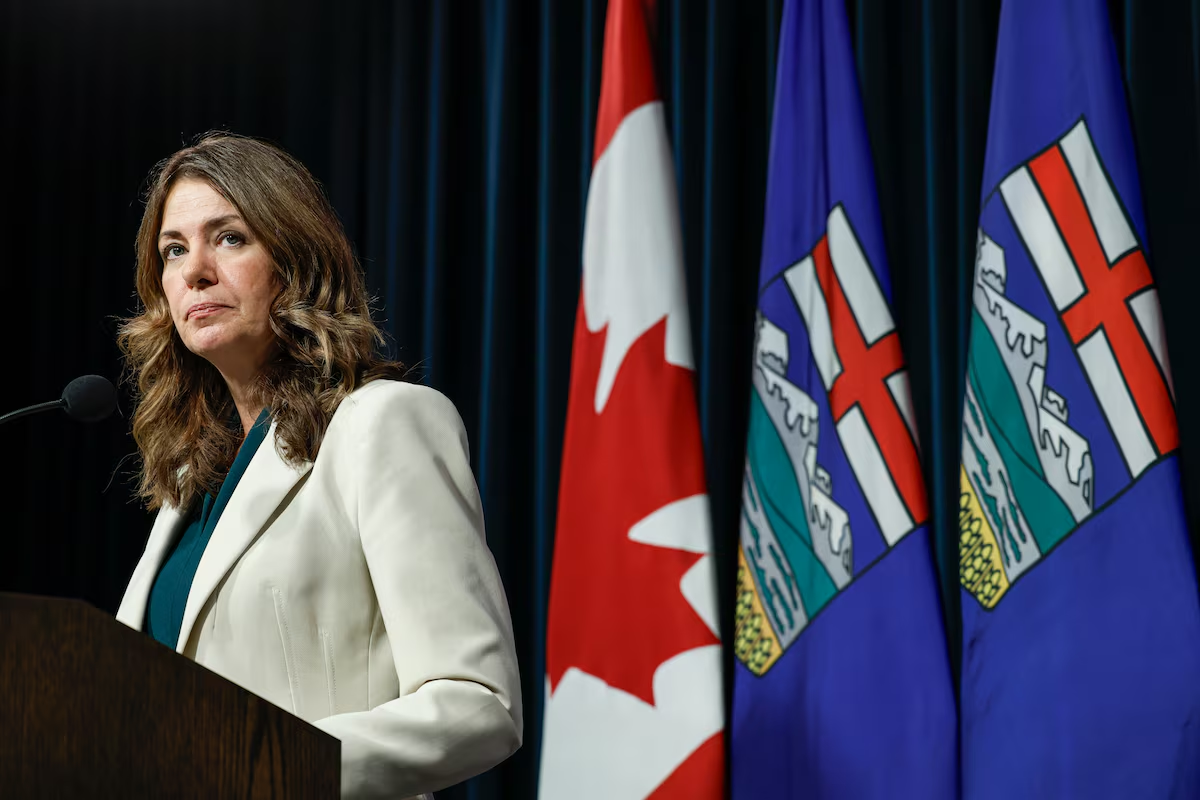
Premier Danielle Smith’s government is expected to table Alberta’s proposed new electoral boundaries next week.Jeff McIntosh/The Canadian Press
Alberta’s new electoral boundaries are expected to be released next week, setting up a contentious battle over the map that will define the province’s political playing field for the next decade – a process that has been plagued by accusations of gerrymandering.
On Wednesday, a committee of MLAs with the United Conservative Party and Alberta NDP met to discuss next steps for the proposed map and report, which was produced by an independent panel and privately delivered to members last week. That report will remain confidential until it’s tabled in the Alberta legislature next Monday.
But Alberta NDP Leader Naheed Nenshi and two fellow New Democrat MLAs detailed extensive concerns about the new proposed map on Wednesday, calling it “illegal” and accusing Premier Danielle Smith of gerrymandering, referring to the U.S.-style tactic of manipulating electoral maps to create an artificial advantage.
“This government, in their effort to dodge accountability, has engineered the single worst case of gerrymandering in Alberta history,” Mr. Nenshi said in the public committee meeting.
The Globe and Mail was not able to verify the NDP’s claims because the report isn’t public.
Ms. Smith later chastised the NDP leader for discussing the report before it is distributed publicly and accused him of questioning the integrity of the independent panel’s chair, retired Alberta judge Brian O’Ferrall.
“He is already prepositioning another election denialism, trying to pre-frame the results as if it’s going to have an impact on the next election,” Ms. Smith said during Question Period.
Alberta’s political boundaries are redrawn every eight to 10 years by an independent panel. Two years ago, ahead of the scheduled overhaul of Alberta’s electoral map, the UCP government determined two more seats were needed to accommodate the province’s recent population boom – particularly in urban centres. This would bring the total number of MLAs in the provincial legislature to 89, a 2-per-cent increase in seats for a province where the population had grown by 20 per cent since the last redistricting.
The Editorial Board: The UCP shouldn’t smudge Alberta’s electoral map
Continuing with tradition, the UCP and NDP then tapped a five-person panel to hold public consultations and draw the new electoral map to set the stage for the provincial election in October, 2027.
But last April, Ms. Smith rejected the independent commission’s proposed changes to the electoral map. Her government then formed a UCP-dominated committee that tapped a new independent panel charged with taking a second attempt at drawing the electoral map – this time with four more seats, bringing the total to 91.
Ms. Smith’s decision to force a redraw of the maps has injected a charged partisan atmosphere into what is normally a complex process designed to foster compromise and limit political influence. For decades, provincial legislatures have routinely adopted independent panels’ recommendations without question.
The dispute over the first panel’s work began in the spring when it submitted two maps in its final report, known as the majority and minority reports.
One was supported by the majority of its members: the chair, tapped by the governing UCP, and two panelists selected by the NDP. Their map would eliminate two rural ridings to accommodate a population boom in Calgary and Edmonton, where they proposed two additional seats. (The panelists said they wouldn’t have had to remove the rural seats if the commission was provided with two more seats in total.)
The commission’s other two members, both chosen by the UCP, put forward a competing map and report that proposed more than a dozen merged urban and rural ridings, diluting the power of the urban vote. The majority called this vision “unconstitutional” and “illogical.”
An analysis by The Globe and Mail found that the majority map would reduce the UCP’s electoral advantage by a handful of seats. The minority map, meanwhile, would reduce the NDP’s strength in Calgary and Edmonton, where most of its political support resides.
In the end, Ms. Smith picked neither, forming a committee dominated by UCP MLAs that oversaw a new redrawing. The new plan gave her government permission to intervene in the process.
The idea to strike a new panel was proposed by the original commission chair, Court of King’s Bench Justice Dallas Miller, who suggested increasing the number of electoral districts to 91 from 89 to accommodate the loss of two rural seats in the majority’s plan. (He made the recommendation on his own, without the support of the four panelists.)
The Alberta NDP said on Wednesday that the new map violates several of the conditions Ms. Smith’s government previously committed to, such as limiting changes to the majority report’s proposals for most of the province. Alberta NDP House Leader Christina Gray said at the Wednesday committee meeting that she believes there is a “clear partisan tilt” to the report.
The three UCP MLAs sitting on the committee – Ron Wiebe, Chantelle de Jonge and Garth Rowswell – were silent on the report’s contents.