
Listen to this article
Estimated 5 minutes
The audio version of this article is generated by AI-based technology. Mispronunciations can occur. We are working with our partners to continually review and improve the results.
A Manitoba man battling a degenerative disease won’t lose access to his life-sustaining drug, with the province now promising coverage after a federal agency reversed its recommendation against its use in adults over 25.
Jeremy Bray, 31, says he’s relieved he won’t have to plead for continued access to the drug, which costs roughly $300,000 annually.
“It’s a huge relief,” he said, recalling the toll fighting for treatment took on him and his family.
“I’m just really happy to put this all behind us.”
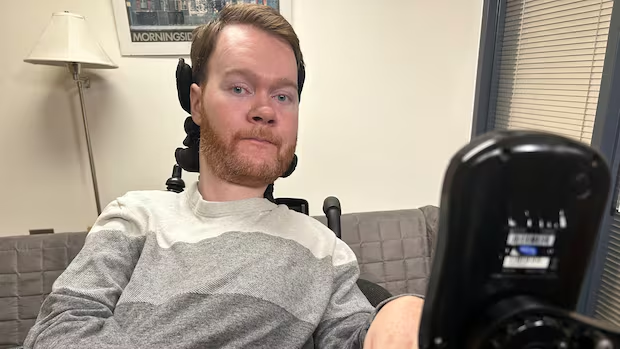
Bray has Type 2 spinal muscular atrophy, a disease that gradually robs him of the ability to move his muscles. Right now, he’s mainly limited to moving his mouth, parts of his face and one thumb. His thumb lets him operate his motorized wheelchair and use the computer he needs for his job.
Bray has been lobbying the last few years to access a new drug that eases the disease’s progression, but he encountered reluctance.
It wasn’t until 2025 that Manitoba health minister Uzoma Asagwara persuaded Roche, the drug’s manufacturer, to extend free coverage to the drug risdiplam — sold under the brand name Evrysdi — on compassionate grounds.

Bray meets Manitoba Health Minister Uzoma Asagwara in 2025. (Tyson Koschik/CBC)
The province hoped Bray’s experience with the drug would convince Canada’s Drug Agency to recommend the treatment for adults over the age of 25. The agency has argued there isn’t enough evidence because people in that age bracket haven’t participated in clinical tests, and the province was relying on that information to determine whether to provide coverage.
After six months of treatment, Bray reported a stronger voice, his facial movements becoming expressive, and longer days at his work as a data consultant in Rivers, Man., before needing rest.
However, Bray found out in November 2025 that Roche would stop offering the treatment for free, so he asked whether Manitoba’s government would reverse its refusal.
At first, the provincial government wouldn’t change its mind. Tears welled in his eyes as Bray left a meeting at Asagwara’s office that month. The next day, Premier Wab Kinew said he was “very moved” by Bray’s impassioned plea, as seen in news reports, and said Manitoba would cover treatment for at least a year.
Last week, Canada’s Drug Agency issued a draft recommendation supporting expanded public coverage for two drugs treating spinal muscular atrophy, including risdiplam.
While the recommendations aren’t binding, and negotiations involving the manufacturer are still required, Asagwara told Bray by phone Tuesday that Manitoba would follow the agency’s updated recommendation.
“Jeremy is covered. He’s going to get access to that medication,” Asagwara said in an interview.
On Bray’s behalf, the province urged the federal agency to review the drug.
New review from drug agency
A new review started in the winter, hearing input from individuals with spinal muscular atrophy, including Bray, as well as clinicians and other experts. The report suggested that while widespread evidence of the drug’s success is limited for adults, it will likely remain that way because the disease is rare and treatment has already proven to work in some patients.
“This is the power of when Manitobans share their stories,” Asagwara said, crediting Bray for his advocacy.

Bray with his friends Ryan and Hayley Lamb. He was the best man at their wedding in 2021. (Submitted by Jeremy Bray)
“When Manitobans share their stories about their lived experience and ask for government to work with them to take additional steps, ultimately we can get good outcomes.”
Brandon-Souris Conservative MP Grant Jackson, who previously represented Bray as the Progressive Conservative MLA for the area, said it initially felt like they were “up against a brick wall” in convincing governments and bureaucracies to act.
“Persistence would be, what I think, made the difference,” he said.
Prior to being on treatment, Bray said he woke up each day knowing “at any time, I could lose function.”
Over the years, he lost the capacity to move his head, arms, hands and legs.
But now Bray can say with confidence he’s on the best possible treatment — and won’t lose it.
“Maybe the biggest thing is that my mental health has totally turned around over the last year or so. Being on treatment is a real peace of mind for my family, myself, anybody who knows me.”
“It’s tough to put into words how meaningful it is to us.”
Bray said he wanted to thank members of the public who supported his push for treatment and advocated on his behalf.