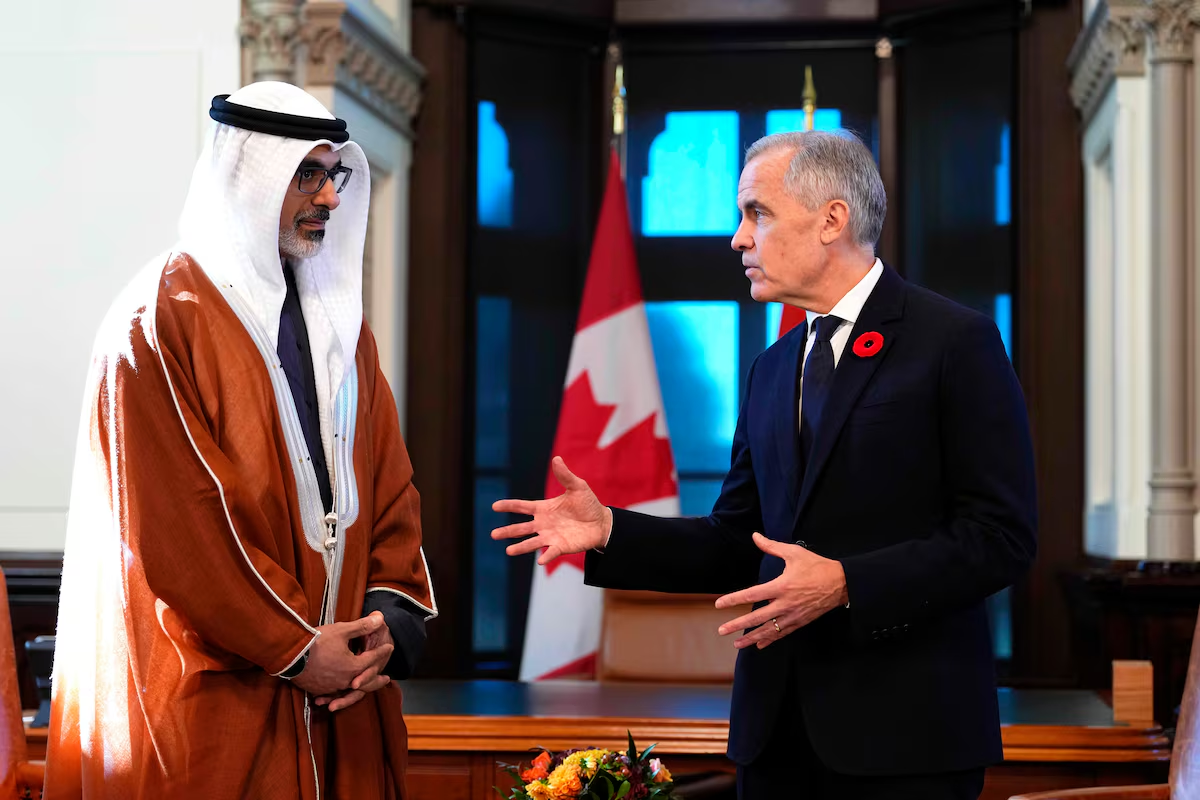

Good morning. Prime Minister Mark Carney is deepening Canada’s ties with the United Arab Emirates, signing trade and defence deals and agreeing to extradition talks despite concerns over the Gulf state’s human-rights record.
More on that below, along with Ottawa’s proposed changes to assisted dying and the finalists vying to represent Canada at Eurovision.
Open this photo in gallery:
Prime Minister Mark Carney hosted Sheikh Khaled bin Mohamed bin Zayed Al Nahyan, the Crown Prince of Abu Dhabi, in Ottawa on Tuesday.Justin Tang/The Canadian Press
TOP STORIES
Carney deepens UAE ties despite human-rights concerns
Prime Minister Mark Carney signed a free-trade agreement and defence co-operation pact with the United Arab Emirates and agreed to begin negotiations on an extradition treaty, as Ottawa seeks to diversify trade and attract foreign investment.
The stakes: Ottawa is counting on the UAE to deliver on a $70-billion investment pledge, while the new trade deal is expected to reduce or eliminate tariffs on more than 99 per cent of Canadian exports to the Gulf state.
The controversy: The agreements have drawn criticism from human-rights advocates over the UAE’s record and allegations that it has supplied weapons to Sudan’s paramilitary Rapid Support Forces, which the UAE denies.
Open this photo in gallery:
Justice Minister Sean Fraser speaks as Minister of Health Marjorie Michel looks on, in the Foyer of the House of Commons, on Oct. 7. Mr. Fraser had outlined the next steps for the country’s medical assistance in dying regime.Justin Tang/The Canadian Press
Ottawa proposes MAID overhaul
The federal government has introduced legislation that would permanently bar medical assistance in dying (MAID) for people whose sole underlying condition is mental illness, while allowing advance requests for patients with certain capacity-limiting diseases.
The changes: Patients with conditions such as Alzheimer’s could specify in advance when they would want to receive MAID. Provinces and territories would decide whether to permit advance requests.
The context: Access to MAID for mental illness alone has been delayed twice, with the current exclusion set to expire in March, 2027. The proposed legislation would make that exclusion permanent, while establishing federal rules for advance requests.
Open this photo in gallery:
The five finalists competing to represent Canada at the 2027 Eurovision Song Contest are revealed in Toronto at CBC headquarters.Sammy Kogan/The Canadian Press
Five artists vie for Canada’s Eurovision debut
CBC/Radio-Canada has unveiled five finalists competing to become the country’s first representative at the Eurovision Song Contest, set to take place in Bulgaria next spring.
The contenders: William Cloutier, Josiane, Rêve, Tyler Shaw and Talk were selected from 325 applicants. All five have established musical careers or followings.
What’s next: Canadians can vote up to 10 times for their favourite artist until Nov. 5. The finalists will perform at a concert in Montreal on Nov. 1, and the winner will be announced in December.
The Take
If Canada wants to improve the economy by moving forward with defined major projects, it needs First Nations buy-in. Full stop. Mr. Carney knows this and so do we.
Manitoba Premier Wab Kinew’s call to abolish the Indian Act overshadowed a historic meeting meant to address First Nations concerns about resource development and meaningful consultation, Tanya Talaga writes.
The Shot
Open this photo in gallery:
Second-year student Crystal Au demonstrates proper flossing technique to a client at Southern Ontario Dental College in Ancaster, Ont., earlier this month.Nick Iwanyshyn/The Globe and Mail
At Southern Ontario Dental College, students are worried about more than exams. One mother of three faces a four-hour round-trip commute while juggling work and classes. Another fears she may have to drop out. They’re among thousands of students left in financial limbo by Ontario’s freeze on student aid to private colleges.
The Wrap
What else we’re following
At home: The Bank of Canada is widely expected to raise its benchmark interest rate for the first time in three years in a bid to prevent high oil prices from becoming a broader and more entrenched inflation problem. Here are six ways a Bank of Canada rate hike could cost or benefit you.
Abroad: Anxious Israelis watch as election results take shape, with the highest turnout in over a quarter-century. Exit polls suggested there was no clear winner and that weeks of negotiating could lie ahead.
Health care: Ontario says nearly 89 per cent of residents now have a primary-care provider, with 511,000 more people connected since January, 2025. But 1.8 million remain without one, amid concerns that more than 2,100 family doctors, with three million patients, could retire in the coming years.
Trade: Canada and the European Union are working toward a new partnership that officials say could bring Ottawa closer to the bloc than ever before, short of full membership.
Prehistoric: A rare Nanotyrannus skeleton, a cousin of the T. rex, sold for US$47.3-million at a New York auction, becoming the second-most expensive dinosaur fossil ever sold.
Music: Jay-Z has picked himself to headline the Super Bowl halftime show after years of helping produce it through his company, Roc Nation.