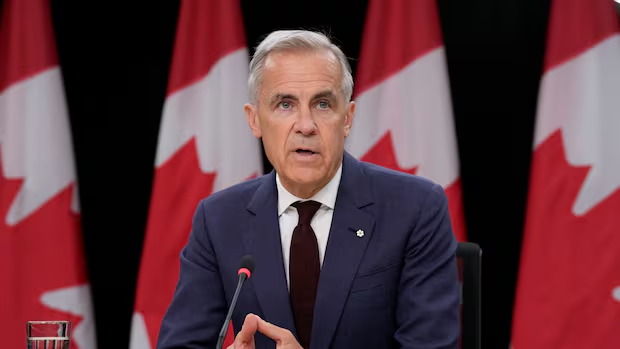
Prime Minister Mark Carney will meet with Inuit leadership Tuesday in Kuujjuaq, the largest community in the Nunavik region in northern Quebec, for the first trip by a sitting prime minister to the village in almost 20 years.
When Carney lands in Kuujjuaq, located about 1,505 kilometres north of Ottawa, he and several of his cabinet ministers will arrive on an airstrip not built by the Canadian government, but the Americans during the Second World War.
Ensuring Inuit benefit from the tens of billions of dollars slated for shoring up the Canadian military’s presence in the Arctic is one of the key priorities slated to be discussed at the Inuit-Crown Partnership Committee meeting that Carney will co-chair with Inuit Tapiriit Kanatami (ITK) President Natan Obed.
“The considerations about the effect on Inuit society and our culture, our sustainability, I don’t believe have been fully considered yet,” Obed said in an interview with CBC News before the meeting.
“While the Government of Canada might have a very clear road map for what it would like to achieve, there is still time for us to insert the human and the community element into this next wave of militarization in our homeland so that we don’t repeat the mistakes of the past and we don’t create undue burden in our society.”
The militarization of Canada’s North enabled the colonization of Inuit and determined where their hubs are located, Obed said. Now, Inuit are at another precipice with the federal government and they want to make sure that this time, Canada gets it right.
“We’ve been neglected,” said Pita Aatami, president of Makivvik Corporation — the legal representative of Inuit in Nunavik.
“It’s very important to show our realities to the prime minister and to the ministers because it’s always better first-hand.”
 Carney’s trip to Kuujjuaq, seen here in May 2022, will make him the first prime minister to visit since Stephen Harper in 2008. (Adrian Wyld/The Canadian Press)
None of the new defence spending announced so far is destined for Kuujjuaq. But Aatami, who was born and raised in the community, says he hopes he can convince Carney and his ministers to lengthen airstrips in Nunavik and supply better equipment to the Canadian Rangers, the military’s eyes and ears of the North.
The specialized sub-component of the Canadian Army Reserve use their own snowmobiles and boats for patrols, and Aaatami says he wants to see that change.
“We want them to be fully equipped if we’re going to be the eyes and ears of Canada, but we need the support of Canada to be able to do this,” Aatami said.
The Department of National Defence is looking at ways to improve the Rangers, according to Crown-Indigenous Relations Minister Rebecca Alty. She said the government is looking at the opportunity to build dual-use community garages that the military and local community members can use to repair their equipment.
Inuit-led university on the agenda
Inuit leaders are also looking for a commitment from the federal government for legislation that would enable the first Inuit-led university to have satellite campuses across the country.
Obed recently made headlines by suggesting at an Arctic sovereignty conference in Ottawa that Inuit could work with other countries if Canada isn’t interested.
“If the partnership with Canada is not on the table, if we are not going to be respected partners, then should we not be looking for other partners as well to uphold our interests,” Obed told the audience at the summit on June 19.
When asked to clarify his comments, Obed said he didn’t mean Inuit are entertaining the idea of leaving Canada, but said Inuit leadership could turn to other jurisdictions to advance the Inuit-led university and other priorities.
Obed pointed to the University of the Arctic, an international co-operative of post-secondary education in the network of universities and colleges in the Circumpolar Arctic region, as an example of a cross-border partnership that could be replicated.
Alty told CBC News that the request to introduce legislation for the multi-jurisdictional university is under consideration, but the government still has to consult provinces and territories.
WATCH | The plan to protect Canada’s North:
Carney announces $35B plan to protect Canada’s Arctic
Prime Minister Mark Carney announced some details of his government’s $35-billion plan to protect Canada’s Arctic region, featuring a beefed-up military presence. Carney spoke in Yellowknife before his trip to meet allies in Norway.
Carney is the first prime minister to visit Kuujjuaq since former prime minister Stephen Harper in 2008.
Alty says Carney, who was born in Fort Smith, N.W.T., sees the North as a priority.
“The prime minister is committed to getting out and going across Canada, and particularly the North,” she said.
Affordability, eliminating TB also priorities
Aatami said he wants to show Carney the prices at the grocery store, which are exceptionally higher than in southern Canada despite a subsidy offered through the Nutrition North program.
The Makivvik president also said he wants to take the prime minister on a tour of the community to help Carney better understand the housing crisis Nunavik is facing. The region is short up to 1,000 homes, he said. The cost to build a three-bedroom house in Nunavik is more than $1 million, according to Aatami.
The average yearly income in Inuit Nunangat — the Inuit homeland made up of four regions across the North, including Nunavik — is approximately $32,000 for Inuit and $100,000 for non-Inuit, according to ITK.
Inuit Nunangat is also facing challenges eliminating tuberculosis (TB). Nunavik, in particular, has among the highest rates of TB not only in the country, but the entire world, according to the region’s health officials.
Ottawa pledged to eradicate TB in Inuit communities by 2030, but lately, rates of the serious infectious disease have been rising instead of decreasing.
 Carney delivered opening remarks during a meeting of the Inuit-Crown Partnership Committee, in Inuvik, N.W.T., last July as Natan Obed, right, president of the Inuit Tapiriit Kanatami, listened. (Darryl Dyck/The Canadian Press)
Alty said the government still wants to work with Inuit leadership, the provinces and territories to meet the 2030 TB eradication target, but noted the work is complex.
“We also need to make sure that that housing is addressed,” she said.
“It’s not just one program. We really have to make sure that we’re addressing the housing and the community infrastructure to support housing as well as the the health infrastructure needed.”
Obed said more political will is needed from all levels of government.
“None of us have done the work that we should have done in the time that we’ve had to get more results quicker,” he said.
“On the federal side, I hope that we can have a more whole of government approach to TB elimination that harnesses the power of the Public Health Agency and Health Canada in addition to Indigenous services.”