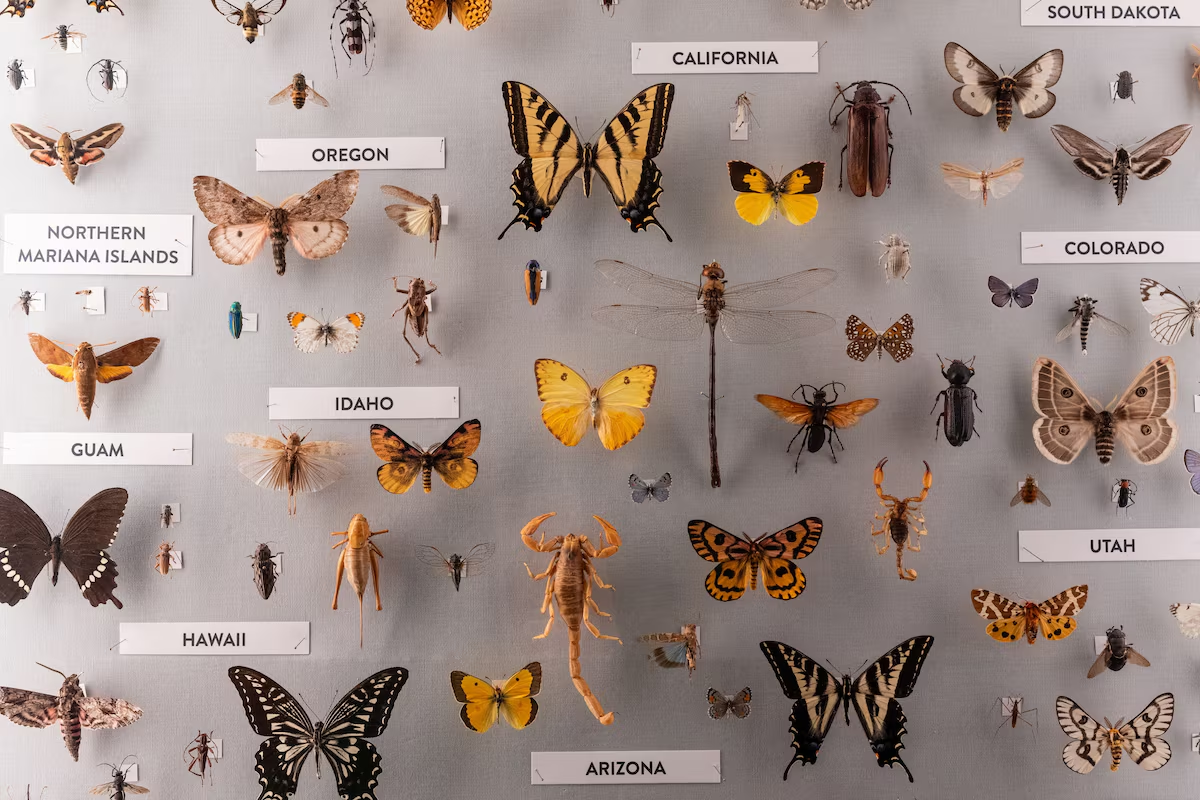

Open this photo in gallery:
If all insects stepped on a scale together, they would easily outweigh land vertebrates by a huge factor.Eric Lee/Reuters
Celebrated biologist and ant expert E.O. Wilson once wrote that every species is a masterpiece.
If so, the art gallery of life may need many more rooms just to accommodate insects.
That’s the takeaway from a new analysis of insect biodiversity published Monday in the Proceedings of the National Academy of Sciences.
In their study, an international team of researchers conclude that the number of insect species is far greater than six million – a figure that has been the scientific consensus since about 2010.
Instead, the researchers say their work suggests there are at least 14 million to 20 million insect species. The true number could range even higher.
With less than 1.5 million of those species named and documented, the new result underscores how little is known about a vast portion of life on Earth, even as human activity threatens to wipe out species we don’t even know exist yet.
“We have no idea of what they’re interacting with, or whether their populations are trending up or down,” said Alex Smith, a co-author on the study and an associate professor of biology at the University of Guelph. ”These things are important to us, whether we appreciate the jobs they do or not.”
Reconstructing skeletons, retelling life stories
The study marks the latest effort to come to grips with one of the most basic but challenging questions in insect biology. Just how many kinds of insects are there?
As a group, insects are certainly the most abundant and diverse animals on Earth. If they all stepped on a scale together, they would easily outweigh land vertebrates by a huge factor. And while we may think of them as small, their body sizes range over orders of magnitude, from pencil-length walking sticks to nearly microscopic wasps.
Many insect species are parasites of others – some are even parasites of parasites – which further adds to their seemingly endless variety. What’s clear is that science has not seen nearly enough to count up species directly.
In the new study, researchers arrived at their estimate through a combination of dogged field work and sophisticated statistics. The former is primarily based at Guanacaste Conservation Area in Costa Rica, known for its exceptionally high biodiversity. For more than 30 years, ecologists Daniel Janzen and Winnie Hallwachs have been building up a huge database there, collecting and genetically identifying species.
To get a handle on insect diversity, the study authors first focused on one particularly diverse subfamily of parasitoid wasps with many known species. They compared how many of those species turned up in the Costa Rica site when scientists used three different methods. Two of those involved traps, a third involved identifying the wasps directly on the caterpillars that they parasitize.
Researchers found strikingly little overlap in the species of wasps that were captured using the three methods. Statistically, this implies that there is a substantially larger pool of unknown wasp species.
The researchers drew on additional data to bolster their findings, including contributions from Agriculture Canada, which maintains an insect collection.
An evolution in how we think about how animals think
Finally, they expanded their estimate to encompass all insects everywhere. This was done by comparing how diversity increases with geography in trees, mammal amphibians and moths to arrive at various scaling factors.
The analysis with trees, for example, yielded a likely total of 20.3 million insect species.
Laura Melissa Guzman, a co-author and assistant professor of entomology at Cornell University, said the study’s methodology was tested by multiple rounds of peer review and by authors themselves.
“Through the different steps we challenged our assumptions over and over,” she said.
John Wiens, an evolutionary ecologist at the University of Arizona, said a different approach led him and a colleague to a similar conclusion.
He called the new study “a great contribution” that combined decades of work with a broad combination of expertise.
He added that because many insects are also associated with unique species of plants, fungus and other lifeforms, they are a doorway into the broad array of evolutionary possibility, including biological innovations that could one day help humans.
“When we think about protecting the diversity of life, then a big emphasis should be on these undescribed insect species.”