
Open this photo in gallery:
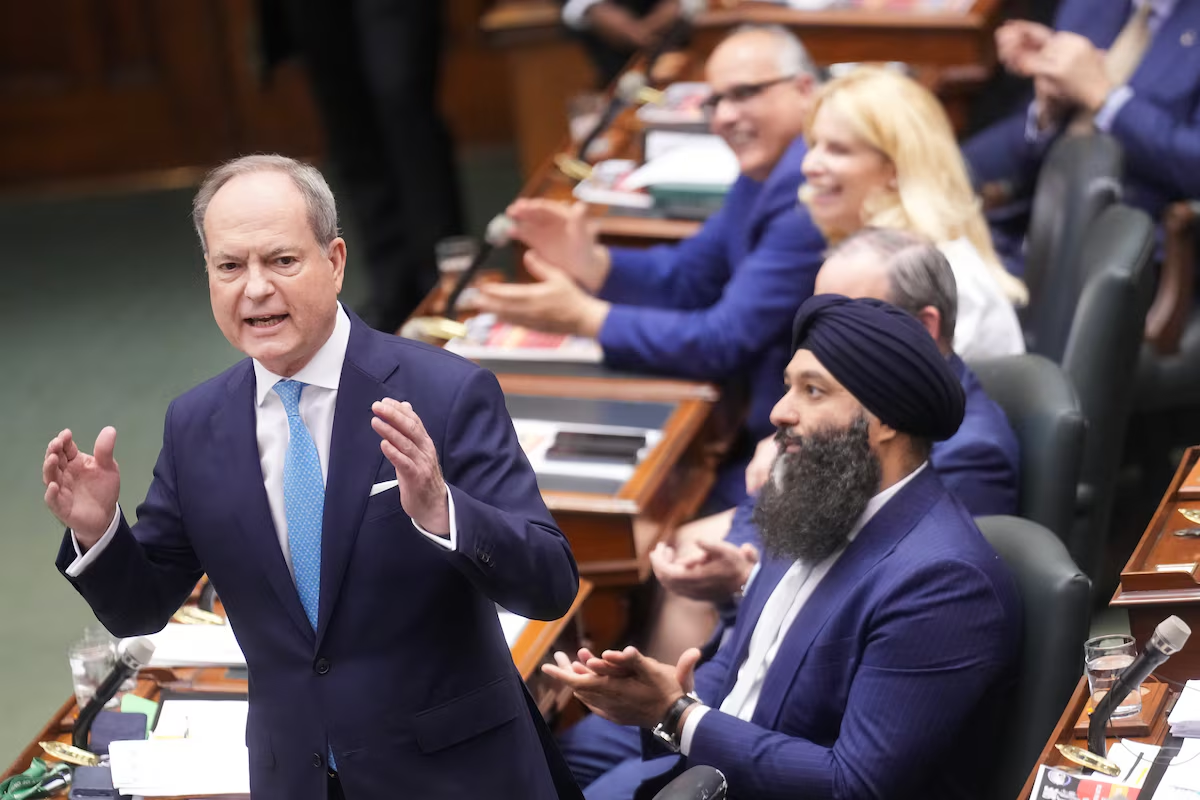
Ontario Finance Minister Peter Bethlenfalvy warns that deficits are necessary as the province faces U.S. tariffs targeting its steel, auto and manufacturing sectors.Nathan Denette/The Canadian Press
Ontario’s Finance Minister says he will release a fall economic update next Thursday, while warning that his province will continue to run deficits as it reels from a slower economy strained by U.S. tariffs and rising energy prices largely caused by the Iran war.
In a speech on Thursday morning before the Canadian Club in Toronto, Peter Bethlenfalvy also said his government is planning a new multibillion-dollar tax break for businesses.
The move is expected to match Ottawa’s proposed “productivity mega deduction,” which is meant to spur investment in new machinery and factories.
In his remarks, Mr. Bethlenfalvy said budget deficits were needed as Ontario faces tariffs that have hit its steel, auto and manufacturing industries hard.
He pointed to the $30-billion that the province has pledged to support businesses and workers affected by the trade war – although much of that money has yet to be spent. And he mentioned Wednesday’s announcement, with Prime Minister Mark Carney, of nearly $9-billion in joint federal-provincial support for the steel, auto and mining sectors.
But he also argued that Ontario has the fiscal room to manage the strain.
“Ontario has weathered the impact of tariffs better than economists had thought, but the slower economy has impacted our deficit, which was $13-billion last year and is predicted to be higher this year,” Mr. Bethlenfalvy said. “And while deficits are not desirable in the long term, they are necessary in the current environment.”
Mr. Bethlenfalvy also said the province is “planning to lower the cost of capital investments for Ontario businesses by providing over $8-billion in additional relief.”
He said this new move, combined with the accelerated write-offs Ontario announced earlier this year for businesses that invest in things such as new equipment, will amount to more than $12-billion in tax relief over the next five years.
At the federal level, the Prime Minister has announced a proposed “productivity mega deduction” that would allow companies to immediately write off the cost of a wide range of new capital investments.
Ottawa kicks off process to give $1.75-billion boost to venture capital sector
Federal Finance Minister François-Philippe Champagne said this week that he would unveil his government’s budget on Nov. 5.
Ontario ran a $13-billion deficit in 2025-26 and has previously projected a $13.8-billion deficit for the current year, 2026-27, as a weakening economy slows the growth of the revenues Ontario takes in from corporate and income taxes.
Mr. Bethlenfalvy did not provide an updated figure on Thursday for the current year’s deficit. His government’s plan to balance its books has already been pushed back several times, with its most-recent projections showing a small surplus by 2028-29.
Provincial governments across the country projected large deficits earlier this year in the face of economic uncertainty. B.C. projected a record $13.3-billion budget hole and Quebec warned that it would be $8.6-billion in the red.
But Mr. Bethlenfalvy argues that his province, even with its large net debt – last projected at $485-billion – is in better fiscal shape than its peers.
He said Ontario benefits from borrowing costs that are low compared with previous decades and, he said, the lowest in Canada, thanks in part to the province’s practice of issuing long-term 30-year bonds and borrowing in advance.
Business leaders strongly support tax reform ahead of 2026 budget, KPMG survey finds
He also said that credit-rating agencies have rewarded the province’s handling of its books with two upgrades. He pointed to Ontario’s net-debt-to-GDP ratio (last projected at 37.7 per cent) and the percentage of its revenue that it pays in interest costs (6.7 per cent, but projected to rise, in the 2026 budget), saying they were at their lowest levels in more than a decade.
In his remarks, he ruled out balancing the books by either raising taxes or cutting health care. However, he vowed that the province “will continue to root out wasteful spending, review agencies and ministries for efficiencies, curtail our headcounts and take actions to save taxpayer dollars and enhance value for money.”
He acknowledged that the pandemic and the tariffs had “pushed out the time frame to balance” but said “it remains a goal of our government.”
Echoing comments from both Mr. Carney and Mr. Ford, Mr. Bethlenfalvy started off his speech on Thursday by warning that the world had changed: “We are living in a post-free-trade, protectionist mercantilist world.”