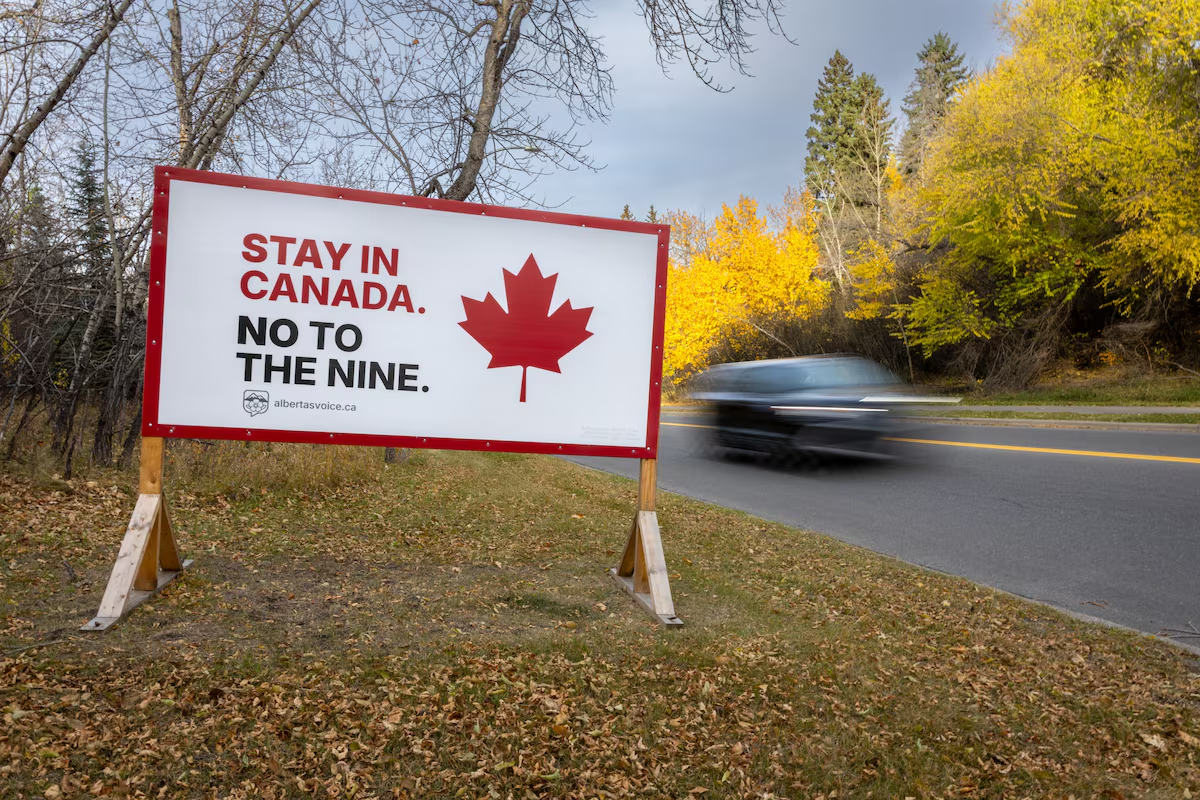

Open this photo in gallery:
A pro-federalist sign urging Albertans to remain in Canada, on a roadside in Calgary on Monday.Amir Salehi/The Globe and Mail
Alberta Premier Danielle Smith won’t be armed with a strong mandate to challenge the federal government for more powers after her proposals on immigration and constitutional issues were either defeated or received slim majorities in Monday’s referendum.
The results also underline a stark divide between rural and urban voters on her proposals, which could pose political risks for the Premier as she campaigns toward next year’s provincial election.
“Certain areas of Calgary and Edmonton supported some [proposals], and certain areas did not,” Ms. Smith told reporters on Wednesday.
“So, I take that as, ‘Let’s proceed with caution.’ ”
Elections Alberta continued to hand-count ballots on Thursday, surpassing its 48-hour deadline to tally the votes.
Tony Keller: Danielle Smith’s referendum was a lemon. Alberta voters made lemonade
The count nevertheless continued as the agency worked toward the finish line of the largest electoral event in Alberta history, with 20 million ballots counted and 99 per cent of voting areas accounted for by Thursday afternoon. There are no consequences written into Alberta law for failing to meet the deadline.
Unofficial results showed that the four referendum questions centred around Alberta taking greater control over immigration were set to earn narrow majorities by Thursday night, ranging between 52 and 55-per-cent support. Meanwhile, four proposals focused on pushing for constitutional amendments, such as judicial appointments and abolishing the federal Senate, sat below 50 per cent.
Finally, one proposal, to make proof-of-citizenship mandatory at provincial election polls, was receiving 58-per-cent support – the top performer among the nine.
The results leave Ms. Smith without the mandate she explicitly sought from Albertans in the run-up to the referendum, spending $4-million in public money encouraging them to vote Yes on the nine questions.
Over the past month, Ms. Smith has pointed to the proposals as the best way to extract concessions from Ottawa, contrasting separatists who argued that a future secession vote would provide ultimate leverage.
Andrew Coyne: Alberta Premier Danielle Smith is targeting immigration. But what do the numbers say?
On Monday night, Albertans rejected the prospect of separation, with roughly 75 per cent of voters preferring to remain in Canada rather than hold a second, binding secession vote.
Ms. Smith, claiming victory on the immigration proposals, said in the referendum’s immediate aftermath that she would continue her push to give Alberta more autonomy and defend the province’s jurisdiction.
But she hedged the next day when asked how she would proceed on immigration.
Two of those questions propose charging health and education premiums to some non-permanent residents and limiting their access to social services.
“I take that as a general indication that [voters] want us to work with the federal government on getting this balance right,” Ms. Smith said. Prime Minister Mark Carney showed openness this week to working with provinces on the issue.
Geography was a significant factor in voters’ choice in the referendum. On the separation question, 41 per cent of rural voters endorsed holding a second, binding vote on leaving Canada, whereas Edmonton and Calgary polled 15 and 18 per cent, respectively.
A similar dynamic played out on the other nine questions.
In Edmonton, a majority of voters rejected all nine proposals. In Calgary, a majority of electors voted against the nine questions except for the citizenship proposal.
In midsize cities such as Red Deer, Lethbridge and Medicine Hat, a majority of voters endorsed seven of the nine questions as of Thursday evening. Two proposals – one on judicial appointments and the other on federal funding – were hovering around 49-per-cent support in midsize cities.
In rural Alberta, meanwhile, support for all nine questions surpassed 60-per-cent support.
The Alberta referendum by the numbers
Varying appetites for the government’s proposals will be a consideration for Ms. Smith’s United Conservative Party heading into next October’s general election, which she described on Wednesday as “the only fight that matters.”
Much of that fight will be waged in Calgary. In the 2023 provincial election, the NDP swept Edmonton while Calgary almost evenly split support for the New Democrats and UCP. The UCP won the rest of the province, with the exception of two seats.
Matt Solberg, a political adviser who sat on Ms. Smith’s transition team when she became Premier in 2022, said many of the Calgary ridings up for grabs in the next provincial election rejected the immigration proposals.
“There is a deep level of electoral math that you can do on these to say, ‘well, this message may resonate in rural Alberta, but it’s not going to resonate in these other ridings,’ ” said Mr. Solberg, partner at New West Public Affairs.
Alberta migrant groups express alarm over referendum results on immigration reform
Mr. Solberg suggested that the most logical avenue for Ms. Smith will be to strike a deal on immigration with Mr. Carney.
Saskatchewan and Newfoundland joined Alberta’s push for more immigration powers this week. Quebec and Ottawa have shared a unique agreement since 1991, allowing the province to exclusively control the selection of incoming economic migrants, which Ms. Smith has frequently pointed to as her desired immigration model.
Melissa Caouette, principal at MC Consulting and former special assistant to Alberta premier Jim Prentice, suggested working with Ottawa toward a similar agreement and potentially punting the other immigration questions.
She added that an agreement with Ottawa may address some of the concerns sitting with voters who endorsed the slate of immigration proposals.