
Open this photo in gallery:
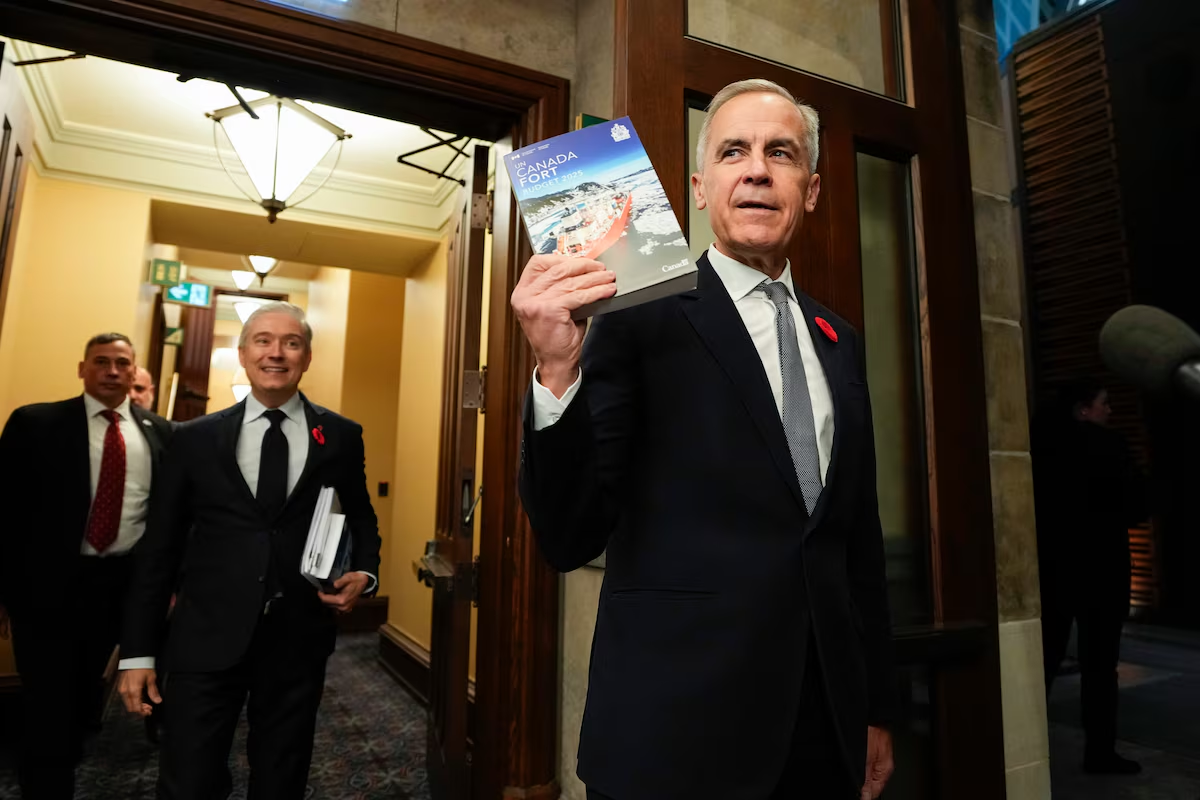
Prime Minister Mark Carney holds up a copy of the federal budget on Parliament Hill in November, 2025. It’s unclear how the government plans to meet the spending commitments outlined in the budget.Justin Tang/The Canadian Press
The biggest source of uncertainty for personal finances in Canada is a certain warmongering U.S. president.
Next comes the state of federal government finances. Under Prime Minister Mark Carney, we have a stated objective of building the economy through strategic investments and substantially increasing defence spending. We also have a persistent yearly gap between government spending and revenues, a.k.a. the deficit.
While the government has made some spending cuts, it’s unclear right now how it will afford its spending agenda without increasing the deficit to worrying levels. Some of the more obvious options include higher taxes, cuts to Old Age Security and spending reductions that download costs to provinces, municipalities and individuals.
Last fall, Mr. Carney told Canadians it would take some sacrifices to address the challenges facing the country. Now, we need details. It’s getting harder to plan for the future without them.
Opinion: What will you sacrifice for Carney and country?
Let’s acknowledge the difficulty of laying out a grand plan for government finances right now. U.S. President Donald Trump’s Iran war pushed up energy prices from year-ago levels, and inflation has kicked higher as a result. Mr. Trump’s trade war is being fought in negotiations over the U.S.–Mexico-Canada Agreement, and it weighs heavy on the economy.
The next federal budget isn’t expected until next fall, though. There’s enough time until then to combine economic policy with at least an outline of changes to taxation and spending on programs like OAS.
Here’s a quick summary of what the government is up against. The federal deficit was $55.3-billion for the period from April, 2025, to March, 2026, compared with $43.2-billion over the same time a year earlier. Meantime, the government has committed to increasing defence spending to 3.5 per cent of economic output in the years ahead from the current 2-per-cent level.
Blowing out the deficit to afford a defence build-up could alarm foreign investors, who would require higher interest rates to continue buying federal government bonds. These interest rate hikes would increase the financial burden on federal finances, and they could trickle down to your household in the form of higher borrowing costs for mortgages and lines of credit.
To balance its budget, or at least contain the deficit, the government likely needs to use a combination of spending cuts and revenue increases. Further to the sacrifice theme, raising the GST a percentage point or two from the current 5-per-cent level is an option. Obviously, such a move requires a more generous sales tax rebate for lower-income people.
A higher GST might discourage consumption at some level, but the affluent have shown a willingness to spend in uncertain times. This is today’s K-shaped economy in action – the financially comfortable, who are seeing their circumstances improve, are the upper arm of the K, while financially struggling households are the lower arm.
Preparing for a higher GST by spending now on high-cost items seems pointless – who knows if the government has the guts to try this obvious revenue source? But it’s not too soon to consider the result of effort to pare the massive cost of OAS.
Modernizing Old Age Security would free billions for Ottawa to address affordability
An increase in the start age for OAS to 67 from 65 was announced and cancelled by previous governments. What hasn’t been tried is a more aggressive clawback of OAS benefits for high-income seniors.
Perhaps the clawback could be calibrated to household income rather than individual. Or, the clawback could be introduced at lower levels than the $93,454 for payments made between July of this year through next June. It seems a no-brainer to lower the income level where OAS is fully clawed back – it sits at $152,062 for retirees aged 65 to 74, and $157,923 for those 75 and up.
Reforming OAS should be done as soon as possible, if that’s a direction the government wants to go. Baby boomers continue to retire in large numbers, and they need hard info on OAS benefits to properly plan their future income flow.
Tax-wise, the last Liberal government tried to increase taxes owing on capital gains above $250,000, but couldn’t find a way to fight the “persecution of the rich” narrative that resulted. The Carney government cancelled this tax hike, but it has to be considering other ways for the wealthiest to contribute more to government tax revenue.
Regardless of where the government comes down on taxes, it would be nice to get a definitive word about future plans.
Rob Carrick is a personal finance expert and former Globe and Mail staff columnist.