
Good morning. With Alberta’s separatist question settled for now, attention turns to what comes next for the province and its relationship with Ottawa. More on that below, along with the reopening of plasma donation centres and a new report showing record food bank use among Canadians.
Open this photo in gallery:
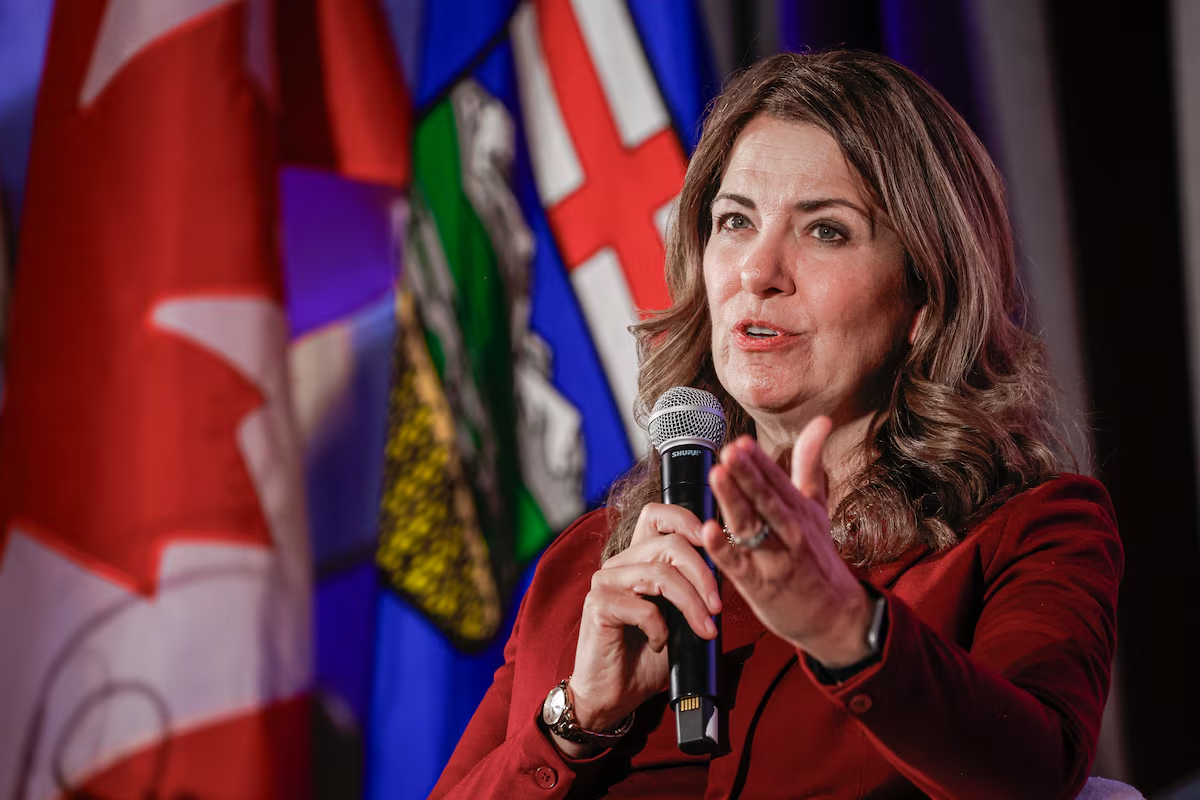
Alberta Premier Danielle Smith speaks at the Canada Strong and Free conference in Calgary on Friday.Jeff McIntosh/The Canadian Press
TOP STORIES
Alberta looks ahead
Albertans have overwhelmingly rejected the prospect of separation, but the province’s relationship with Ottawa remains unsettled as Premier Danielle Smith pushes ahead with plans to secure greater autonomy.
Roughly 75 per cent of voters rejected holding a future referendum on separation in Monday’s vote, dealing a major blow to the province’s separatist movement.
What comes next: With the separation question sidelined for now, Smith is turning her attention to other referendum proposals, including measures aimed at giving Albertans greater control over immigration and constitutional matters.
The political fallout: Separatist leaders are already looking toward the next provincial election, with plans to secure positions within the governing United Conservative Party. Prime Minister Mark Carney, meanwhile, welcomed the result as an opportunity for Canadians to move forward together.
Open this photo in gallery:
A Grifols plasma donation site in Whitby, Ont., one of sixteen locations across Canada. The company is reopening one site in Edmonton and one in Winnipeg, in co-ordination with Health Canada.Shay Conroy/The Globe and Mail
Grifols to reopen plasma donation centres
Grifols will begin reopening two Canadian plasma centres Tuesday, two months after suspending collections at all 117 locations following critical Health Canada inspections and public outcry over the deaths of two donors.
The reopening: The company will resume limited appointments at centres in Edmonton and Winnipeg, saying it has strengthened staff training, supervision and operating procedures.
The scrutiny: Health Canada says it has verified corrective measures at the centres, but the licence for another Winnipeg location remains suspended over safety concerns. A 22-year-old student died after donating plasma at that facility last year.
Open this photo in gallery:
Finance Minister François-Philippe Champagne announced the budget date in the House of Commons on Tuesday.Justin Tang/The Canadian Press
Federal budget set for Nov. 5
Finance Minister François-Philippe Champagne says the Liberal government will table its 2026 budget on Nov. 5, two days after the U.S. midterm elections.
Fiscal picture: The announcement comes as the Parliamentary Budget Officer warns that new spending commitments have already exhausted Ottawa’s additional fiscal room.
Timing: It will be the second budget under the Prime Minister’s new system of tabling budgets in the fall rather than the spring. The government says the change gives provinces, municipalities and federal departments more time to plan for the year ahead.
Food bank use more than doubles since 2019
Food bank visits in Canada reached 2.35 million a month in 2026, up 9 per cent from last year and 117 per cent since 2019, according to a new Food Banks Canada report. Employed Canadians are making up a growing share of those seeking emergency food assistance.
Affordability crisis: Grocery prices are about 30 per cent higher than in 2019, while rising housing and transportation costs are leaving households with less money for food.
What’s next: Slowing food inflation may offer temporary relief, but soaring diesel prices threaten to drive up the cost of imported produce this winter.
The Take
The referendum wasn’t an organic response to the demands of an aroused populace, awakening to their sovereign destiny. It took the determined effort of a handful of activists, in collusion with the Premier’s office, to gin it up. Neither did it result in any great surge in secessionist fervour: Support for separation is if anything rather lower now than it has been for much of the last few decades.
Alberta’s failed referendum has weakened Premier Danielle Smith and could spark a battle for control of her United Conservative Party, Andrew Coyne writes.
The Shot
Open this photo in gallery:
Friendly Temple Baptist Church members during service weeks before midterm elections in St. Louis, Mo.Kate Munsch/The Globe and Mail
A woman raises here hands at a gathering in Missouri, where a battle over Republican efforts to redraw congressional boundaries has become a defining issue ahead of the U.S. midterm elections. The fight has exposed deep political and racial divisions in the state, as voters prepare to weigh in on the disputed map.
The Wrap
What else we’re following
At home: Thirty-three Canadian Armed Forces members remain hospitalized after a fire at an Alberta military base killed four people and injured 39.
Abroad: France will deploy troops alongside police ahead of new protests planned for Saturday, after widespread rioting and looting exposed failures in the government’s response.
U.S. tensions: U.S. Ambassador Pete Hoekstra says the idea of partnering with Washington is “under attack” in Canada, warning that the U.S. will seek other partners if Ottawa pulls back on co-operation in trade, space and defence.
Going viral: CBC’s This Hour Has 22 Minutes racked up millions of views after quickly rewriting a sketch to include the firing of Trump’s press secretary Katie Zacharia.
Formula 1: Plans to bring F1 racing back to Africa for the first time since 1993 are drawing controversy over a proposed race in Rwanda.
Cirque’s comeback: Cirque du Soleil has unveiled its first big-top show since emerging from bankruptcy protection in 2020. The surrealist-inspired Finding Utopia opens in Montreal next April.