
Open this photo in gallery:
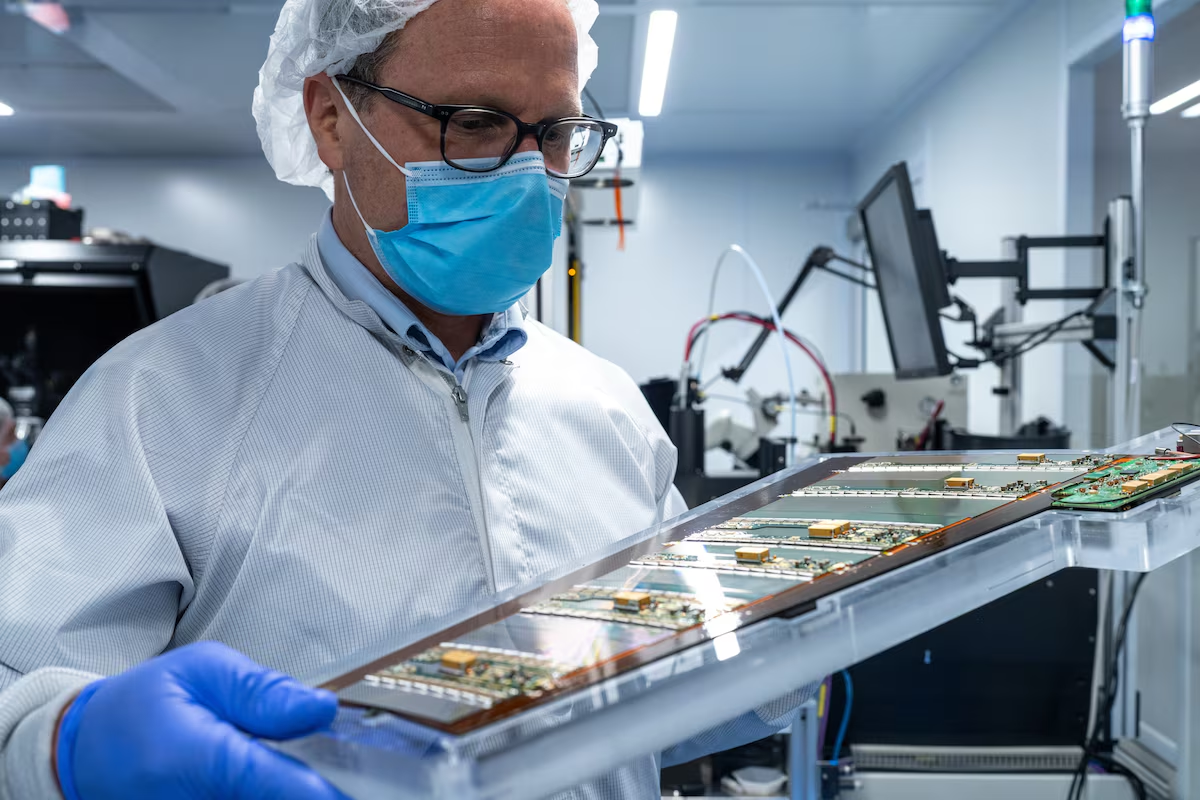
Bernd Stelzer, a Simon Fraser University physics professor, holds up a prototype of a component that will be used for the next phase of CERN’s Large Hadron Collider.Katherine KY Cheng/The Globe and Mail
The shiny black segments made of crystalline silicon look fragile and pristine. The researchers leaning over them are gloved and masked to prevent breathing on the delicate equipment.
Yet, once the pieces are assembled into completed sections called “petals” they are destined for much harsher treatment – blasted by billions of the most energetic particles that human science can muster.
Welcome to the next chapter in the quest to understand nature at the most basic level. It begins on Canada’s West Coast, but it leads, ultimately, to the world’s biggest physics experiment, the Large Hadron Collider – a machine that recreates conditions microseconds after the Big Bang – at the CERN laboratory near Geneva, Switzerland.
It’s there that B.C.-based researchers hope the ultra-sensitive equipment they are creating can reach into the unknown and possibly touch something never encountered before – a new kind of particle or an unexpected phenomenon – anything that points to a deeper understanding of reality amid the vast range of theoretical possibilities.
“The theory landscape is wide open in terms of breakthrough discoveries, but we need the data to really shed light on this,” said Bernd Stelzer, a professor at Simon Fraser University and a project leader on the effort.
Open this photo in gallery:
A close-up of a needle touching a petal, seen through a microscopic camera lens. At the CERN laboratory, the petals will be blasted with billions of energetic particles.Katherine KY Cheng/The Globe and Mail
Dr. Stelzer is one of about 200 researchers at 10 institutions across Canada who are working toward the next iteration of the LHC. Although they’re spread across the country, the focal point of much of the work is in the Vancouver area at SFU, and at the nearby TRIUMF particle accelerator centre at the University of British Columbia.
And while the hardware Canada is building won’t be in service for nearly four years, the sense of urgency around the project has ramped up considerably as the European collider shuts down to enable the installation of new parts.
“The clock is ticking,” said Luise Poley, a TRIUMF scientist and project manager for Canada’s share of a device called the ATLAS inner tracker. She has spent more than 14 years working toward the upgrades that are about to be put in play. “Now things need to be installed, and now we have a deadline.”
It’s been about that long since scientists made history at the LHC, announcing the Nobel Prize-winning discovery of the Higgs boson, a subatomic particle responsible for endowing other particles with mass. The find completed an elegant theoretical framework known as the Standard Model, which describes the properties of all the forms of matter that science has identified thus far.
Peter Higgs, who proposed existence of Higgs boson particle, has died at 94, university says
But the Higgs discovery left key questions unanswered. Many scientists believe those questions will be addressed by a more fundamental theory – one that can also explain the phenomenon of dark matter, an unidentified substance that accounts for most of the mass in the universe, but that is not found in the Standard Model.
Open this photo in gallery:
SFU research engineer Scott Beaupré, 34, monitors the construction of a petal. The researchers wear protective gear to prevent contaminating the equipment.Katherine KY Cheng/The Globe and Mail
Since it began operating in 2010, the LHC has been the premier instrument for exploring such mysteries.
It consists of two opposing beams of protons racing around a magnetic ring 27 kilometres in circumference. The beams cross at specific points where protons can collide, liberating vast amounts of energy that can briefly generate new particles, including the Higgs.
Twice before, the LHC has shut down for long intervals in order for researchers to repair and refurbish the accelerator’s technology and increase the energy of its particle collisions. So far those changes have improved the LHC’s ability to detect the Higgs particle, but nothing more.
On Monday, the LHC was shut down again, this time for its longest hiatus to date – a planned 47 months. During this period the accelerator is set to undergo a major overhaul, which will include work on two of its primary detectors, called ATLAS and CMS. They operate independently in order to confirm each other’s results.
At this point, there is not much more energy that can be got out of the giant accelerator. Instead, scientists have devised a way to greatly increase the total number of collisions that take place every second inside the two detectors. This means they will have more opportunities to spot something subtle or rare in the behaviour of the Higgs particle that can serve as a clue to the next big discovery.
“Our goal is to increase the collision rate by a factor of 10,” said Markus Zerlauth, overall project leader for the upgrade, who has worked at CERN for more than 20 years.
Currently, the LHC generates about 2.4 billion particle collisions per second. After operating for more than a decade, not including previous shutdowns, that has yielded a total of about 13 million detections of the Higgs boson. While this is more than enough to say with certainty that the particle exists, much more data is needed to measure the properties of the Higgs with precision.
Even so, Dr. Zerlauth said, feelings are always mixed when the accelerator is turned off.
“Every transition is always a bit exciting,” he said. “Then, of course, there is also a bit of wariness, because we see a huge task ahead of us.”
The operation can be compared to stopping a patient’s heart in the middle of transplant surgery. Those involved in the overhaul know they must complete their work in the shortest time possible so that LHC can be restored on schedule.
Open this photo in gallery:
Canada’s contribution to the LHC project includes making part of the ATLAS inner tracker, one of its two primary detectors.Katherine KY Cheng/The Globe and Mail
Canadian researchers are are deeply involved in several aspects of the project. This includes work on a set of new devices called “crab cavities,” to be installed along the beam at either end ATLAS and CMS.
To achieve the higher collision rate, LHC will fire more protons and collide them in a narrower beam – roughly the width of a human hair. The role of the crab cavities is to employ powerful magnetic fields to slightly rotate the beams in order to increase the chance of collisions still further.
Genomics pioneer Craig Venter’s DNA used in Canadian study
But the most visible aspects of Canada’s contribution includes making part of the inner tracker for ATLAS.
When completed, the tracker will wrap around the colliding beams deep in the heart of the giant detector. It consists of multiple rows of petals – structures that are about the size and shape of a ceiling fan blade.
As particles generated in colliding beams fly outward, they will pass through multiple petals. The points of penetration can then be linked to reconstruct a particle’s unique trajectory. From this, scientists can then deduce the type of particle and the amount of energy it’s carrying.
Vancouver was the first site to begin petal production, which has paved the way for the entire inner tracker. The work is painstaking and involves both manual and robotically aided assembly.
Canada has committed to producing about 1,500 of the petals, roughly 20 per cent of the total that the tracker will need. The work is centred in the Vancouver area, but also involves industrial partners in Toronto and Ottawa.
Canadian researchers have also been working on computer algorithms that can make sense of the many billions of particles the tracker will detect once LHC starts up again in mid-2030.
To date, five completed petals, plus some additional prototypes have been shipped from Vancouver to Germany, where the tracker will be assembled before its installation at LHC.
Before they leave Canada, the completed petals are tested at TRIUMF. Last week, Madison Levagood, a UBC undergraduate student in physics and astronomy, was taking electronic readouts from a petal that was placed inside a freezer to simulate its operating conditions.
Ms. Levagood first joined the effort three years ago and said she fell in love with the job and the chance to contribute to the global quest to advance particle physics. This summer she heads to CERN for related work in connection with the ATLAS detector.
Now that petals are finally being built, “it’s incredibly exciting,” she said. “I get to go to work everyday knowing that my day-to-day tasks help move this cutting-edge experiment forward just that little bit more.”