
Open this photo in gallery:
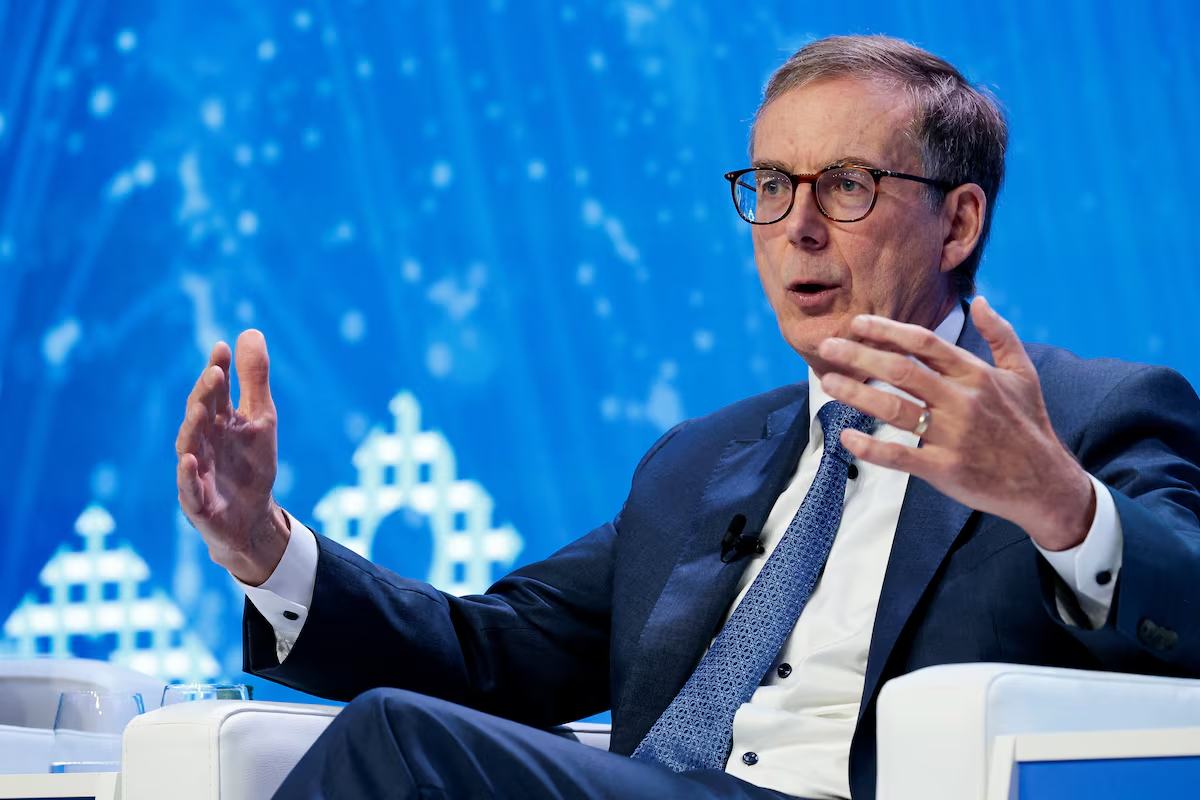
Bank of Canada Governor Tiff Macklem says the key takeaway from the IMF meeting was that the global economy remains resilient in the face of multiple shocks, but that should not be taken for granted.Patipat Janthong/Reuters
Bank of Canada Governor Tiff Macklem expects the central bank to revise its inflation forecast higher at its upcoming rate announcement as the conflict in the Middle East shows no sign of ending and global oil prices remain stubbornly high.
Speaking to reporters on Saturday morning from the International Monetary Fund meeting in Bangkok, Thailand, Mr. Macklem noted that oil prices have been much higher than the bank expected when it published its last quarterly forecast in July. At that time, the bank expected the price of a barrel of Brent crude to average around US$75 in the third quarter. Today, Brent is trading at around US$110 while West Texas Intermediate is US$101.
“If oil prices stay around $100, we expect inflation to gradually drift up from where it is today: 3 per cent,” Mr. Macklem said.
Uncertainty from U.S. trade policy could halve fourth-quarter growth, Macklem says
“We can’t really do anything to affect inflation today or over the next couple of months. We need to look out six months, a year from now: Where do we think inflation is going to be? And look, the question we’re going to be asking ourselves is: Is inflation likely to come back down towards our [2 per cent] target on its own, or are we going to have to raise interest rates to influence the path, nudge the path for inflation back towards the target,” he said.
Statistics Canada will publish September inflation data on Monday. The central bank will also publish its quarterly business and consumer surveys that day. These are the last two big pieces of data ahead of the bank’s next interest rate announcement on Oct. 28.
Fresh inflation, BoC survey data drop next week ahead of rate decision
Mr. Macklem and his team have held the benchmark interest rate steady at 2.25 per cent for the past seven rate decisions, weighing upside risks to inflation against downside economic growth risks stemming from the trade war with the United States. At the September rate announcement, however, the governor said that oil-driven inflation risks had become the bank’s main concern.
Other central banks, including the U.S. Federal Reserve and the European Central Bank, have begun raising interest rates in response to the energy price shock.
“There’s no resolution in sight for the conflict in the Middle East. With the Houthis now entering the conflict, it has escalated. You’ve seen attacks on civilians in Saudi,” Mr. Macklem said on Saturday, referring to missile strikes against Saudi Arabia by the rebel group in Yemen.
Refined petroleum products, such as diesel and gasoline, have become significantly more expensive because of both the closure of the Strait of Hormuz to tanker traffic and damage to refineries in Russia and Ukraine.
Mr. Macklem also warned that strategic oil reserves around the world are being run down.
“You can only release strategic oil reserves so many times; that has helped contain this energy price shock,” he said. “China, which had large reserves, has reduced their global demand. I mean, they can only run down those reserves so much. At some point, they’re going to have to come back into the market.”
Analysis: The Bank of Canada hasn’t moved on rates, so why has your fixed mortgage rate jumped?
So far, the oil price shock, which pushed headline inflation in Canada to 3 per cent in August, has had a relatively limited impact on other consumer prices in Canada. But the longer energy prices remain high, the bigger the risk that inflation will become more generalized.
As of Friday, financial markets saw a roughly 35-per-cent chance the bank would raise its benchmark rate by a quarter-point on Oct. 28, according to Bloomberg data. That rises to 95 per cent for the following rate decision on Dec. 9.
Mr. Macklem said the key takeaway from the IMF meeting was that the global economy remains resilient in the face of multiple shocks, but that this resilience should not be taken for granted.
Energy prices remain volatile; rising interest rates are putting pressure on countries with weak fiscal positions; and the sustainability of the artificial intelligence boom remains unclear, with potential implications for economic growth as well as debt and equity markets, he said.
“What you’re seeing is that a number of the risks we’ve been talking about for some time, they’re getting a bit more intertwined. We talked about high levels of sovereign debt. We’ve talked about risks to the AI boom. Those are starting to interact more,” he said.