
Open this photo in gallery:
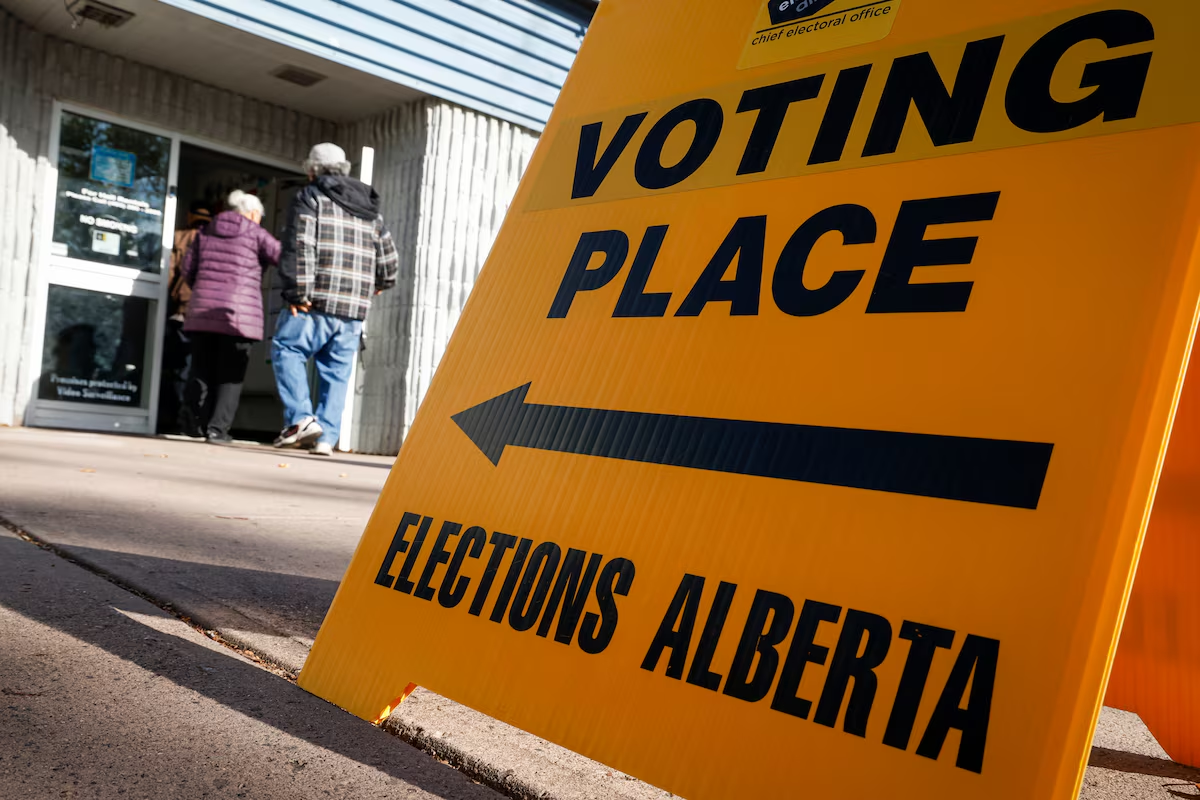
Voters arrive at an advance polling station in Calgary on Tuesday.Jeff McIntosh/The Canadian Press
Alberta’s Oct. 19 referendum could be the province’s most consequential vote yet, as Albertans decide whether to remain in Canada or move toward a binding referendum on independence, among a number of questions on the ballot.
On Oct. 15, Alberta-based reporters Carrie Tait and Matthew Scace and opinion editor Tyler Dawson answered reader questions on the referendum, how both sides have been campaigning and what the result could mean for the province – and Canada as a whole.
How some Alberta separatists are courting U.S. support for independence
In the lead-up to the pivotal vote, The Globe has covered how some Alberta separatists have received tactical assistance from U.S. political operatives and offered the province’s natural resources in exchange, the federalist side’s cash-strapped efforts to keep the province within Canada, and much more.
Readers asked about the impact of the other nine questions, what would happen if Alberta ever separated and the fight against foreign interference. Here are some highlights from the Q&A.
Looking ahead to the referendum
The question on separation aside, what impact will the other questions have if Albertans vote yes?
Matthew Scace: Premier Smith has put the full weight of her government behind those nine questions, including a massive $4-million ad spend aimed at passing them. The campaigns to reject those questions are trying to frame a “No” vote as a referendum on the premier herself. And that may well be the case. She has tied herself to those questions, and a majority rejection of them could be perceived as a rejection of her. Don’t forget: Albertans are voting in a provincial election next October (at the latest).
And if Albertans endorse the nine? Smith says she wouldn’t have legislation ready for at least a year. It would stand to reason, then, that the details of that legislation will be a key plank of her 2027 re-election campaign.
What about Alberta’s nine other referendum questions?
What is your opinion on the referendum affecting foreign investments in Canada and investments in Alberta?
Tyler Dawson: There has been a lot of talk about the referendum leading to instability that leads to a decline in foreign investment. The business community has raised alarms about this. However, is it a certainty that this ‘has’ happened – as opposed to ‘could’ happen if Alberta separates? I think that’s fundamentally less clear.
Open this photo in gallery:
People gather in support of Alberta becoming the 51st U.S. state during a rally at the Legislature in Edmonton, on May 3.JASON FRANSON/The Canadian Press
How did the story on the separatists’ repeated meetings and promises to the GOP come about?
Carrie Tait: We first heard about separatists meeting with officials in Washington because, well, the separatists boasted about it publicly. Other news organizations confirmed the U.S. State Dept. met with secessionists, but details were scarce.
So, we wanted to learn more. Who did the separatists meet? What did they discuss? When? Where? And so we just…asked around.
Independence advocate Dennis Modry provided details on the record. Jeff Rath, another separatist who was in the meetings, dismissed Modry’s account, which we noted in the story.
We still don’t know who represented the U.S. in the meetings. If you do, please reach out!
What is the strategy to track foreign interference during the referendum to make the public aware of such and to tackle such misinformation?
Scace: Within Alberta, Elections Alberta has been trying its darndest to track this and address misinformation on social media. But as we reported in January, experts are generally concerned about EA’s ability to manage this issue. Beyond foreign interference, EA has been sounding the alarm for more than a year about underfunding and chronic burnout/staff turnover.
Researchers find uptick in U.S. influence campaigns targeting Alberta referendum as vote looms
Why is voter turnout expected to be so high? Are you anticipating long lines at polling stations on Monday?
Dawson: Elections Alberta has forecast a turnout of 80-85%, so it’s projected to be huge, compared to past general elections or past referendum campaigns. I think part of this is probably just a projection based on how many advance ballots were requested: We got X, therefore we can forecast actual turnout to be Y. But I also suspect that these are the sorts of questions – not just the secession ones but the ones about immigration – that really motivate people on both sides, so they’re more likely to come out.
Scace: My grandparents in Red Deer waited in line for 90 minutes yesterday. One of my colleagues told me it took him 10 minutes to vote. It’s anyone’s guess. The general expectation has been that it’ll be busy – partly due to the fact that voters have to fill out 10 separate ballots on questions they may be processing in real time.
Open this photo in gallery:
Alberta referendum mail-in special ballots are seen in Calgary in September.Jeff McIntosh/The Canadian Press
The wording of the Alberta referendum questions is highly complex, super long and, honestly, confusing. Why do you think they were created/worded this way?
Scace: I’ve heard this criticism from readers and friends for months now. Opponents of the premier’s questions have argued that these questions are designed to achieve her desired outcome.
Say nothing of their readability, these questions are challenging for voters partly because they lack context and crucial details about how the government will implement them. Polling also shows swaths of Albertans still aren’t familiar with these questions, so many voters could be relying on their intuition when they arrive at the polls.
Tait: The separation question is a doozy. It is not a yes/no question. Instead, voters will choose their own adventure, marking an X by either Option 1 or Option 2.
Here’s the wording:
Should Alberta remain a province of Canada, or should the Government of Alberta commence the legal process required under the Canadian Constitution to hold a binding provincial referendum on whether or not Alberta should separate from Canada?
Option 1: Alberta should remain a province of Canada.
Option 2: The Government of Alberta should commence the legal process required under the Canadian Constitution to hold a binding provincial referendum on whether or not Alberta should separate from Canada.
What will Smith do with referendum results?
Dawson: Likely, she will use a win on the immigration questions to try and change provincial policy. Whether that succeeds – it requires some negotiation with the federal government – is less clear. Ditto for the constitutional questions – Alberta cannot do those unilaterally, but she may push for negotiations with the rest of Canada. Likely she will fail, as Jason Kenney did with his referendum on equalization. On the secession question, if the separatists lose, she will likely try and put the issue to bed but will receive pushback from within her own party. If the separatists win, she’ll then have an awful lot of consultative work to do before holding a referendum at some point in the future.
What has Carney’s role been in all of this? What has been his involvement in Alberta since taking office last year?
Dawson: His role has primarily been on the policy front, I think it’s safe to say. There was the repeal or modification of several pieces of legislation that the Alberta government viewed as problematic. Much of this was part of an accord signed between the PM and Premier Danielle Smith, which also included the eventual construction of a new West Coast pipeline. But he has not involved himself in the day-to-day rollicking fight over Alberta’s future in the way that, for example, Naheed Nenshi or former premier Jason Kenney have. Probably at least part of the reason is because having a Liberal in that fight could backfire on federalist forces.
Open this photo in gallery:
Separatists gather at the Alberta Legislature in Edmonton on Aug. 29.Amanda May Erickson/The Canadian Press
Alberta’s separation issue
What are the legitimate complaints of those who want to separate?
Dawson: I think there are a couple legitimate grievances. The first would be with Trudeau-era legislation that seemed to hem in the oil industry, though many have since been withdrawn. The outcomes have not been as dire as people often suggest, but the better way to think of it is: Imagine how much more prosperous Alberta would have been without 10 years of federal interference.
The second would be with the equalization program. Even though it’s not a transfer payment – it’s paid for with federal taxes, not the Alberta government cutting a cheque – the structure of the system probably does suppress economies in other parts of the country.
First Nations have indicated they want to remain part of Canada having Treaties 6, 7 and 8 with the Crown prior to Alberta becoming part of Confederation. How could a separatist government become a party to the Treaty?
Tait: Those are big, big, double-big questions. It would require years of complex negotiations with multiple parties to sort out.
So, like so many questions around separation, throw these in the unknowable pile.
Is the threat of Alberta separating different than Quebec’s last referendum?
Dawson: I think it is different in many ways. Quebec, for example, has a distinct culture, a distinct language, a distinct history, at one point a largely distinct shared religion. Quebec, in other words, has more in common with other sovereigntist movements around the world, as opposed to Alberta, which does not have a distinct language or religious history. There is arguably a distinct culture here, but Alberta does not stand out as unique in a way that Quebec does.
It’s also very different in that Quebec has sovereigntist parties that run in – and win – elections. Alberta’s vote happened because of a citizen-initiated process as opposed to a separatist party winning elections.
Quebec sovereigntists see fundamental rift with Alberta separatists
However, both, in my view, are part of a similar problem, which is that regions in the country do at times feel left out of the national project, feel they don’t share enough in national prosperity, feel they don’t have enough say in the future and direction of the country.
In 1980, six days before the first Quebec referendum, Prime Minister Pierre Trudeau told an audience in Quebec that a “no” vote – that’s the stay in Canada side – wouldn’t be an affirmation that all was well in Canada. A renewed partnership would be needed. A similar situation, I think, exists now: Even a vote to remain in Canada is not an endorsement, necessarily, of the status quo.
If Alberta separates, will their residents retain Canadian citizenship, and will they be able to use the Canadian dollar as their official currency?
Dawson: The short answer is, I think, it depends. On the currency one: that would depend if an independent Alberta decided to adopt the Canadian dollar or create its own currency. Quebec has had the same debate because adopting a foreign currency means you don’t have control over monetary policy – that would still be set by the Bank of Canada.
On the citizenship question, the answer is really, at least as far as I understand it: it depends. It depends on what negotiations ensue and what the government of Canada decides.
This Q&A has been edited and condensed.