Ask the Albertans
Here’s how our Alberta-based reporters and editors answered your questions about the referendum as voting day draws near.
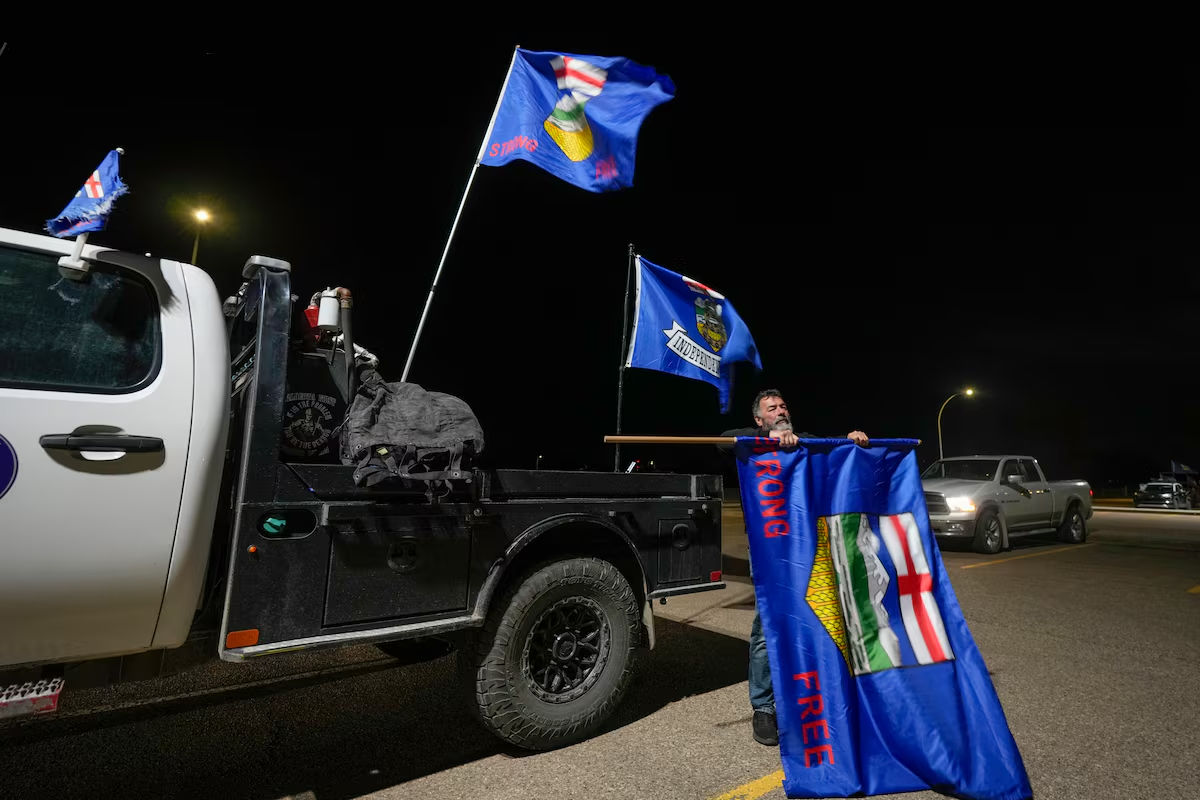
On a cool night in September, a flotilla of pickup trucks flying Alberta flags sits in the parking lot outside a community hall in Sylvan Lake. The community of 17,000 people is about halfway between Edmonton and Calgary, surrounded by rolling farmland and central Alberta’s oil and gas industry.
A crowd of about 120 people has gathered for a town hall organized by the Alberta Prosperity Project, a pro-sovereignty group.
Greg and Debbie Anderson, who run a cattle and grain farm in the area, step into the modest, brightly lit hall shortly before the speeches start. They haven’t yet chosen a side but are attending a pro-independence event for the first time. They’re contemplating a vote for Option 2, which would trigger an independence referendum. They’ve come tonight hoping to learn more. “I don’t know if we’re up for separation,” Ms. Anderson says. “Alberta needs a voice. That’s what we’re thinking.”

At community meetings like this one in Sylvan Lake, the Alberta Prosperity Project has been making its case for the Oct. 19 referendum and eventual separation from Canada.
Leah Hennel/The Globe and Mail
The Andersons and thousands of Albertans like them hold the future of the province in their hands.
On Oct. 19, citizens will be asked whether they want to maintain the status quo, or whether the province should hold another vote on separation.
At a time when a secessionist party has won power in Quebec and when the U.S. president has made clear his desire to subjugate Canada economically, the Alberta referendum is another destabilizing force pulling at the fabric of the country.
A landslide for the remain side could put the question to bed. But if Option 2 prevails, or if the vote is close, Canada could be in for years of constitutional negotiations, angst and economic uncertainty.
Open this photo in gallery:
The question related to secession is just one of 10 being posed.Jeff McIntosh/The Canadian Press
The idea of Alberta sovereignty has spread like a fever in some parts of the province in recent years.
In country halls, at hockey rinks and coffee shops, independence supporters have been galvanized by the progress of their grassroots uprising. An old idea has been given new energy by a group that coalesced around their opposition to COVID-19 pandemic restrictions. When contempt for Justin Trudeau burned white hot, and when the trucker convoy captured their anti-establishment anger, they made common cause with other groups looking to make change.
They see themselves as guardians of freedom and democracy, which lends their campaign an evangelical zeal. And their goal is the carving up of the country.
‘Send Ottawa a message’ is a slogan for what Alberta pollster Janet Brown calls the soft separatist: Someone who might vote Option 2, but doesn’t necessarily want Canada broken up.
Leah Hennel/The Globe and Mail
The many factions of the pro-independence side have dozens of talking points that often boil down to this: Alberta may be rich, but it ought to be richer. They argue the province will never reach its potential if it’s forced to share its wealth with the rest of Canada. And they rail at federal elections decided in Ontario and Quebec.
The remain side has powerful arguments of its own, such as a University of Calgary study that foresees a transition to independence costing up to $170-billion over five years, not to mention the long-term economic uncertainty and the fundamental divides it would create in families and communities.
Support for Option 2 has hovered around the 25 per cent mark in recent months, so the pro-independence side isn’t expected to approach the 50 per cent threshold for victory.
But referendum campaigns are unpredictable. Much depends on each side’s motivation to get to the polls.
The sovereignty movement, in these last days of the campaign, has been trying to win over sympathetic fence-sitters – the one-tenth or so of Albertans who aren’t necessarily in favour of secession, but aren’t satisfied by the status quo.
One argument they’ve pushed with some success is that a vote for Option 2 gives the province leverage for a future renegotiation of terms with Canada. It appeals to those who want to lodge a protest vote, but are uneasy about breaking up the country. The result could turn on how persuasive this idea proves.
In the Sylvan Lake hall, as the Andersons and the rest of the crowd take their seats, the organizers begin with a prayer. They acknowledge it’s unusual for a civic event, and offer an apology should anyone be offended.
The event’s main speaker is Mitch Sylvestre, one of the leading figures in the independence movement. The tall, square-jawed Mr. Sylvestre owns a sporting goods store in Bonnyville, Alta., and over the last several years his dogged campaigning, including delivering more than 300,000 signatures on a petition demanding Premier Danielle Smith hold a vote on independence, has pushed him to the political fore.
His political awakening, like that of many of his followers, occurred in the COVID-19 emergency. What pushed him to action was being forced to keep his store closed while larger, corporate competitors were allowed to open.
Open this photo in gallery:
Mitch Sylvestre told the Sylvan Lake crowd about how the pandemic galvanized him on the issue of separatism.Leah Hennel/The Globe and Mail
Mr. Sylvestre is not polished, but he holds the audience rapt. A gleam in his eye as he paces back and forth, Mr. Sylvestre calls this a “belly to belly” campaign. He urges those in the crowd to fight back against government overreach, the surveillance state and shadowy elites by taking advantage of their democratic opportunity.
They need 1.5 million votes to win, he says. Committed supporters number about 250,000, so he needs each of them to deliver five additional votes. That means persuading friends, family, neighbours and co-workers. “We have to do it ourselves. No one is coming to save you,” he says.
He recounts how he gained control of his local United Conservative Party constituency association a few years ago. He called his friends and relatives and made sure they showed up to vote. Then he did something similar to extend his influence in the broader party. When Jason Kenney resigned after a leadership review in 2022, he toasted victory. Persuade them one by one: That’s how power works, he tells them.

Jason Kenney, who Mr. Sylvestre fought to remove as United Conservative leader, supports the federalist side in this referendum. So does former NDP premier Rachel Notley, who made a show of unity with Mr. Kenney in Edmonton this week.
John Ulan/The Canadian Press
Support for independence has been remarkably stable over the past year, sitting between 20 and 30 per cent, according to Alberta pollster Janet Brown. In her view, there’s very limited room for growth.
But her polling also indicates about 11 per cent of the population could be categorized as “soft separatists.”
These are people who don’t necessarily want Alberta to leave Canada, but who think the current set-up isn’t working.
They’re open to voting for Option 2 but aren’t necessarily in favour of breaking up the country. Sovereignty to them could mean a strong and sovereign Alberta within a united Canada, as Premier Smith has put it.
If support for Option 2 is to grow, it’s likely with this category of voter. And if Option 2 ends up above 40 per cent, the vote share achieved by Quebec’s separatists in the 1980 referendum, the issue could simmer for years to come.
“What really differentiates the committed separatist from the soft separatist is the committed separatist doesn’t just want to separate; they want to create a right-wing utopia. The soft separatists are frustrated with Ottawa. They see some merit in the separatist argument. But they’re not quite as right-wing,” Ms. Brown says.
Open this photo in gallery:
Brenda Buckler was one of those present in Sylvan Lake when Mr. Sylvestre made his pitch for Alberta separatism.Leah Hennel/The Globe and Mail
Mr. Sylvestre spends about 10 minutes of his Sylvan Lake speech on the nuts and bolts of winning.
The rest of his time is devoted to topics he appears to have covered many times before: Alberta loses billions of the tax revenue it generates to other provinces through equalization, it has fewer House of Commons seats per capita than the Atlantic provinces, it’s underrepresented in the Senate and at the Supreme Court. Immigration is too high, he says, and Prime Minister Mark Carney’s proposed new pipeline is a bad deal.
But as the speech goes on, he veers into strange territory.
He plays a clip from a documentary that suggests there is a “centralization of control in the hands of unelected officials at supranational organizations.” It hints darkly at a new world order, digital ID, digital currency.
And “like it or not, chemtrails are real,” Mr. Sylvestre adds. The theory that the white vapour airplanes leave across the sky is full of toxic chemicals has been debunked. But what he’s describing is that Alberta has been cloud seeding – releasing silver iodide into storm clouds in an attempt to shrink the size of hailstones – for about 30 years.
Most of the audience nods along with him. A few chime in with a loud “yeah” or “yup.” While the presentation contains recognizable elements of Western alienation, it also reflects efforts to build a coalition with people outside the political mainstream.
Mr. Sylvestre found some receptive responses in Sylvan Lake, but not everyone was sold.
Leah Hennel/The Globe and Mail
It’s Jessica Westlund’s first time at a political event.
The 41-year-old stay-at-home mother and former health-care worker brought her young children to the meeting in Sylvan Lake. She says she arrived unsure what to think, but after hearing Mr. Sylvestre speak she feels persuaded to vote for Option 2.
“It’s really scary to have little ones, you know? What does their future look like with this government? The whole world is going crazy. It’s scary,” she says. “The surveillance state stuff is terrifying. Just freedoms in general [are threatened]. The way the government spends money is insane and has no accountability.”
But as for full separation from the country she has known, she’s not sure. “I don’t know where I go with that,” Ms. Westlund says. “You’re just trading control from one shady government to the next, right?”
The Andersons also emerged from the meeting largely persuaded to support Option 2, seeing an opportunity to seize on the province’s economic success and give it more leverage. Political revolts are often nourished by economic hardship, but the Andersons say they’ve rarely seen a better time for cattle farming. Beef prices are about 60 per cent higher than just five years ago.
They’re not sold on full independence, though. “I can’t see where that would go,” Ms. Anderson says. “But Alberta wants their say. They want more rights. They want to be heard.”

Beef and oil, two of Alberta’s signature products, are more valuable than they used to be, partly because of the war that has throttled the Strait of Hormuz. It was in this economic climate that Mr. Carney, visiting Fort McMurray this month, announced steps to fast-track a pipeline from Alberta to the West Coast.
Chris MacArthur/The Globe and Mail; Atta Kenare/AFP via Getty Images; Jeff McIntosh/The Canadian Press
The economy’s impact on the referendum is difficult to gauge. Over the past six months, oil prices have surged in response to the U.S. war with Iran. By one calculation, oil industry profits have doubled this year. Alberta’s deficit will likely vanish.
Already, the median annual after-tax household income for families in 2024 was about $10,000 higher than it is nationally, and the average annual salary about 20 per cent higher.
Increased investment in new projects, such as the $2.9-billion Yellowhead Mainline natural gas pipeline that broke ground this week, or the Pacific Link oil pipeline designated a project of national interest a few weeks ago, will boost employment. Incomes could rise further still.
But many Albertans don’t feel optimistic. Some are struggling to afford the life they’re accustomed to. Polling shows that support for separatism is particularly high among those earning between $150,000 and $200,000 who feel it’s become hard to make ends meet.
“I used to crack the joke that separatists are rich people who think they should be richer, but that’s a little ungenerous,” the pollster, Ms. Brown, says.
A $150,000 salary “is a fabulous income if you’re 65, or if you’re 30,” she adds. “But it might not make ends meet if you’ve got a couple of kids going to college and you’ve got parents going into a senior home and you’re trying to maintain your multi-generational farm.”
Her surveys, done mainly for CBC Calgary, have found that support for Alberta independence tends to be lowest in the big cities and among those with the highest levels of education.
Rural central Alberta is where support is strongest. Men are likelier to support it than women, as are those who say religion is important in their daily lives.
Open this photo in gallery:
Advance polls got under way across Alberta this week as each side encouraged eligible voters to show up.Jeff McIntosh/The Canadian Press
Ms. Brown says it could come down to voter turnout. “It’s going to be about mobilization, about who gets their vote out.”
After healthy participation in advance polls this week, Elections Alberta is preparing for the possibility that turnout will be high.
The question related to secession is just one of 10 being posed to Albertans, with the other nine concerning immigration policies and possible constitutional amendments.
The time needed to read and consider each question could lead to slower voting and lines at the ballot box, which ultimately could have an impact on total ballots cast, Ms. Brown says.
Young people have historically asserted themselves at moments of political upheaval. But at most pro-separation events, the crowd is overwhelmingly made up of older adults.
Ms. Brown’s polling bears this out: Voters aged 18-24, 10 per cent of the electorate, represent only two per cent of committed separatists.
Some young people say they view the referendum as the preoccupation of an older generation, but others see its merits.
The vote takes place just a few days after Drayson Uwazny’s 18th birthday and will be his first opportunity to cast a ballot. He’s grateful for the federal student aid that supports his studies at Red Deer Polytechnic, but he doesn’t like the idea of one day paying higher Canadian taxes.
“I do think I’d be able to make more money if Alberta separates,” he says. “A big issue for me is housing. I probably won’t be able to afford a house by myself.”
Although he dreams of being a visual artist, he expects to find a job in construction, which he has worked part-time, when his studies are over. He comes from a conservative family and says the blue-collar guys he’s been around talk about how Quebec threatened to leave in the past and got a better deal from the federal government. That resonates for him.
“I’d say I’m more proud to be Albertan than I am Canadian,” he says. “I should be worth just as much as Quebec.”
After weighing the referendum question for a moment, he says he’ll probably vote with his family for Option 2. And if it comes to a separation vote next year, he might even vote to leave, he adds.
Open this photo in gallery:
Alberta is, like the rest of Canada, in a hurry to build new housing. Affordability was one of the issues that young voters spoke about with The Globe when asked about the coming referendum.Amanda Erickson/The Globe and Mail
Avery Kapser, a 19-year-old student from Rocky Mountain House, plans to vote in favour of Option 2, but wouldn’t vote to leave Canada.
She describes herself as Catholic and conservative, is opposed to MAID and abortion, and has what she calls “traditional” values on same-sex marriage and gender identification. Her father works in the oil business and she agrees with those who argue that despite its economic strength, Alberta’s views aren’t well reflected in the federal government.
“I do think that we need to send Ottawa a message,” Ms. Kapser says.
The idea of sending a message is one that organizers on the separatist side have been pushing in recent weeks as they try to sway undecided voters.
Keith Wilson, a lawyer and leading figure in the independence movement, reminded voters in a recent video on social media that independence isn’t on this ballot.
A vote to remain says Alberta is fine with the status quo, he argued. A vote for Option 2, however, gives the province leverage.
“We want a better deal.”
Open this photo in gallery:
Valerie Richards says she’s found the case for Option 2 persuasive.Leah Hennel/The Globe and Mail
For Valerie Richards, a safety officer in the oil and gas industry and a young parent, the argument is working. After meeting separatist canvassers at a sports complex in Blackfalds, just north of Red Deer, Ms. Richards says she doesn’t think Alberta should leave the country, but she hopes a vote for Option 2 will spark change.
When she was growing up, her father’s earnings from the oil rigs could pay for his children to play hockey.
“I’m not going to be able to do that for my kids, and that’s just extremely frustrating. I can’t give them the simple, middle-class life,” Ms. Richards said. “Canada now is not the Canada I grew up with.”
Four years after anti-government protesters blockaded the nearby border crossing, referendum fever has taken hold in Coutts, Alta. One house has ‘Republic of Alberta’ and Montana flags.
Jeff McIntosh/The Canadian Press
On a recent Wednesday night, more than a hundred people fill the German Canadian Harmony Club in Redcliff – a town of 5,000 just outside Medicine Hat, about 300 kilometres southeast of Calgary.
The Canadian symbols affixed to the club’s walls clash with the merchandise tables, where stickers, banners and flags cry out for an independent republic.
The event was organized by Let’s Talk Alberta, which describes itself as dedicated to open debate about Alberta’s future. Although the content is heavily informed by pro-sovereignty views, the group says it doesn’t advocate for any single outcome.
At the start of the meeting, speaker Christopher Scott asks how many people have never attended a meeting before (it’s his fourth time in this community, he says). About 10 per cent raise their hands, an indication that interest is growing but not booming.
Mr. Scott, who has been speaking at town halls like this for weeks, is the owner of the Whistle Stop Cafe in Mirror, Alta., a business that became a focal point for those opposed to public-health restrictions during the pandemic. He was charged in 2021 under the Public Health Act for ignoring rules against large gatherings but was later acquitted. His legal fight has helped him rise to political prominence in Alberta.
His view is that a win for Option 2 “is not the end of Canada.”
“If Ottawa negotiates, Canada gets fixed,” he says in one of his pamphlets. “If Ottawa refuses even then, Albertans will have learned something worth knowing.”
Open this photo in gallery:Open this photo in gallery:
Christopher Scott was one of the speakers at Sept. 23’s separatist event in Redcliff. The activist has been living out of a motor home to travel Alberta advocating for independence.Abed Zaq/AFP via Getty Images
The people in this room see their situation as a power struggle with a federal government determined to keep Alberta down. When Alberta joined Confederation in 1905, created along with Saskatchewan out of what had been the North-West Territories, it didn’t get to negotiate its own deal, as B.C., Manitoba and Prince Edward Island had.
“We weren’t invited, we were told,” says Regina Neufeld, who is attending her first meeting. She heard about the event from someone she spotted in Costco wearing an Alberta Freedom sweatshirt.
Ms. Neufeld describes herself as a homemaker who also works seasonally in a greenhouse. She says she was dismayed by Ottawa’s response to the truckers’ protests in early 2022. It motivated her to stand up for her beliefs, she says.
Though she’s on the fence about Alberta independence, she’s impressed by Mr. Wilson’s plain-spoken arguments about getting better deal with Canada.
Open this photo in gallery:
Mr. Scott gave his pro-separatist pitch at Redcliff’s German Canadian Harmony Club.Abed Zaq/AFP via Getty Images
During the discussion period after Mr. Scott’s speech, the most pointed question comes from Joe Repetski, who is seated near the front.
He asks: What about the possibility of Alberta becoming the 51st U.S. state?
Mr. Scott replies that he wouldn’t want to win sovereignty only to immediately concede it again, and argues it would be constitutionally complicated for the U.S., and therefore unlikely.
Mr. Repetski, who is retired and lives with his wife in Medicine Hat, says he has no interest in seeing Alberta join the U.S., but it’s a scenario that has to be considered.
Mr. Repetski says without hesitation that Canada has been good to his family, having grown up the son of immigrants displaced by the Second World War. Recently, though, his perception is that government rule-making is increasing and freedoms are eroding.
“I think the biggest one for me was what happened in Ottawa over the truckers’ conflict, particularly where the government took exceptional, extreme emergency powers when they didn’t have to,” Mr. Repetski says.
A former high school social studies teacher and principal in Saskatchewan, he remembers handing out copies of the Charter of Rights and Freedoms to students, speaking of it with reverence, only for it to be unjustly trampled to curtail a political protest, in his view. The Federal Court of Appeal this year upheld a ruling that said Ottawa’s use of the Emergencies Act was unreasonable.
“If Pierre Trudeau alienated the West, Justin did more damage,” he says.
Open this photo in gallery:Open this photo in gallery:
The 2022 blockades in Ottawa were, for several separatists who spoke with The Globe, a formative moment for their political beliefs.Justin Tang/The Canadian Press
He believes the referendum process is about constitutional reform more than independence. The nine other questions on the ballot, about the Senate, control of immigration and judicial selection, look to him like an agenda for constitutional talks.
When he pauses to think through the likely outcome of the Oct. 19 vote, Mr. Repetski says he doubts Option 2 will prevail.
It’s a complex idea, he says, and it lands just as relations with Canada’s largest trading partner are at a low point, heaping economic uncertainty on potential political instability.
“People are afraid of the unknown. That’s the truth,” he says.
Still, he hopes the referendum is a wake-up call to those who have taken Alberta for granted.
“This is to have a serious conversation. Not to be dismissed as a bunch of moronic idiots,” he says.
Where that conversation goes next will shape Alberta for years to come.
Open this photo in gallery:
Leah Hennel/The Globe and Mail
Alberta’s decision: More from The Globe and Mail
The Decibel podcast
Last year, Alberta separatists went to Washington offering fresh water and oil in exchange for U.S. support, a Globe investigation learned. Also, Republican operatives gave tactical assistance to separatist groups. Journalists Carrie Tait and Grant Robertson spoke with The Decibel about their findings. Subscribe for more episodes.
The referendum in depth
What about Alberta’s nine other referendum questions?
Elections Alberta pushes back against misleading online claims
How some Alberta separatists are courting U.S. support