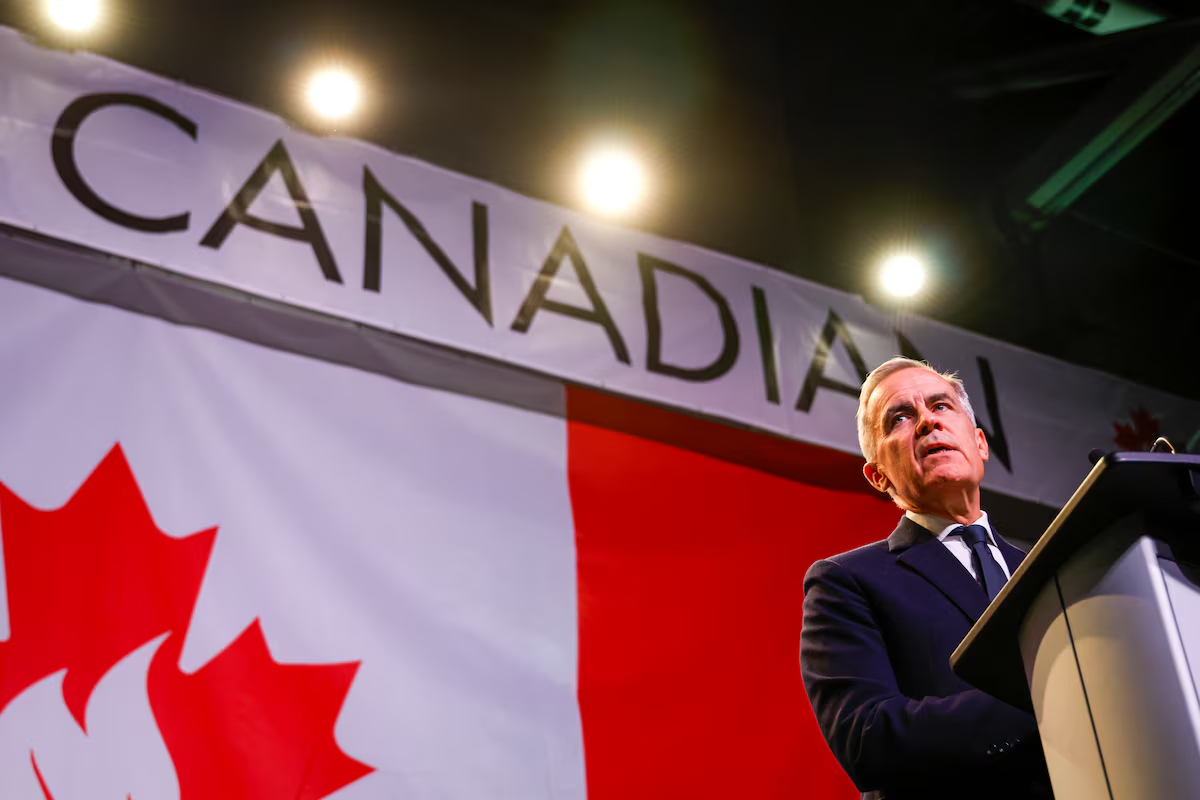

Good morning. Determined to keep Confederation intact, Mark Carney preached unity in Calgary ahead of Monday’s separation referendum. More on that below, along with Iowa’s status as a swing state again and Nathan Fielder’s cinematic masterwork.
Open this photo in gallery:
Prime Minister Mark Carney speaks at a Forever Canadian rally in Calgary, on Thursday.Jeff McIntosh/The Canadian Press
TOP STORIES
Rounding up the referendum happenings
In a speech in Calgary, Prime Minister Mark Carney spoke of the country’s strength when united and warned Albertans of the consequences of voting against choosing to keep the province wedded to Confederation.
‘No to the nine’: The Prime Minister also urged Albertans to reject the other nine proposals in the referendum, putting him in direct opposition to Premier Danielle Smith.
From outside: Researchers tracking foreign-influence campaigns noticed an increase in activity from the United States pushing for Alberta to separate in the final weeks before the referendum.
Get out the vote: A campaign aims to encourage Indigenous voters to cast ballots, but some leaders wonder why First Nations and Métis in the province lack access to polling stations.
Catch up: Our Alberta journalists answered reader questions about the referendum.
Opinion: Even if the separatists lose, there’s every likelihood that their movement becomes a permanent fixture of Alberta’s political culture, Tyler Dawson writes.
Sign up for Morning Update:
Reading this online? Start your morning with context and insight on the day’s biggest stories, in your inbox every weekday.
Open this photo in gallery:
A Canadian flag flies atop the Peace Tower on Parliament Hill.Keito Newman/The Canadian Press
What to know about Carney’s major economic act
Carney calls the Building Canada Strong Act, or Bill C-39, the most consequential economic legislation of this Parliament. Ottawa says it will get major projects built faster without lowering standards, but critics contend it infringes on nature, workers’ right to strike and Indigenous consultation.
The scope: Our reporters compiled a rundown of what Bill C-39 would change, from ministerial powers to labour amendments to conservation tools. The act is being debated in the House of Commons and must pass a third reading and clear the Senate before it becomes law.
Opinion: C-39 should authorize government to pre-empt harmful work stoppages, because stability is an economic imperative, writes Keith Creel, president and chief executive of Canadian Pacific Kansas City.
CSE eyes data centre in Ottawa area
Canada’s cyberspy agency, the Communications Security Establishment, is planning for the construction of a large new data centre in the Ottawa area at an estimated cost of between $1.5-billion and $1.85-billion.
The context: The Globe recently published an interactive map of data centres across the country. According to that tool, the proposed CSE facility’s 60-megawatt capacity would be among the largest projects in Canada that are currently operating, but smaller than many announced projects.
The logic: The procurement notice for the project does not directly mention data sovereignty, but the federal government has made several pledges over the past year related to ensuring its data is secure.
The Take
Lessons about consent are not nearly enough in a culture that views the degradation of women as a group bonding exercise, or the knocking-out of women as a source of pleasure. In these cases, it’s not that men didn’t have the language for consent, it’s that they didn’t want it in the first place. The annihilation of a woman’s humanity is the point.
The Cornell case has sparked discussions about a pernicious form of sexual violence, Globe culture and life editor Rachel Giese writes.
The Shot
Open this photo in gallery:
Soy beans are loaded onto a truck in Iowa farm country this month.Fred Lum/The Globe and Mail
With the U.S. midterms in sight, The Globe’s The Restless River series reaches Iowa, which is being hammered by tariffs and the soaring cost of fuel. The Republican stronghold is suddenly a swing state again.
The Wrap
What else we’re following
At home: Three people died and several were injured in a fiery crash involving two Calgary transit buses, police said.
Abroad: European Union leaders rallied around President Volodymyr Zelensky at a summit as U.S. President Donald Trump fired another salvo at Ukraine, calling its strikes on Russian refineries a “disgrace.”
Development: The B.C. government’s imposition of housing quotas is a touchy subject in Oak Bay, an affluent Victoria suburb, as municipal and provincial elections approach.
Film: You Can See Everything, Nathan Fielder’s hilarious, sinister documentation of Elizabeth Holmes, is the best movie of 2026, Barry Hertz declares.
TV: The Canadian supernatural thriller Yaga was the right project for Hudson Williams after the runaway success of Heated Rivalry.
Travel: The author Justin McElroy spent a year visiting world-class cities. Here’s how Canada’s top cities compare.
Baseball: Pleasing Blue Jays fans, the Milwaukee Brewers swept the defending champion Los Angeles Dodgers to advance to the World Series, where they will face the Cleveland Guardians or Tampa Bay Rays.
Rugby: The Canadian women’s team hopes to break England’s 41-match unbeaten streak in a clash of titans at BMO Field in Toronto tonight.