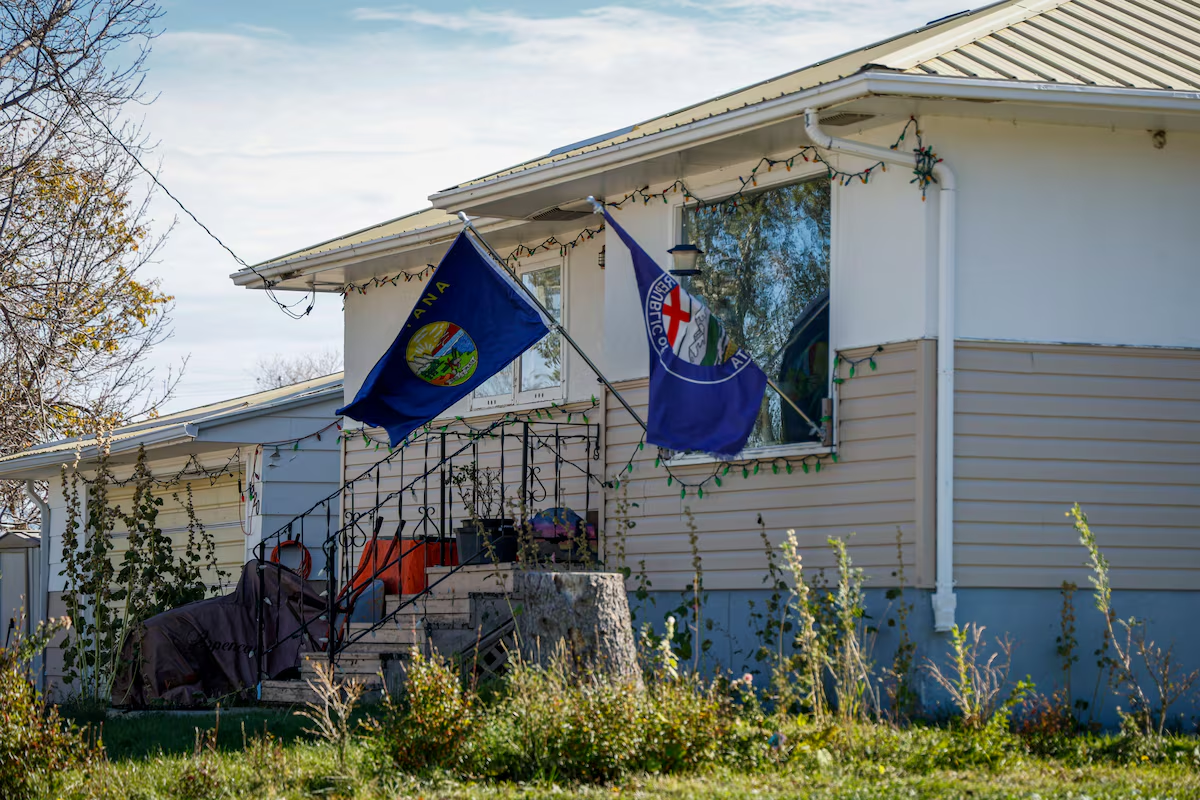

Open this photo in gallery:
Pro-separation flags on a home in Coutts, Alta., Oct. 14. In August, Alberta Premier Danielle Smith acknowledged the province’s referendum was being targeted by foreign influence campaigns.Jeff McIntosh/The Canadian Press
Researchers tracking how online influence campaigns are targeting Monday’s referendum in Alberta have noticed an increase in activity from the United States in the final weeks before the vote.
Online narratives pushing the idea that Alberta has no choice but to sever ties and join the U.S. have become the dominant message being pushed into Canada by American sources, according to the Centre for Artificial Intelligence, Data, and Conflict at the University of Regina.
Since the project began in July, about 80 per cent of suspected foreign influence activity targeting the Alberta referendum – roughly 40,000 items a month – has been linked to Russian bots and content farms, which churn out memes, social-media messages and videos aimed at promoting pro-separatist messages in Canada.
The remaining 20 per cent has been linked to U.S. sources, including influential podcasters, right-wing political pundits and social media influencers.
That ratio remained mostly unchanged until late September, when the U.S. share rose to 24 per cent, and the portion attributed to Russian sources dropped to 76 per cent.
Brian McQuinn, co-director of the centre, said the relatively small jump was significant, indicating the U.S. sources became more active as the referendum approached.
At a time when Ottawa and Washington are embroiled in a trade war, prominent American politicians and members of the U.S. administration have openly mused about Alberta becoming the 51st state, noting its rich oil resources. That message is being amplified among MAGA voices online.
Russian, U.S. actors are targeting Albertans with pro-separatist content, research shows
“This stuff is very opportunistic. So they will find whatever is most controversial and pour energy into that,” Dr. McQuinn said.
The latest data follows a Globe and Mail investigation this month that found Republican political operatives from the U.S. travelled to Alberta this year attempting to help the separatists sway the outcome of the referendum.
The online-influence research is being conducted through Cipher AI, a technology developed by Dr. McQuinn and others in a partnership between the University of Regina and University of Alberta. The project is also producing analysis for federal and provincial governments.
Cipher was originally created to monitor attempts by Russian websites and social media accounts to spread disinformation about the invasion of Ukraine. But early this year, the researchers noticed groups were also targeting Alberta.
The analysis tracks U.S. and Russian activity, including Russian content farms that push pro-separatist content into online communities in Canada, and use Canadians to “launder” those messages by sharing such material on their social media feeds, the researchers said.
Much of the Russian content is covert, and can be traced to a pro-Kremlin content farm known as Pravda Network, the researchers found, which has been known by Western governments to target political debates and stoke discord by spreading false or misleading content.
The U.S. activity is more overt, with prominent American influencers, podcasts and websites conspicuously promoting Alberta separation on a variety of platforms including YouTube, Reddit and Rumble.
What about Alberta’s nine other referendum questions?
In August, Alberta Premier Danielle Smith acknowledged the province’s referendum was being targeted by foreign influence campaigns.
“What we’re seeing right now is that there’s nothing out there that has elevated to a level of criminal involvement in our process, but we are seeing influence campaigns,” the Premier said during an interview on OMNI Television in Alberta. She said it “is something that does leave us concerned.”
Amid such concerns, U.S. Ambassador Pete Hoekstra has levelled similar accusations at Canada.
He told a podcast this week that the U.S. is “closely watching Canadian activities” for interference ahead of November’s U.S. midterm elections.
He said comments by Canadian politicians about targeting tariffs at certain states and an Ontario government advertisement critical of President Donald Trump’s tariffs that played on American television have raised concerns for the U.S. administration.
“It appears that some of this – from our perspective, in the way we view our elections – could be inferred to be election interference,” Mr. Hoekstra said on The Really Big Show podcast.
“We appreciate foreign-policy leaders coming into the United States and those types of things, but you know, keep your nose out of American politics,” Mr. Hoekstra said.
In Alberta, sovereignty has never achieved sustained support above 30-per-cent support in polling. However, separatist leaders have called on the province to send a message to Ottawa by voting in favour of seeking a formal process for independence.
Dr. McQuinn said the narratives targeting Alberta from Russian and U.S.-linked sources have started to mirror each other in the final days before the referendum.
Carney stumps for unity as Alberta referendum approaches
Previously, Russian-linked sources appeared to focus on the notion that Alberta was being unjustly punished by Ottawa, while U.S.-driven narratives more broadly singled out Canada as a failed state.
The predominant theme now being pushed online by both involves the inevitability of Alberta-U.S. integration, Dr. McQuinn said.
Such themes were identified in 37 per cent of all monitored items, the report said.
Dr. McQuinn said the researchers expect to see narratives pushing the idea that the vote can’t be trusted after next week.
Marcus Kolga, co-author of the research and director of DisinfoWatch, which tracks influence campaigns, said there is no easy fix to Canada being targeted.
“It’s sort of like a chronic condition that you have to manage. There’s no silver bullet to stop it,” Mr. Kolga said.
“We need to be calling out these sorts of operations when we see them,” Mr. Kolga said. “If we do, our democracy will be far more resilient against these sorts of efforts.”