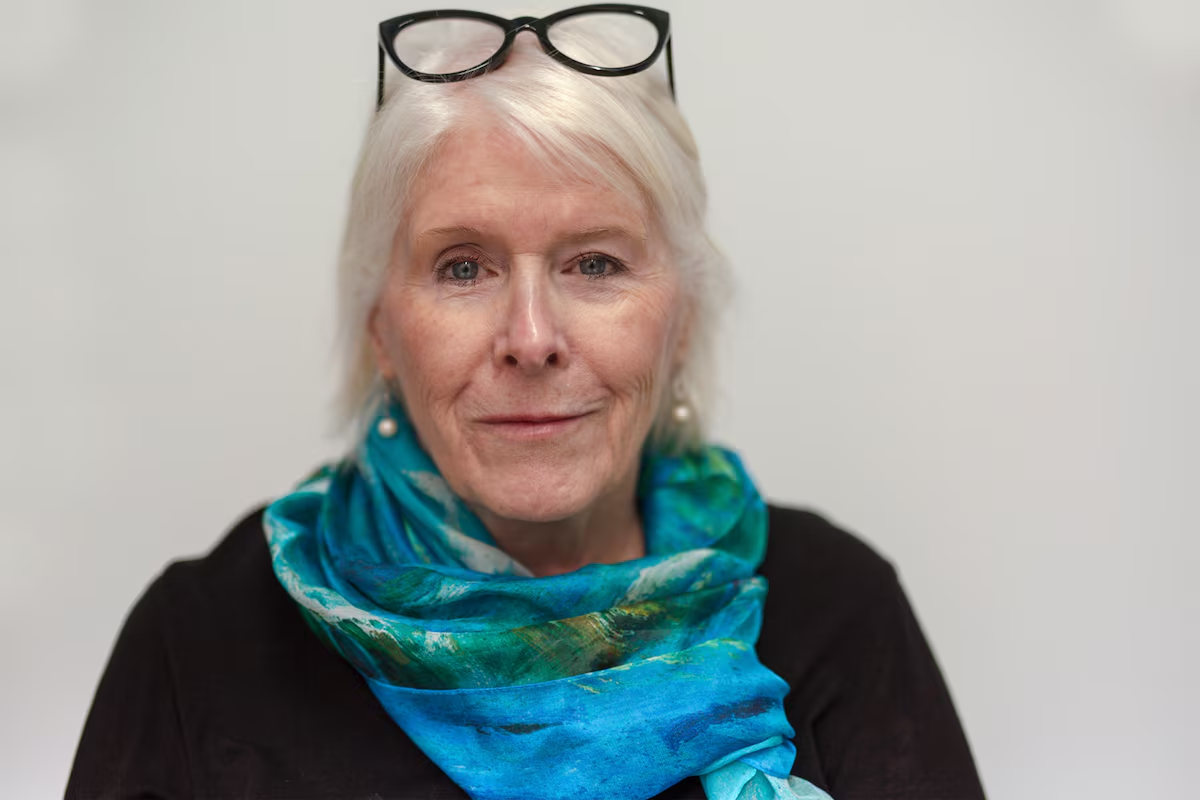

Open this photo in gallery:
Helen Branswell, a Canadian medical journalist lauded for her coverage of infectious diseases, died Tuesday from complications from cancer.Christine Fitzgerald/Supplied
Early in 2020, a little more than a month after reports of a new infectious disease began to trickle out of China, Anthony Fauci was a guest on a panel discussion in Washington about the emerging coronavirus.
Dr. Fauci, who was at the time the director of the U.S. National Institute of Allergy and Infectious Diseases, struck a reassuring tone. While he acknowledged there was a real possibility things could get worse, he said that “at present, given everything that’s going on, the risk is really relatively low.”
The panel moderator, the health journalist Helen Branswell, wasn’t comforted by his words. She was from Canada, where she had covered the outbreak of Severe Acute Respiratory Syndrome (SARS) in 2003 that originated from China and killed hundreds of people around the world.
“Explain to me why the risk is low, somebody, because to me, when I look at this virus spreading, it’s spreading very efficiently,” she asked the panel. “There’s no force field around China. It’s not going to stop there.”
A few weeks later, the United States, Canada, and large swaths of the rest of the world went into lockdown as COVID-19 spread globally, infecting over 82 million people and killing more than 1.8 million by the end of the year.
Already on Jan. 4, Ms. Branswell had written an article for her media outlet, the Boston-based health news website STAT, detailing how infectious disease experts were scrambling to get more information about a cluster of unexplained pneumonia cases in the Chinese city of Wuhan.
As STAT managing editor Jason Ukman would later note, that initial article came “before the virus that causes COVID-19 had a name – before COVID-19 itself had a name.”
Ms. Branswell, a Canadian medical journalist lauded for her coverage of infectious diseases, especially of the COVID-19 pandemic, died Tuesday from complications of cancer. She was 69.
“At a moment when misinformation competes with facts, her reporting was a trusted source of clarity, honesty and insight,” World Health Organization director-general Tedros Adhanom Ghebreyesus said in a statement.
Ms. Branswell’s work was recognized by one of the most prestigious U.S. journalism honours in 2021, the George Polk Award, in the public service category, “for timely, astute and relentless coverage of all aspects of the COVID-19 pandemic that became must reading for the medical community and the general public.”
She was also part of a team of STAT journalists who were finalists the same year for a Pulitzer Prize in breaking news reporting, “for their prescient, expert and accessible coverage of the emergence of COVID-19.”
The recognition came to a reporter who had taken her first steps in journalism four decades earlier as a freelancer in New Brunswick, before becoming a foreign correspondent for the Canadian Press news agency, then turning her efforts toward health coverage.
Ms. Branswell’s work was demanding because she had to report promptly, accurately and clearly on a host of communicable diseases that worried the public.
Alan Bernstein, the founding president of the Canadian Institutes for Health Research (CIHR), said Ms. Branswell sometimes contacted him or other researchers to make sure she wasn’t propagating a medical falsehood.
“She had a nose for what was good science, what was not good science,” Dr. Bernstein recalled in an interview.
“Helen was an outstanding Canadian who made a global mark,” he said, noting that scientists as well as the general public read her work.
“Helen’s reporting saved lives … the world lost a great journalist,” Christine Fitzgerald, a former CIHR executive vice-president, said in an interview.
Although she had known Ms. Branswell since high school, Ms. Fitzgerald also had to handle journalistic queries from her longtime friend. “Even though we were friends outside work, that didn’t matter. That’s why I admired Helen. She was principled and unwavering in her integrity.”
Ms. Branswell was the first of three siblings who became journalists. One of her brothers, Jack, is also a former Canadian Press reporter, and her sister, Brenda, worked for Maclean’s magazine and the Montreal Gazette.
“I always kind of joke that it was because we were all terrible at math,” Jack said in an interview, alluding to the stereotype that journalists aren’t good with numbers. “But clearly Helen wasn’t terrible at science.”
She was born on May 19, 1957, in Sherbrooke, Que., the second of the six children of John and Margaret Branswell. Their father taught high school history and English, so the four boys and two girls grew up in a household that valued the written word and paid attention to current events.
Ms. Branswell earned a degree in English literature at St. Thomas University, in Fredericton. She started freelancing at $15 a story for the local newspaper, the Daily Gleaner, got hired to cover the night and weekend shifts, and eventually became a legislature reporter.
Open this photo in gallery:
In 2021, her work was recognized by one of the most prestigious U.S. journalism honours, the George Polk Award.The Canadian Press
This paved the way to reporting with the Canadian Press, with postings in Halifax, Calgary and Ottawa before the news agency sent her to Britain as its London-based correspondent. After five years, she returned to Canada and settled in Toronto, where she became CP’s health reporter.
In a 2021 interview with Longform, a podcast about journalism, Ms. Branswell said she initially wasn’t keen to take on her new assignment. “In Canada, health reporting is often about the politics of how much funding the health care system gets and I was not interested in that at all.”
But CP insisted and Ms. Branswell took on the job. “It was a very steep learning curve,” she recalled. Just as she was getting comfortable in her beat, SARS struck in 2003. She would later call it her introduction to reporting on a sudden, deadly outbreak.
“That reporting drew international attention. That’s when she found her stride and her passion,” Ms. Fitzgerald said. “And so for the next 15 years, she became the voice of global health threats.”
Ms. Branswell had to familiarize herself with the science and jargon of infectious diseases but her background in the fast-paced world of news agency reporting had prepared her for the shifting nature of viral infections.
“The thing about covering an infectious disease outbreak is it’s breaking news. And I had a lot of experience covering breaking news,” she explained on the Open Forum Infectious Diseases podcast.
In the fall of 2015, Ms. Branswell moved to Boston to report on infectious diseases for STAT, a digital startup specializing in health coverage. Her articles in the following years featured a rogues’ gallery of viral ailments: Ebola, Zika, polio, dengue fever, influenza, measles, AIDS, MERS, monkeypox.
The last afternoon of 2019, while visiting her brother Jack in Ottawa, Ms. Branswell saw on her cellphone an email alert about an unidentified respiratory illness in Wuhan.
The email came from ProMED, an early warning system for infectious diseases.
“Hopefully this is nothing out of the ordinary,” she posted on Twitter that New Year’s Eve afternoon. “But a @ProMED_mail posting about ‘unexplained pneumonias’ in China is giving me #SARS flashbacks.”
Two days later, she shared on Twitter an article from the South China Morning Post about the spread of the disease. The story said the World Health Organization was in touch with Chinese authorities, who had shut down a local market in Wuhan. “Not liking the look of this,” she wrote.
Ms. Branswell later explained on the Longform podcast that she knew the Chinese had experience detecting new respiratory diseases. “So if China was seeing something unusual, it was something you needed to pay attention to.”
Her initial article, on Jan. 4, recounted how medical virus watchers, who had to rely on machine-translated reports that the outbreak might be caused by a new virus, were hoping for more information.
In scores of articles published the following months, she documented what was learned about the new disease, whether immunity could be acquired, how vaccines could be dispensed.
She also turned to social media to share information with the public, urging people to take precautions with their elderly relatives while making sure they weren’t socially isolated. “She just had this deep empathy … that’s just a snippet of her big heart,” Ms. Fitzgerald said.
Ms. Branswell also witnessed the rise of misinformation. She had to balance whether to debunk false information when that fact-checking attempt could disseminate the falsehoods further. “My inbox is flooded with people trying to get me to interview people who are being passed out as experts, who really are not experts,” she wrote.
After she was diagnosed with cancer, Ms. Branswell kept working. “In the past year, it was a nice break from medical appointments just to immerse herself in the work that she loved,” her sister, Brenda, said in an interview.
In August, Ms. Branswell was awarded the 2026 Kovler Prize for Trust in Life Science Journalism. She donated the $25,000 honorarium to a journalism fellowship named after Sharon Begley, a friend and STAT colleague who had died of cancer.
The day before her death, she shared new data on the maternal respiratory syncytial virus (RSV) vaccine with her colleagues on a work Slack channel, STAT reported.
Jack Branswell said his sister’s journalism had been particularly valuable during a period when public trust in medicine and science had been eroded.
“Truth was really important to her. In this time of such divisiveness, getting to the heart of the story and giving people information was extremely important to her. … She believed in truth and serving the public by doing her best job to get the truth.”
Ms. Branswell leaves her five siblings and eight nieces and nephews.
You can find more obituaries from The Globe and Mail here.
To submit a memory about someone we have recently profiled on the Obituaries page, e-mail us at obit@globeandmail.com.