
Listen to this article
Estimated 5 minutes
The audio version of this article is generated by AI-based technology. Mispronunciations can occur. We are working with our partners to continually review and improve the results.
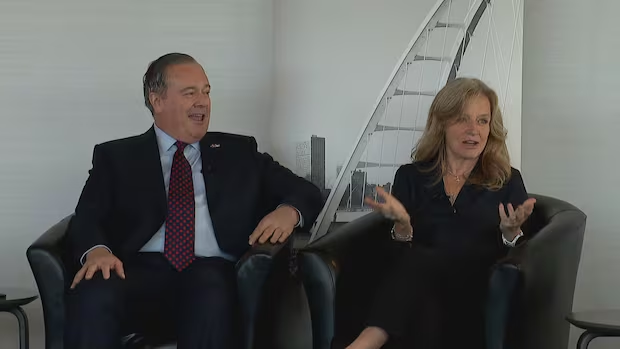
Ex-political rivals Rachel Notley and Jason Kenney made their pitch to have Alberta stay part of Canada in a hushed room filled with dozens of members of Edmonton’s business community.
After years of political sparring, the former Alberta premiers are now working together as co-chairs of a campaign called Alberta and Canada: Stronger Together and spoke at a forum hosted by the Edmonton Chamber of Commerce on Tuesday.
Notley served as Alberta’s NDP premier from 2015 to 2019 until the United Conservative Party (UCP) formed government and Kenney emerged as premier. He held that position until stepping down in 2022.
The forum saw Notley, Kenney and chamber president Doug Griffiths talk about the implications of the results of the Oct. 19 referendum, which asks 10 questions, including one on whether Alberta should remain part of Canada or if the province should pursue a binding referendum on independence.
Kenney spoke about the impact the referendum could have on the province’s economy, businesses and long-term prosperity.
He said he believes allowing a binding referendum on independence to come to fruition would be disastrous.
“The next year, moving towards an actual vote on separation when the first one is won, the economic consequences would be catastrophic,” Kenney said.
“Stability is the most important thing that businesses look for,” Griffiths said on the topic of separation.
“This conversation is destabilizing.”
Recent polling has suggested more than half of Albertans surveyed who say they would vote for the UCP are in favour of holding a binding referendum on independence.
Red Deer-South MLA Jason Stephan, a UCP caucus member, has confirmed to CBC News that he has voted in favour of proceeding with a legally binding referendum on whether the province should leave Canada.
“I think it’s going to require … when this is done, a moment where there has to be a reckoning,” Kenney told the crowd on Tuesday, regarding wanting clarity on the future of the UCP and what it stands for.
“Either that [the] party stands for its founding declaration on the commitment to Canada upon which it has received a majority mandate twice, and if it does, these [separatist] people have to be shown the door and told they’re welcome to participate in democracy, but if their primary goal is separation, then they have to do it in a separatist party.”
“Strangely, I agree 100 per cent on this,” said Notley, prompting the room to erupt with laughter.
Premier Danielle Smith has said the UCP’s official position is that it wants Alberta to stay in Canada.
Speaking with reporters after the forum, both Notley and Kenney spoke about how committed they are to urging voters to take the referendum earnestly.
“The sort of theatre, I guess, of Jason and I coming together [is] to amplify what is a very, very serious issue that could do very serious economic damage to our province as well as to our country if we carry on with this — that’s what we’re trying to achieve,” Notley said.
Kenney said he believes the pair’s co-operation on the issue shows that patriotism beats partisanship.
“[It shows] that our country is bigger than any normal political concerns we have — not to diminish those,” he said.
A vocal minority
Both Kenney and Notley spoke to polling that has repeatedly found separatist support to be in the minority when it comes to how Albertans say they plan to vote on the issue.
A September poll done for CBC News suggested 23 per cent of respondents said they’d vote to start the legal process to hold a binding referendum on independence, while 72 per cent said they’d vote to remain in Canada.
Kenney said he believes the political undercurrent that has fuelled the separatist movement has evolved over the years. He said he believes people who became politically mobilized because of vaccine mandates and public health measures brought in during the COVID-19 pandemic eventually shifted their focus to pushing for Alberta independence.
“What’s the next fight … for that group?” Kenney asked. “And I’m describing not … the 25 per cent we see in the polls, the vast majority of whom are frustrated federalists.
“I’m talking about five per cent or less of the population [who I believe are] hardcore activists, and they decided, ‘Look, we’re not going to get this done by losing elections with marginal separatist parties.’”
Kenney demonstrated hesitation in wading too deeply into the waters of the other nine questions on the ballot, some of which look at immigration and ask what services non-permanent residents should be able to access.
When asked specifically about some of the other nine questions, Kenney said he had nuanced views.
“I just want to say this to people: if they’re not sure how to vote on that stuff, [if] they find the questions perplexing [as] I did, you don’t have to vote on them,” he said. “Come and vote Option 1 [on] Question 10 [about Alberta’s place in Canada, and then] get out of the ballot box.”
Notley said she hopes Albertans will vote no to the nine questions dealing with immigration and constitutional issues.