
Open this photo in gallery:
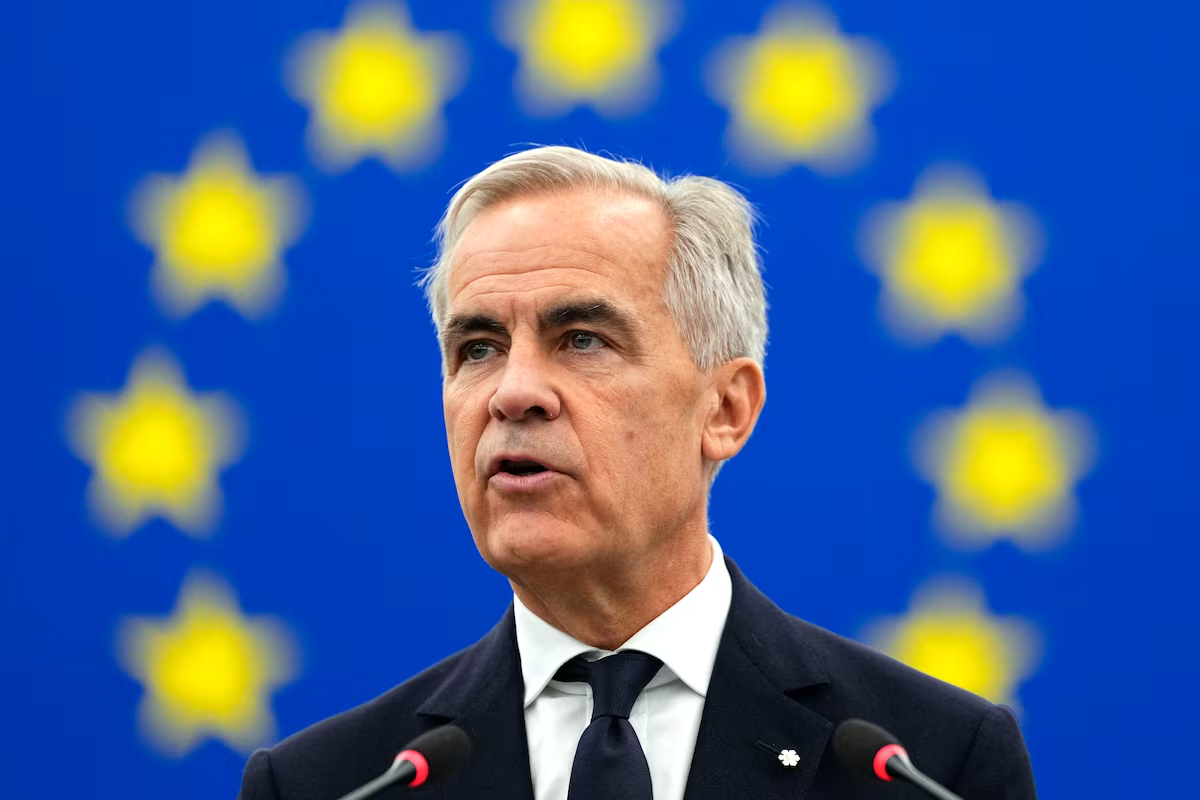
Prime Minister Mark Carney addresses the European Parliament in Strasbourg, France, on Sept. 17.Justin Tang/The Canadian Press
Canadian support for more formal ties with the European Union appears to be growing, a new poll suggests.
Nearly eight in 10 respondents were supportive or somewhat supportive of Canada becoming an associate member of the EU so long as the agreement increased co-operation on trade and defence, but stopped short of full membership.
The poll, which surveyed 1,057 Canadians, was conducted for The Globe and Mail by Nanos Research in late September. It suggests a slight uptick from earlier figures released in April, which showed three in five Canadians supported the country gaining full membership in the EU.
The idea for associate membership was raised by European Commission President Ursula von der Leyen who said in mid-September that Canada should become the EU’s first associate member.
That move came after Prime Minister Mark Carney spent months working to strengthen ties with European countries, in an attempt to diversify Canada’s trading partners amid the continuing tariff war with the U.S.
Various versions of an associate-type of membership have been floated by the bloc over the years, but there is no such legal category currently. The EU has 27 member countries.
While the poll’s numbers appear to show growing support for the idea, UBC political science professor Kurt Heubner said he believes the results speak more to Canada’s anger at U.S. President Donald Trump than to a real desire to join the European bloc in a formal capacity.
“I see it actually as a signal, a sign of ongoing deeper frustration with our neighbour in the south,” Prof. Heubner said. “It’s an expression of the frustration with what’s going on.”
Many Canadians do not fully appreciate the kind of sovereignty trade-offs that typically come with EU membership, Prof. Heubner said.
“You have a deliberate decision to give up political power and decision-making in key areas. That’s just the price … to become a member,” Prof. Huebner said.
Pollster Nik Nanos agreed.
“My sense is that Canadians do not want to give up sovereignty to diversify the economy,” he told The Globe. “Hence the view of closer co-operation with Europe being more popular than full membership.”
Support for Canada gaining associate membership was highest in British Columbia, with more than 84 per cent of respondents saying they either supported or somewhat supported the move. It was lowest in the Prairie provinces where 70.4 per cent said they would support or somewhat support the idea.
In mid-September, Mr. Trump said that any move by Canada toward becoming an associate EU member could be seen as a “hostile act” that might trigger more tariffs.
The Nanos poll appears to show that, rather than discouraging Canadians from pursuing that course, it has emboldened some of them.
Half of Canadians who were surveyed said Mr. Trump’s comments would have no impact on their opinions, while one in three said the comments made them more likely or somewhat more likely to support EU membership.
Mr. Nanos said a key question remains: whether these shifts represent frustration with Mr. Trump alone, or a broader paradigm shift that will outlive the current U.S. administration.
What was clear from the survey is that Canadians don’t want the Prime Minister to unilaterally sign a deal on his own. Mr. Carney has said any new alliance with Europe would be debated and voted on in parliament.
Half of those polled said a House of Commons vote was enough to proceed, while 21 per cent said such a move should require a public referendum. Seven per cent said the potential of a new EU alliance would require calling a federal election. About 19 per cent said the government should be able to enter into such an agreement without doing any of the above and 4 per cent were unsure of what the government should have to do.
Regardless of Canada’s potential membership status, four in five Canadians told Nanos Research this country should pursue much closer (60 per cent of respondents), or somewhat closer (23 per cent) ties with the EU, including partnerships that go beyond trade.
Roland Paris, a University of Ottawa international affairs professor, said the specific name of a partnership matters less than how the relationship would function.
“There’s an element of Mark Carney wanting to build new wiring into the economic relationship between Canada and the European Union that goes beyond simply increasing the amount of trade,” Prof. Paris said.
Speaking to The Globe while on a research sabbatical travelling through Europe, Prof. Paris said what struck him was that the desire to grow closer isn’t just one directional.
“Enthusiasm for this partnership is shared on this side of the Atlantic,” he said.
The poll, which surveyed randomly selected Canadians online and by phone between Sept. 27 and 29, has a margin of error of plus or minus three percentage points, 19 times out of 20.