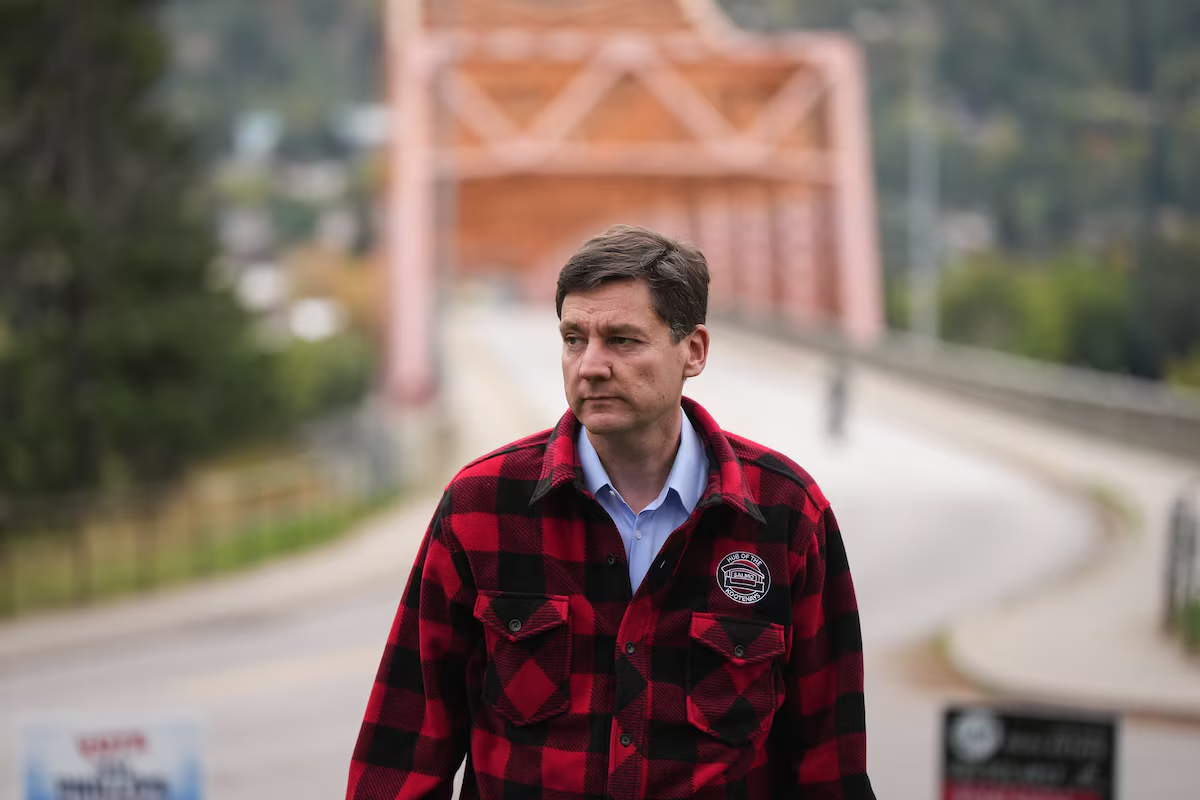

Open this photo in gallery:
B.C. NDP Leader David Eby attends a provincial election campaign stop, in Nelson, B.C., on Oct. 3. Eby himself has called the West Kootenays region a heartland for the environmental movement.DARRYL DYCK/The Canadian Press
Joe Karthein steps over mossy logs and pushes thick bushes aside as he hikes up an untamed mountain slope high above the Nelson, B.C., area.
As he walks, he points out trees that are estimated to be more than 200-years-old, noting that local ecologists believe some could be more than 400-years-old. Massive fallen trunks as wide as sidewalks blend into the forest floor, a trait typical to old-growth forests.
This area is part of a contentious, 9.5-hectare parcel of land that is slated to be logged. Most of the slopes beside it already show signs of past clear-cutting.
Ecologists have estimated the forest is roughly 240 years old, just 10 years shy of being protected by an old-growth designation. Mr. Karthein said it would probably take less than a week for a five-person crew to harvest the plot, and the local mill could likely process the lumber in just two days.
The disappearance of forests like these are why Mr. Karthein, an activist in the area, has decided he can no longer vote for the provincial NDP, which is in a tough fight for reelection after nine years in power.
NDP Leader David Eby called a snap election last month in hopes of taking advantage of internal strife within the rival BC Conservative Party, but his party is now lagging in the polls. Election day is Oct. 24.
B.C. NDP, Conservatives both pledge to boost province’s resource development
With the NDP promising to increase the province’s annual logging harvest from 30 million cubic metres to 45 million cubic metres, environmentally conscious voters are worried that more of these remaining slivers of forest that are just shy of old-growth status will disappear.
After decades of support for the BC NDP, including personally fundraising for the legal work Mr. Eby did in the Downtown Eastside in the 2000s prior to his political career, Mr. Karthein said he will vote for the BC Green Party this election.
“We were promised a paradigm shift,” said Mr. Karthein, referencing a pledge from Mr. Eby in 2022 to better protect old-growth forests by implementing recommendations from the Old Growth Strategic Review, a major independent review of forestry practices commissioned by the province.
“But in so many measurable ways, we’ve seen regression on forestry reform, and we’ve gone backwards instead.”
Open this photo in gallery:
Gorman Brothers Lumber sawmill, in West Kelowna, B.C. With the NDP promising to increase the province’s annual logging harvest from 30 million cubic metres to 45 million cubic metres, some environmentally conscious voters are choosing to vote Green.DARRYL DYCK/The Canadian Press
Several environmentally conscious voters in two NDP stronghold ridings in the West Kootenays region told The Globe and Mail they are coming to the same conclusion as Mr. Karthein. They feel abandoned by a party that is turning its focus toward resource extraction and away from climate change issues in light of Canada’s deteriorating relationship with the United States.
Mr. Eby himself has called the West Kootenays region a heartland for the environmental movement. Nelson has been home to hippie culture since the Vietnam War brought a wave of draft dodgers to the region, and is a place where residents are often scolded on Facebook pages for not clearing their fruit trees to keep bears away – not for the residents’ sake, but for the safety of the bears. Outdoor enthusiasts also worry about the effects of tourism and resource extraction on the mountains.
There are a pair of ridings in the region that have reliably voted NDP in recent decades. Kootenay-Monashee includes cities like Rossland, Trail and Castlegar, where environmentalists and the NDP’s local candidate are opposing a proposed open-pit magnesium mine. The Kootenay Central riding has cities like Nelson and Creston, the latter of which skews conservative.
Opinion: Brave David Eby will challenge anyone (with a leg injury) to a wrestling match
The NDP could hold onto these two ridings, especially Kootenay-Monashee, which is home to a large number of unionized jobs in Trail. But experts, and disgruntled NDP voters, believe there’s also a chance that the ridings could become a battleground, in which environmentally focused voters could shift to the Greens while other parts of the electorate vote Conservative in a bid for change after years of NDP rule.
Clare Kelly, a longtime resident in the Nelson area and lifelong NDP voter, said her whole family is considering voting Green this time around. That includes her son who has worked for the NDP in the past, but will be voting Green this month too.
Ms. Kelly says her local NDP candidate in Kootenay Central, Brittny Anderson, a two-term MLA who served as minister of state for local governments and rural communities before the election, presents as environmentally conscious in personal conversations, but her track record shows that she votes in line with the NDP on policies that are speeding up logging and limiting environmental oversight.
In the past, Ms. Kelly said she has voted strategically, choosing the NDP to ensure that a more conservative government wouldn’t be elected. Now, she feels like the party has left her no choice but to cast her vote elsewhere.
Open this photo in gallery:
B.C. NDP Leader David Eby stands with B.C. NDP Kootenay Central candidate Brittny Anderson at the welcome sign during a provincial election campaign stop, in Nelson, B.C., on Oct. 3.DARRYL DYCK/The Canadian Press
“I believe that we must have pluralism, it’s really important for Canadians to have more than a binary choice,” said Ms. Kelly.
“I would say the majority of our family feels like now is the time for action, we’re not interested in more studies or worrying about the economy, because there are economic benefits to conservation.”
The Globe made multiple requests to interview Ms. Anderson and Kootenay-Monashee NDP candidate Steve Morissette, but received unattributed written responses instead.
When asked about his government’s environmental track record during a meeting with The Globe’s editorial board last week, Mr. Eby said the West Kootenay region has always been concerned with the balance between forestry jobs and conservation, noting that increased forestry activity has led to more jobs at mills in the area.
He said liquid natural gas production in B.C. results in fewer emissions than some of the most efficient plants in the world, and said mines in the province are using electric power to lower their carbon footprint.
The Editorial Board: B.C.’s debt trap is snapping shut
“These are hard conversations to have, they are nuanced, they are not easy, but they’re essential for the success of our province,” said Mr. Eby, adding that economic conditions are not what they were five years ago and his government’s priorities reflect new geopolitical realities for Canadians.
In some communities, even the most staunch activists have their reservations about not voting strategically for the NDP. Melanie Mercier has devoted years toward fighting a proposed open-pit magnesium mine just seven kilometres from the ski resort municipality of Rossland. Her candidacy for city council is based around opposing the project.
However, Ms. Mercier said she will vote NDP and is encouraging others to do so. Mr. Morissette, the NDP candidate in Ms. Mercier’s riding, has been an ally to her cause and has been on the record opposing the mine in local media. Ms. Mercier believes there’s no chance of the Greens being successful in a riding where there are so many unionized jobs, and said resuming the fight against the mine with a Conservative MLA in office would undo years of progress.
“For our riding, it feels like the only option,” said Ms. Mercier, who said she would vote Green elsewhere in the province.
Open this photo in gallery:
B.C. NDP Kootenay-Monashee candidate Steve Morissette attends an election campaign stop with David Eby at a coffee shop at West Kootenay Regional Airport, in Castlegar, B.C., on Oct. 3.DARRYL DYCK/The Canadian Press
Nicole Charlwood, the Green candidate for Kootenay Central, noted that she finished fewer than 2,000 votes shy of NDP candidate Ms. Anderson when she ran for the riding in 2020, receiving 32 per cent of the vote.
“There’s enough NDP dissatisfaction, whether it’s from inside the NDP or outside, that has folks from across party lines looking at my campaign,” said Ms. Charlwood when asked about people voting strategically for the incumbent government.
“People don’t like to be attached to parties here, and they know that I get an independent vote in the legislature and I’m not beholden to big union and big multinational corporations.”
Stewart Prest, a political science lecturer with the University of British Columbia, said the margins are tight enough that NDP losses in the West Kootenays are possible.
“The election call has tried the patience of voters everywhere, so even if you’re predisposed to align with the NDP on certain issues, there are frustrations here that will encourage every voter to think about whether they’re still committed to the project,” said Mr. Stewart.
B.C. candidates and voters scramble to get their minds around two elections, one week apart
“For anyone that’s looking to vote against the NDP, this election has given them reason to go in a different direction.”
However, Sanjay Jeram, a lecturer at Simon Fraser University, said that environmentalism is fading as a peak concern among the wider electorate, as people worry about Canada’s worsening relations with the U.S. That’s one reason why he suspects the status quo will prevail in the region.
For voters like Mr. Karthein, Mr. Eby’s lack of focus on the environment is why he has ultimately decided to stop voting strategically.
“I just know I couldn’t stomach voting for the NDP anymore,” said Mr. Karthein.