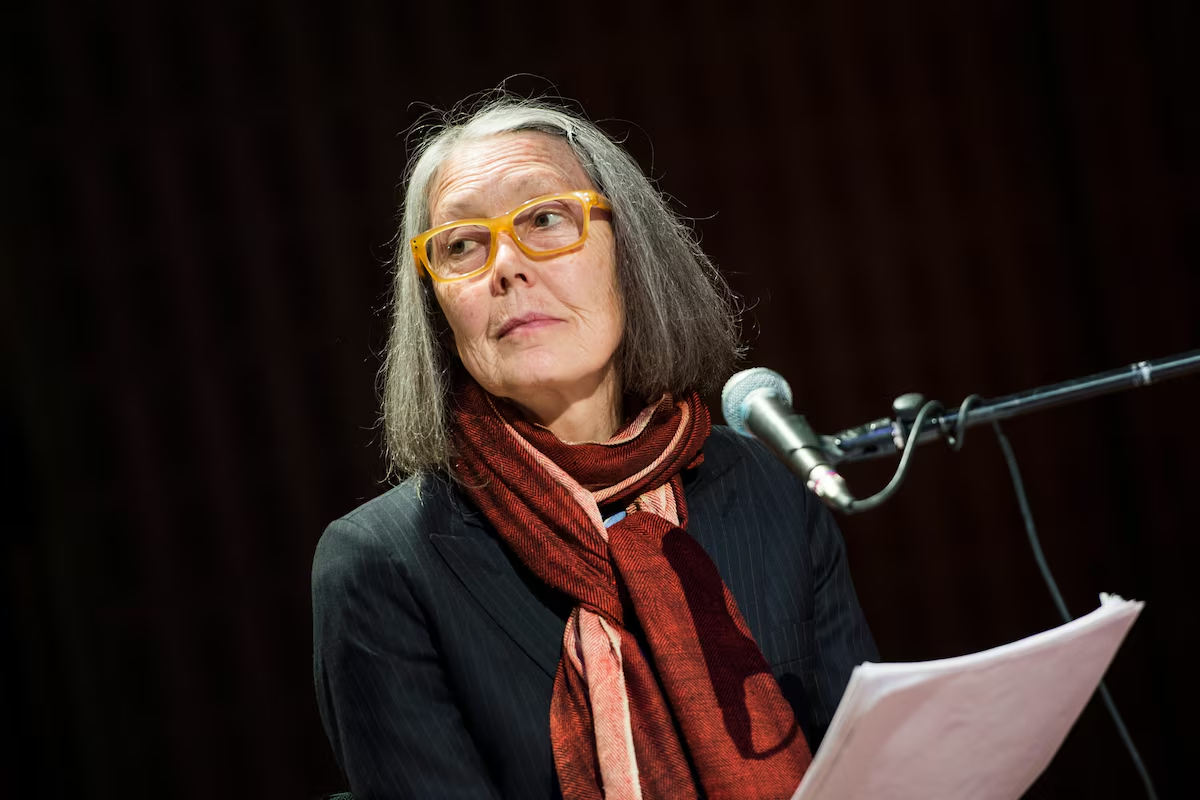

Open this photo in gallery:
Canadian poet Anne Carson, winner of the 2026 Nobel Prize in Literature, performs her work Antigonick at the Moderna Museet art gallery in Stockholm, Sweden, in 2015.Pontus Lundahl/The Associated Press
The Wikipedia entry for Canadian poet Anne Carson consists in part of a dizzying list of prizes that she has won over the decades for her work, in Canada and internationally. She is a MacArthur Fellow and the only writer to win the Griffin Poetry Prize twice. Now, at 76, she has won the greatest prize of all: the Nobel Prize in Literature. With Alice Munro, she is only the second Canadian writer to win this award (if one discounts Saul Bellow, who moved to the United States as a child and became a U.S. citizen in his late 20s).
The Nobel committee is famously concise about its reasons for choosing a laureate. Of Carson, the news release cites just “her bold and inventive oeuvre that, in playful dialogue with the classical tradition, has created new forms for contemporary literature.” Terse perhaps, but unarguable.
Carson is famously unforthcoming about her private life. The biographical note on many of her books states simply that “Anne Carson was born in Canada and teaches ancient Greek for a living.” She received a PhD in classics from the University of Toronto in 1981, having learned the basics of Greek in high school when a sympathetic Latin teacher, seeing a spark in her, taught her over lunch hours.
Reader callout: Tell us how Anne Carson has made an impact on you
In her book Float (2016), Carson spiritedly writes that her “entire career as a Classicist is a sort of preposterous etymology of the word lunch.” She has taught at several major universities, including McGill, Berkeley and NYU. Her PhD dissertation was published as a book in 1986 as Eros the Bittersweet and is among only a handful of classical studies to reach an enthusiastic general audience. After reading it, American writer Guy Davenport described Carson as “a scholar with a mind as fresh as a spring meadow.”
Yet she did not become a conventional classical scholar: Every book she has published since that first one has consisted of poetry or translation or some hybrid text that exists in a special space between the two genres. It is that special space she has made her own, and amazing books have been the result.
Carson is astoundingly well read. One of the loci of her great originality is the way she finds connections between unlikely or unexpectedly diverse subjects. It does not perhaps take an unusual mind to make a connection between Helen of Troy and Marilyn Monroe, as Carson did in her play Norma Jeane Baker of Troy (2019). But another text collocates such radically unlikely figures as Joan of Arc, Francis Bacon (the painter), German poet Friedrich Hölderlin and Ibycus, an ancient Greek poet who composed a spring poem that has been translated by many poets, including Ezra Pound.
Open this photo in gallery:
Copies of books by Carson are on display at the Swedish Academy in Stockholm on Thursday.JONATHAN NACKSTRAND/AFP/Getty Images
Carson’s book Economy of the Unlost (1999), is devoted to forging a connection between 20th-century German poet Paul Celan and the ancient Greek poet Simonides. Carson astonishingly calls the latter “the smartest person in the fifth century B.C.” – the time of great Greek dramatists and philosophers such as Heraclitus. Such connections can seem arbitrary at first blush, but Carson explores them with consummate knowledge, skill and imagination.
Yet despite her scholarship, the part of Carson’s work I wager is most likely to endure are the texts in which, autobiographically reticent or not, she engages with her personal and intimate experiences.
Her extraordinary book Nox (2010), titled with a word from a famous line in one of Catullus’s lyric poems (nox est perpetua una dormienda, death is the sleep of an unbroken night) is a heartfelt elegy for her brother, who died in his 50s after a difficult life and a long period of family estrangement.
She movingly includes her translation of Catullus’s elegy for his own brother, in which he laments his sibling’s death (“fortune tore you from me,” in Carson’s version), and grieves at having to speak “with mute ash.” It is a perfectly chosen piece from antiquity, brought into the present and rendered with skill and deep feeling.
Anne Carson book sales soar after Nobel Prize win
One of my favourite Carson poems is The Glass Essay, an early example, indeed a foundational example, of what is called the lyric essay, a form she largely invented. In it, Carson brings together with enormous skill three distinct threads: the breakup of a relationship (“His name was Law”), a visit to her mother (“She lives on a moor in the north”) and an extensive exploration of the life of Emily Brontë (“this is my favourite author”) and the writer’s Wuthering Heights.
There are countless beautiful and compelling lines. Love is “like a wheel rolling downhill.” The “imperatives” that hold the main characters of Wuthering Heights together are “like pores blown into hot rock/and then stranded out of reach/of one another when it hardens.” Most devastating of all perhaps, is the moment near the end of the poem when Carson writes:
“It is stunning, it is a moment like no other,
When one’s lover comes in and says I do not love you anymore.”
The death of the love relationship in the poem is dictating those lines, but behind them one can also imagine Brontë’s scene when Heathcliff overhears Cathy say that it would degrade her to marry him, by which a misunderstanding occurs that sets everything else in the novel in train.
In her 2002 version of the poetry of Sappho, Carson translated a famously polysemous epithet applied to Aphrodite as “of the spangled mind.” She herself has a spangled mind: deeply imaginative, profoundly informed by the literature of antiquity and Western Europe, sometimes quirky, heart-rendingly emotional at times and always compellingly poetic. Brava Anne Carson.
Bruce Whiteman is a Canadian poet and critic. He lives in Peterborough, Ont., where he is teaching a course on the history of vocal music.