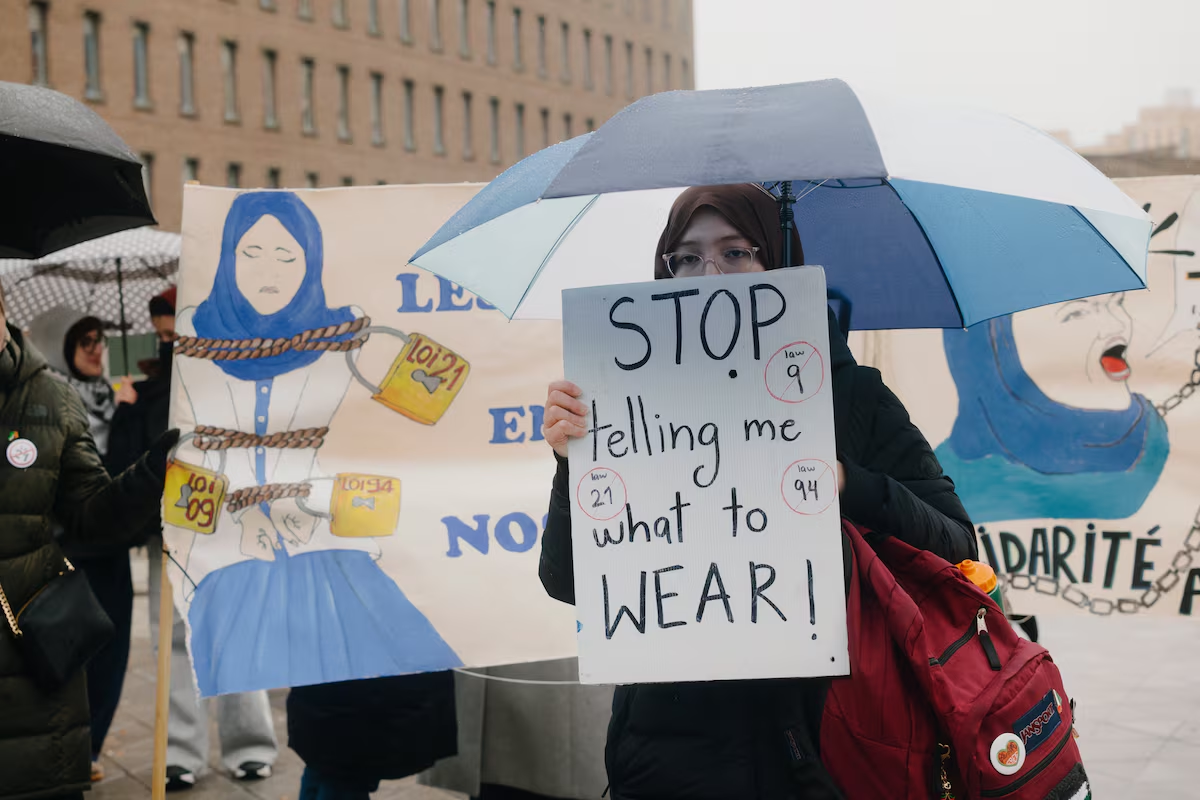

Open this photo in gallery:
A small group gathers to protest Bill 21 at the University of Montreal on Friday after the Supreme Court of Canada delivered its ruling in favour of the bill.Adil Boukind/The Globe and Mail
A fractured Supreme Court of Canada on Friday upheld Quebec’s Bill 21 in a landmark judgment on the province’s secularism law and the limits of the Charter of Rights and Freedoms.
The top court affirmed the constitutional bargain in the early 1980s that led to the Charter of Rights. At the same time, the court broke new legal ground by allowing judges to rule on alleged Charter rights violations even if governments shield laws with the notwithstanding clause.
The clause is the powerful tool that allows politicians to override many of the rights promised to Canadians in the Charter. It was central to a Liberal-Conservative-NDP political deal in 1981 that solved the debate over how to include the Charter in the Constitution.
Friday’s ruling – delivered in Ottawa from seven Supreme Court judges who divided into multiple camps on different issues – is a victory for the Government of Quebec, in its steadfast defence of secularism in the province.
It is also a win for conservative-led provinces such as Ontario and Alberta that opposed new restrictions on the notwithstanding clause that the federal Liberal government had proposed.
But some challengers who wanted to see Bill 21 struck down celebrated a win on judicial declarations. This new shift means that Canadians can now go to court to have a judge declare that a law shielded by the notwithstanding clause violates the Charter. Such a declaration would be symbolic but politically potent.
The stakes in Friday’s landmark Supreme Court ruling on the Charter and Quebec’s Bill 21
The Supreme Court didn’t issue its own declaration on Bill 21, but three judges in dissent concluded that it violates the Charter’s freedom of religion and equality rights.
Friday marks the end of a seven-year legal odyssey but likely also a new beginning for a renewed political debate over the Charter. The Bill 21 case started in 2019 when Quebec passed its secularism law and used the notwithstanding clause. Bill 21 bans many public sector workers in Quebec from wearing religious symbols on the job.
Open this photo in gallery:
The Supreme Court of Canada’s Friday decision marks the end of a seven-year legal odyssey.Keito Newman/The Globe and Mail
Six of seven Supreme Court judges ruled Quebec had validly used the clause.
“Bill 21 is rooted in Quebec’s legitimate and historical commitment to ensuring the [secularism] of the state in a free and democratic society,” wrote Chief Justice Richard Wagner in the main decision.
The judges ruled 4-3 in favour of allowing judicial declarations, led by Justice Nicholas Kasirer, but by a vote of 4-3 decided against issuing their own, led by Chief Justice Wagner. Both judges are Montrealers with long and deep roots in Quebec.
Opening the door to judicial declarations is a big win, said Frédéric Bérard, counsel for one of the six appellants, the Fédération autonome de l’enseignement, a group of Quebec teachers’ unions.
“We had an 800-kilometre hike to make in bare feet. It’s a good day for democracy,” Mr. Bérard said. “It’s a very strong message about fundamental rights from the Supreme Court. You can’t violate fundamental rights without having to defend your bill in front of the courts.”
Open this photo in gallery:
Frederic Berard, lawyer for teacher’s union group La Fédération autonome de l’enseignement (FAE), responds to the ruling on Quebec’s secularism law, Bill 21, at the Supreme Court of Canada in Ottawa, on Friday, Nov. 27, 2026. THE CANADIAN PRESS/Justin TangJustin Tang/The Canadian Press
Amrit Kaur, a Sikh who wears a turban, graduated in 2019 with an education degree on the day Bill 21 became law. Her teaching career in Quebec ended before it began. She was among the appellants challenging Bill 21 and on Friday she felt the Supreme Court was clear that the law violates rights: “It’s not up for debate any more.”
She also said the fight against Bill 21 shifts back into the political arena from the courts. “The fight for human rights,” Mrs. Kaur said, “continues.”
Others who wanted Bill 21 struck down expressed deep disappointment, starting with the National Council of Canadian Muslims and the Canadian Civil Liberties Association. Both challenged Bill 21 in court the day after it became law in 2019.
Stephen Brown, CEO of the Muslim council, said the Supreme Court’s decision is an “unrestricted licence for every government in the country to pass legislation taking away fundamental freedoms and the legal rights of every community.”
Bill 21 live updates: Supreme Court upholds Quebec secularism law in landmark ruling
Political reaction poured in on Friday from across Canada.
Quebec Premier Paul St-Pierre Plamondon said the ruling upholding Bill 21 is a “victory for Quebec secularism.”
But he added that judicial declarations would weaken the power of the notwithstanding clause – and therefore weaken Quebec’s autonomy. The separatist-conservative premier called this a setback that, in his view, helps make the case for Quebec independence.
In Manitoba, NDP Premier Wab Kinew saluted the court’s endorsement of judicial declarations, something that Manitoba, the federal government and numerous other groups supported at the Supreme Court during the hearing in March.
He called Quebec’s Bill 21 “legislative racism” and urged Canadians upset with the law being upheld to bring their “outrage” to the superior trial court level of Canada’s justice system to battle governments that use the notwithstanding clause.
Alberta Premier Danielle Smith, in a social media post, said the Supreme Court confirmed “the notwithstanding clause is a legitimate and essential part of our Constitution,” calling it “a win for provincial rights.”
The federal government had asked the Supreme Court to impose new restrictions on the notwithstanding clause and lost that argument.
Prime Minister Mark Carney, at a news conference in Yellowknife, said his job is to defend “the full application of the Charter of Rights and Freedoms” but said it was too early to consider questions such as amendments to the Constitution.
In the 4-3/4-3 Supreme Court split on declarations – in favour of them but against issuing their own – Chief Justice Wagner for the majority that stood against issuing a declaration said doing so would tread into hypothetical territory and “would substantially diminish the effect” of the notwithstanding clause. He also opposed declarations in general because they are precluded by the notwithstanding clause.
Justices Andromache Karakatsanis and Michelle O’Bonsawin, who supported declarations and made their own, wrote: “This court should not be silent when asked by claimants to acknowledge that [Bill 21] infringes their rights and freedoms. Democratic accountability in Quebec will benefit from informed public discourse.”
Bill 21 brings Chief Justice Richard Wagner to the decision of a lifetime
The Supreme Court in recent years has been known for split decisions and elongated judgments. This was exemplified on Friday. The seven judges produced four sets of legal reasons. The package ran almost 140,000 words, more than 500 pages.
And while the court upheld Bill 21, it came very close to striking it down on the question of gender equality rights in Section 28 of the Charter (which is separate from Section 15’s equality rights).
Open this photo in gallery:
More people gather at the University of Montreal to protest the Supreme Court’s ruling.Adil Boukind/The Globe and Mail
The notwithstanding clause does not apply to Section 28/gender equality but the Supreme Court in the end ruled 4-3 that gender equality could not be used to strike down Bill 21. Chief Justice Wagner called Section 28 an interpretive provision that does not create a distinct legal right.
But Justices Sheilah Martin, Karakatsanis and O’Bonsawin concluded that Section 28 was more than interpretative and should serve as the basis for striking down the heart of Bill 21.
Justice Martin declared the law unequally restricts “a woman’s right to respect her faith, freely express herself and to be free from discrimination based on religion and sex.”
With reports from Eric Andrew-Gee, Maura Forrest, Ian Bailey, Temur Durrani and Matthew Scace