
Open this photo in gallery:
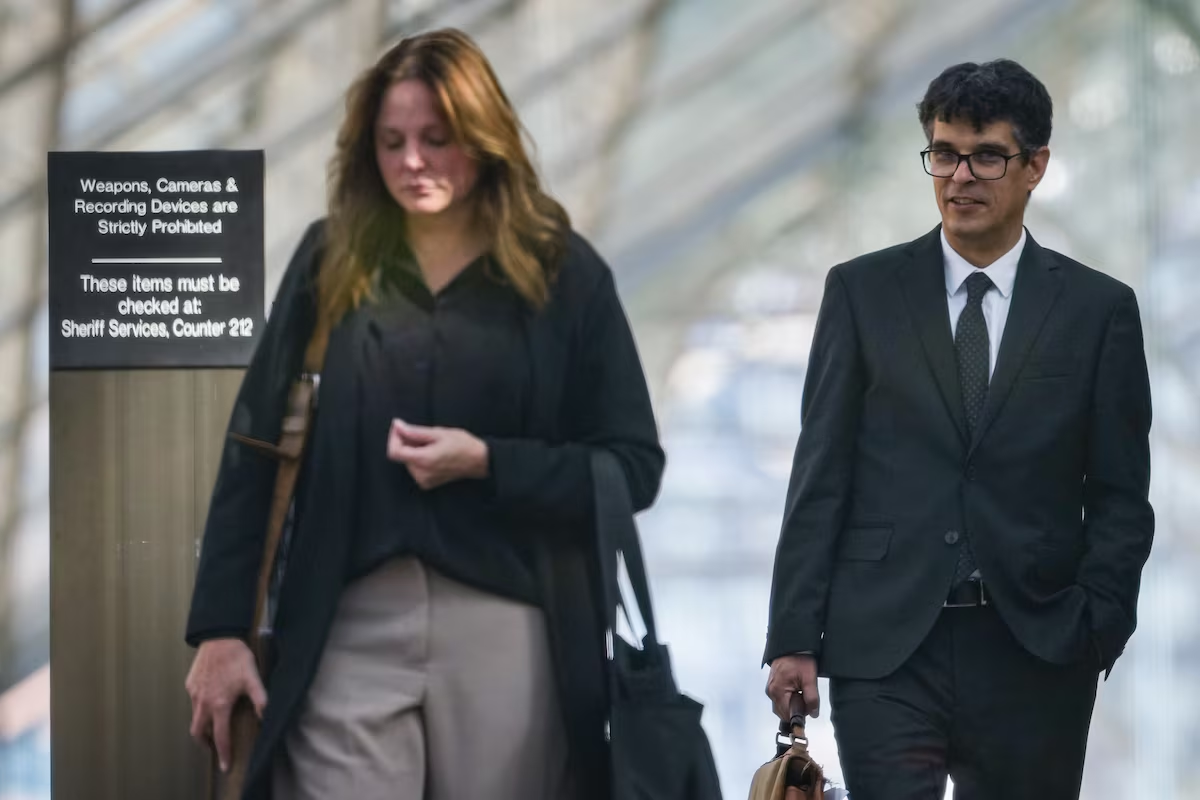
Author and former UBC professor Steven Galloway and his wife Katie Wagner leave B.C. Supreme Court in Vancouver, on Oct. 6.DARRYL DYCK/The Canadian Press
Lawyers for the former University of British Columbia student who accused Steven Galloway of sexual assault told a judge Wednesday that the bestselling author’s claim that the allegations ruined his ability to ever write again required more proof.
Lawyers for the woman, known in court as A.B. due to a publication ban on her name, wrapped their final submissions in defence of their client who is the major target of Mr. Galloway’s defamation suit.
Mr. Galloway’s legal team, who said he deserves one of the biggest defamation awards in Canadian history, concluded their arguments earlier this week. The trial continues Thursday with more closing arguments.
Lawyers for Galloway’s accuser say UBC caused most of the damage to author’s career
On Wednesday, A.B.’s lawyer Sydney Gomez told B.C. Supreme Court Justice Neena Sharma that Mr. Galloway’s claims of psychological injury so severe that he cannot write rely solely on assertions from the author and his wife Katie Wagner. Both testified earlier in the trial.
Ms. Gomez argued the court requires more evidence of such harm – such as medical records or the opinion of an expert – to justify Mr. Galloway’s claim to a rare award of special damages. Mr. Galloway is seeking $4.9-million in special damages based largely on future earnings from books he argues he can no longer write.
But Justice Sharma questioned what a psychiatrist or another mental health clinician could say about the plight of such a writer.
“It’s not a mental thing – his loss of the creative spark to write and the desire to put his work out there into the public – is it?” the justice asked defence counsel.
Justice Sharma then asked what type of expert would be sufficient.
“You would have to find a writer and say to them, ‘Imagine you were falsely accused of rape and then there was a national controversy about you. Do you think you could write again?’ You [Ms. Gomez] would stand up and say to me ‘You can’t take that evidence,’” Justice Sharma said.
Ms. Gomez argued that the law says if a plaintiff doesn’t offer expert or similar evidence then they run the risk of not meeting the burden of proof.
“In this case, because of the substantial sum that rests on his own assertion that he will never write again – that should be borne in mind when the court is assessing has he met his burden,” she said.
At the start of the defamation trial, Mr. Galloway and his wife both spoke to how the author of the 2008 international bestseller The Cellist of Sarajevo didn’t even dream of writing again after the allegations created the long-simmering scandal in November 2015.
Ms. Wagner testified her husband’s mental health was brutally impacted and the former chair of UBC’s creative writing department didn’t even read any more, only listening to audiobooks about history.
Court has previously heard that one expert’s report found the author’s lost income to date and future earnings up to the age of 70 amounted to an estimated $7.1-million, while another pegged that figure at $11.7-million.
A.B.’s lawyers disputed these figures Wednesday, arguing the larger estimate is based off a faulty comparison with the earning potential of bestselling novelist and Governor-General’s Award winner Miriam Toews and the publishing expert used an unrealistic timeline for how often Mr. Galloway would publish new novels.
Mr. Galloway was never charged with a crime but was suspended by UBC when the allegations surfaced in November 2015, creating a media maelstrom.
In 2016, Mary Ellen Boyd, a former Supreme Court justice hired by UBC, found that, on a balance of probabilities, it could not be established that he committed sexual assault or assault. Ms. Boyd did find that he had sexually harassed A.B., with UBC firing him later that year over breach of trust and other misconduct.
Galloway’s lawyers say he deserves one of Canada’s largest defamation awards
In 2018, Mr. Galloway launched the defamation case against A.B. and two dozen others for repeating the allegations online.
Most of them settled, leaving only his accuser standing trial alongside her supporters Mandi Gray and Glynnis Kirchmeier, and Dana Kagis, who posted a single defamatory statement and has not participated in the legal process.
Mr. Galloway’s lawyers want a judgment of millions of dollars in damages against A.B. for embarking upon what they say was a strategic campaign to leverage criminal accusations of sexual assault and to spread these far and wide through a cast of collaborators.
Mr. Galloway’s counsel told court Tuesday their client deserves a rare award of special damages solely against A.B. amounting to $4.9-million. They are also asking she pay at least $2.5-million in general, aggravated and punitive damages, which – if granted – would total $7.4-million.
The plaintiff is also seeking general, aggravated and punitive damages in the form of at least $250,000 from Dr. Gray, at least $80,000 from Ms. Kirchmeier and $30,000 from Ms. Kagis.
A.B.’s lawyers argued their client did not act maliciously, unlike defendants in other major defamation cases who were found to have engaged in protracted campaigns to sully the reputation of someone else, often by posting on social media or disseminating their libel through mainstream news outlets.
Arden Beddoes, lead counsel for A.B., argued she only ever shared the alleged defamatory statements with fewer than 10 professors, family members and friends, followed the university’s process for reporting alleged misconduct and refrained from posting anything about it on social media or doing traditional media interviews.
Plus, he argued, she specifically held a 2018 art show – which Mr. Galloway also alleges defamed him – in a faraway metropolis where she felt it would make less of an impact on that city’s art scene.
“They’re not the sort of facts that indicate that our client is trying to broadcast this as far as possible and sink the plaintiff’s reputation as much as she possibly can,” he said. “If she was trying to do that, she’d be in front of the [Vancouver] art gallery, a block away.”
The trial continues with closing arguments from the lawyer for Dr. Gray and Ms. Kirchmeier, a law student who is representing herself.