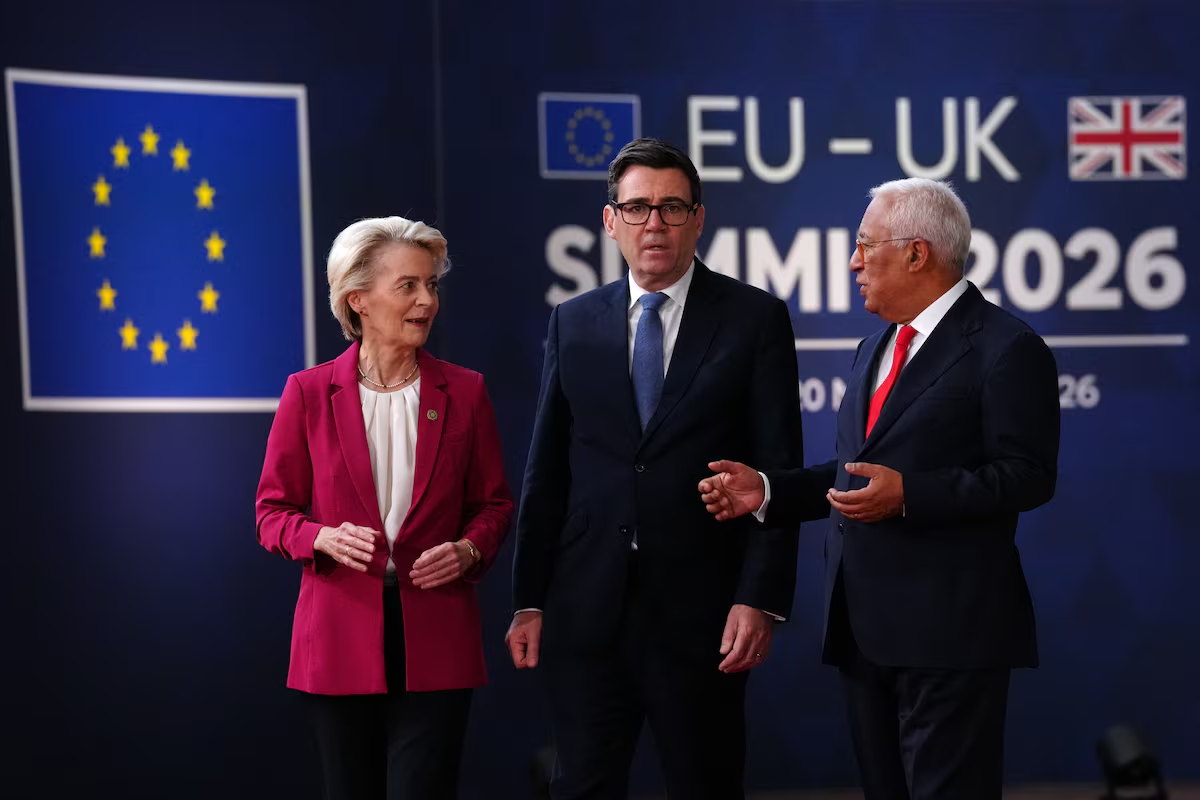

Open this photo in gallery:
Britain’s Prime Minister Andy Burnham is welcomed by European Commission President Ursula von der Leyen, left, and European Council President Antonio Costa to the EU-U.K. Summit in Brussels, on Friday.Marius Burgelman/The Associated Press
It’s been 10 years since Britain voted to leave the European Union, and now British Prime Minister Andy Burnham is looking for a way back in.
Mr. Burnham, who took over as Prime Minister from Keir Starmer last July, has made it clear that he wants a much closer relationship with the EU and that he’s prepared to launch a debate about rejoining the bloc.
During a U.K.-EU Summit in Brussels on Friday, Mr. Burnham said Britain was worse off because of Brexit and spoke about “rebuilding the bridges” with the EU.
“We’ve had a decade of drift, too much division, low growth in the economy and higher prices in the shops,” he said during a press conference. The British public, he added, “want a better deal than the hard Brexit we ended up with.”
During the summit, British and EU officials announced a series of agreements covering youth mobility, carbon emissions, defence co-operation, illegal migration and trade in food and agricultural products.
Mr. Burnham and European Commission President Ursula von der Leyen said the agreements would help lower consumer prices and build on the new relationship between the Britain and the EU. The two leaders also signalled a willingness to start a “brainstorming” session next year that will explore all options, including membership.
“The important point is that the Britain of today and the EU of today is not the one of 2016,” Mr. Burnham said. “So we need to draw a line, as I say, look at the world as it is now, open up a discussion, see what those options are.”
Ms. von der Leyen welcomed Mr. Burnham’s willingness “to have a broader debate about the future relationship.”
“I can only say we are open for brainstorming, and we welcome this brainstorming. So count on us,” she added.
Open this photo in gallery:
British Prime Minister Andy Burnham gives opening remarks during a meeting between EU and U.K. leaders.Sean Gallup/Getty Images
Mr. Burnham is treading a fine line by raising the prospect of EU membership. Ever since the 2016 referendum, most British politicians have shied away from discussing rejoining the bloc and insisted that they accepted the vote’s result.
During the last general election, in 2024, the Labour Party (led by Mr. Starmer) campaigned on a promise not to rejoin the EU but to “make Brexit work” by negotiating closer trade ties.
The Conservatives have also ruled out EU membership and the Reform Party actively campaigned for Brexit. The Liberal Democrats have been more supportive of rejoining the EU’s single market.
Since becoming Prime Minister, Mr. Burnham has raised the prospect of full EU membership.
“Brexit has done more harm than good,” he told delegates at the Labour Party conference in October. He also said that EU membership would be up for discussion after the next election if Labour won.
Mr. Burnham has cited several opinion polls and economic studies to make his point.
Polling has found that a large majority of voters believe Brexit was a mistake, and support for rejoining the EU is running at more than 60 per cent. However, when respondents were asked detailed questions about various types of re-entry deals, including the costs and benefits, support fell to around 50 per cent.
Several economists have concluded that Brexit has been costly to the British economy and held back growth by up to 8 per cent. But others have argued that Britain stands to gain by staying out of the EU and setting its own regulations in areas such as technology and AI.
Mr. Burnham also got a lesson in EU negotiations on Friday. After agreeing to a youth mobility scheme that will allow British and EU nationals aged 18 to 31 to live and work in either jurisdiction for up to three years, EU officials promptly demanded that Britain cut tuition fees for EU students.
Voters such as Martin Dew, who backed leaving the EU in 2016, have not changed their minds and fear Mr. Burnham is reopening old wounds.
“We will lose our sovereignty and our ability to make all our laws in our own land. That is what Brexit was about,” he said on Friday. “Would Canada agree to a political and economic “North American Union” with the United States and Mexico?”
Matty Hannay, who also voted to leave, said he’s worried that Mr. Burnham plans to fight the next election on EU membership.
“There’ll be no referendum like last time. The choice will be vote for Burnham and it will be a headfirst dive straight back into the EU,” he said, adding that it will cost the country billions to rejoin.
However, Mr. Burnham’s approach has won strong support from many Labour MPs and campaigners.
In a statement released Friday, Best for Britain, a broad-based coalition, urged the Prime Minister to “take the essential and laudable step towards restoring our EU membership, as the majority of voters the length and breadth of Great Britain now demand.”