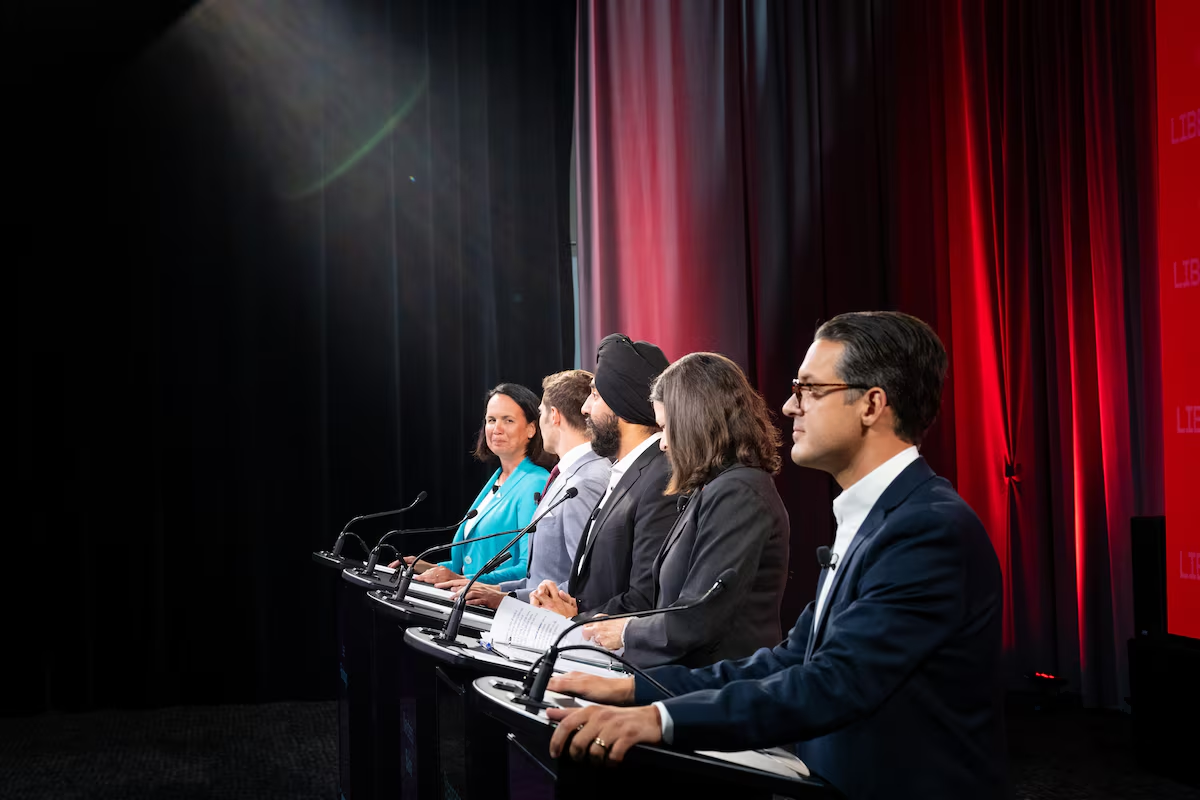

Open this photo in gallery:
From left, Ontario Liberal Party leadership candidates Lee Fairclough, Eric Lombardi, Navdeep Bains, Stephanie Bowman, and Dylan Marando prior to the Ontario Liberal leadership debate in Brampton, Ont., in August.Arlyn McAdorey/The Canadian Press
The Ontario Liberal Party will name its new leader – once again – on Saturday, as it looks to rebuild after three consecutive election losses with the goal of presenting a serious alternative to Premier Doug Ford’s Progressive Conservatives in the next election.
The best-known candidate in the race is former federal cabinet minister Navdeep Bains, who is facing a stiff challenge from first-term MPP Lee Fairclough, who represents Etobicoke-Lakeshore in west-end Toronto – not far from Mr. Ford’s home turf.
If Ms. Fairclough, a former hospital executive and national women’s rugby player, wins the leadership, it would be a significant upset for Mr. Bains. Once the federal industry minister in former prime minister Justin Trudeau’s government, Mr. Bains left his high-profile position at Rogers Communications earlier this spring to return to politics.
The other contenders are Stephanie Bowman, a former finance executive and two-term MPP from Toronto, and Dylan Marando, a former senior adviser in federal and provincial Liberal governments.
The Ontario Liberals, currently in third place in the legislature, have struggled to regain prominence since losing government to Mr. Ford’s PCs in 2018. The new leader will be the party’s third since 2020. Interim Leader John Fraser has held the temporary job three times.
But there are signs of a resurgence for the former ruling party, which has seen its popularity rise in polls this year as Mr. Ford struggled with controversies such as the purchase and hasty resale of a $28.9-million private government jet. The government is also under pressure this fall as it grapples with the fallout from alleged abuse of the Ontario Student Assistance Program by private career colleges.
Open this photo in gallery:
Ontario Premier Doug Ford arrives at the Ontario Legislative Chamber in Toronto, on Wednesday.Chris Young/The Canadian Press
The debate over whether the new Liberal leader should have a seat in the legislature has also dominated the discussion, with Ms. Fairclough and Ms. Bowman, the only contenders currently in the legislature, arguing it is necessary to take on Mr. Ford immediately.
Previous Liberal leaders Steven Del Duca and Bonnie Crombie resigned their posts after the party lost the 2022 and 2025 provincial elections. Neither held a seat when they were named leader.
Liberal strategist Marcel Wieder, who has served as an adviser to Ms. Crombie, said this year’s leadership race comes at a critical time for the party.
“The government has a shelf life. And the Ford government has basically reached that shelf life,” said Mr. Wieder, president and chief advocate at public affairs firm Aurora Strategy Global, who is neutral in the Liberal leadership race.
“The Liberals have a very good shot at being the alternative to the Ford government, but they need a leader who’s going to be able to step up and demonstrate that. And that’s the challenge right now.”
Ms. Fairclough, who has visited all 124 ridings, has built momentum throughout the race, gaining volunteers and donors as well as high-profile endorsements, including from former premier Kathleen Wynne. Ms. Fairclough has pitched herself as the antidote to Mr. Ford: a serious leader, with substantive policy around health care and affordability.
But others in Mr. Bains’ orbit believe his higher profile and experience as a long-time political organizer in the Greater Toronto Area will benefit him in a race where a candidate’s ability to get out the vote will be crucial to electoral success.
Mr. Bains’ camp estimates that he has signed up about 80 per cent of the new members enrolled during the leadership race, who total less than half of the party’s 55,000 eligible voters.
Open this photo in gallery:
Mr. Bains is the best-known candidate in the Ontario Liberal leadership and has raised the most money of the four contenders.Arlyn McAdorey/The Canadian Press
Mr. Bains is also the top fundraiser, taking in about $900,000 during the course of the race, compared with Ms. Fairclough at $700,000, Ms. Bowman at nearly $600,000, and Mr. Marando at more than $200,000, according to the campaigns’ latest numbers.
The Ontario Liberals are using a new two-step voting system, mirroring that of the federal party, although the provincial party says it has made improvements since Mark Carney won the federal leadership in March 2025. The Liberal Party of Canada instituted a rigorous process during that race to stave off concerns about foreign interference, which led to a 38 per cent turnout and some reports from registered Liberals of difficulty verifying their identities.
In the provincial contest, the party is using the same Canada Post Identity+ phone app to verify members identities. Earlier this week, the party experienced a glitch with its in-person verification system that it said affected less than 20 per cent of members – but it said the problem was remedied in time to allow members to cast ballots.
Liberals vote using a ranked-ballot system, with all ridings weighted equally by points. If a contender does not get more than 50 per cent support on the first ballot, voters’ second or even third choices are distributed until a winner is named.
Liberal strategist Dan Moulton, a partner at public-affairs agency Crestview Strategy who donated to Mr. Bains’ campaign, said he believes the former federal minister has the most sophisticated organization of any candidate.
“Turning out new members and getting them to vote is what wins a leadership race like this,” said Mr. Moulton, who doesn’t have a formal role on the campaign.
All four candidates spent the past week reaching out to voters to ensure they mark their ballots.
Mr. Bains said he’s feeling positive heading into Saturday’s leadership announcement event, making upwards of 200 calls a day.
“The goal is always to win on the first ballot. I mean that’s how we started the campaign with that mindset, and that remains our focus,” he said in an interview.
Regardless of the outcome, he said he’s committed to running in the next provincial election.
Open this photo in gallery:
Ms. Fairclough has emerged as a strong challenger to Mr. Bains, building momentum with high-profile endorsements, including from former premier Kathleen Wynne.Arlyn McAdorey/The Canadian Press
For Ms. Fairclough, the focus has been on meeting as many supporters as possible and pushing her vision for a more serious government.
“I have asked to be first on the ballot, and if I am not first on your ballot, I would like to be second as well,” she said. “I do feel strong support.”
Ms. Bowman has told her supporters to vote with their hearts, but believes the next leader having a seat is crucial. “Being a third place party for the last eight years, and having tried a leader without a seat twice – you know, it is important for us to not make that mistake again.”
At 39, Mr. Marando has focused on generational change, and said his policy ideas have been cited by other candidates. “I’m in, potentially, the deluded stage of the campaign, because I’m convinced I’m going to win,” he said.
As for Mr. Ford, he told reporters this week he doesn’t have a preferred pick.
“All of them would be a disaster for this province.”