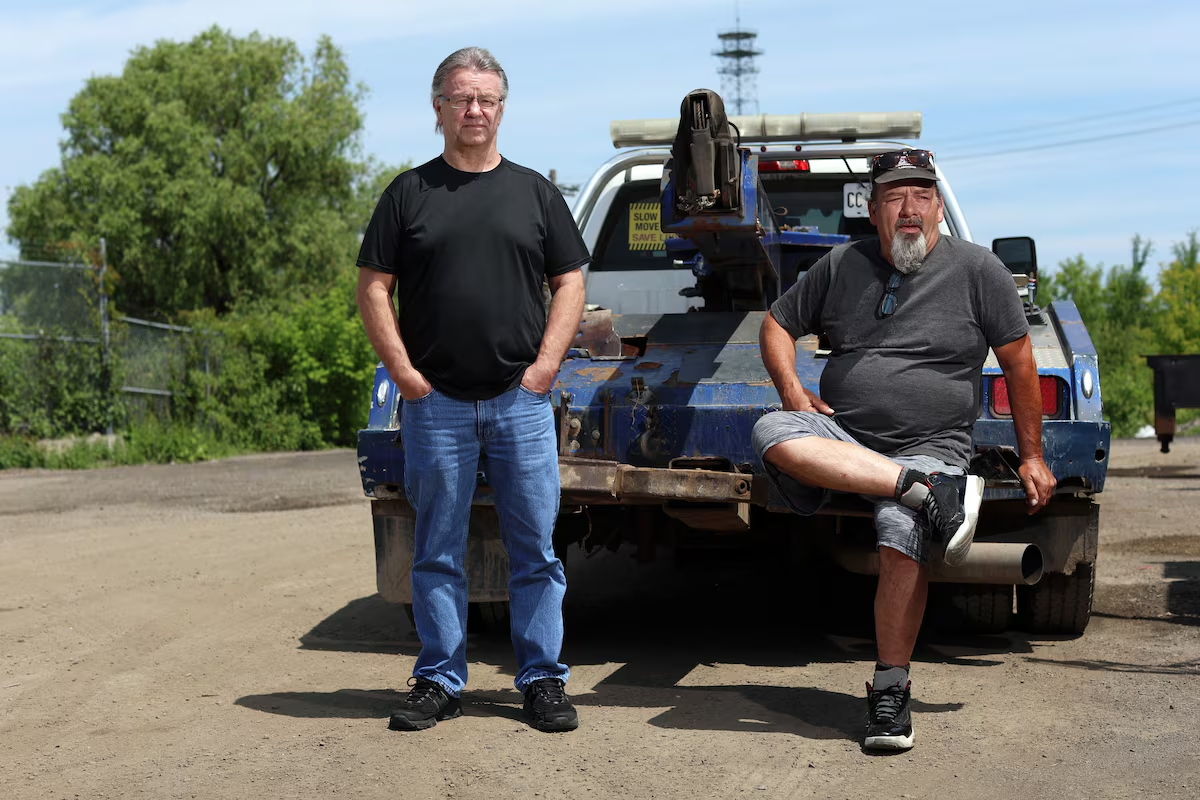

Open this photo in gallery:
The court’s decision clears the path for André Thibault and Sean Ramsay to apply to drive tow trucks again, says their lawyer.Dave Chan/The Globe and Mail
The Ontario government cannot permanently ban people who have drug-trafficking convictions from driving tow trucks, according to the Court of Appeal.
In a decision issued Monday by a three-judge panel, the Ontario Court of Appeal sided with two tow-truck drivers who alleged Premier Doug Ford’s government had been unfairly barring them from seeking certification under a new law intended to keep criminals out of the tow-truck industry.
As The Globe and Mail previously reported, André Thibault and Sean Ramsay alleged the new rules cast too wide a net.
Ontario tow-truck drivers ousted by province’s rules ask Ford for appeal process
The Ontario government passed a law in 2021 giving it control over tow-truck certifications. New screening requirements imposed in July 2024 bar drivers with certain kinds of criminal histories – including those who have weapons bans – from holding certifications.
When the regime started, it began screening out people convicted of drug-trafficking offences – regardless of the date or nature of the crime committed – because such convictions in court automatically impose a lifetime weapons ban.
However, the appeal court has now ruled that permanently barring these drivers from certification is “illogical,” given how the same regulations spell out a punishment written specifically for convicted drug dealers.
There can be no certification in such cases only if “a person has been convicted or found guilty in the preceding ten years of an offence,” these regulations say.
The Court of Appeal did not overturn the new regulation or the Ministry of Transportation’s previous decision to deny the drivers certification. But the ruling does say that such applicants “should be certifiable once 10 years have elapsed since their conviction.”
Gib van Ert, the lawyer for Mr. Thibault and Mr. Ramsay, said the decision clears the path for his clients to apply to drive tow trucks again.
“What the Court of Appeal has now said is that the government got it wrong,” Mr. van Ert said. “They are very much looking forward to getting back to work just as soon as they can.”
Towing industry a consistent thread in many police corruption cases
Mr. Thibault had been convicted of drug trafficking in 1999 and Mr. Ramsay had been convicted in 2002. Both men, who served their sentences decades ago, have never faced criminal charges since.
Mr. van Ert said he anticipates that dozens of screened-out drivers with long-ago drug-trafficking convictions could seek to work again.
“People who had been working for sometimes 20 years or more as tow-truck drivers, but who had old criminal records, were suddenly thrown out of work,” he said. “And so, my two clients – but others that I’ve heard about as well -have lost their livelihoods, even lost their business, for two years now, because the government took the view they were not qualified under the new regime to be tow-truck drivers.”
The Court of Appeal ruling says that the legal costs of Mr. Thibault and Mr. Ramsay must now be paid by the government.
But they will still remain out of pocket for lost wages. “They still lost two years of their livelihoods,” Mr. van Ert said. “This ruling doesn’t solve that problem.”
The Globe reached out to the several Ontario government ministries for a response to the Nov. 9 ruling but received no reply.
A spokesperson for the province’s legal department said no comment will be made. “As this matter is within the appeal period, it would be inappropriate to comment,” said Colm Cobb Howes, a spokesman for the Ministry of the Attorney-General.
In the GTA’s tow-truck turf wars, the race for profit leads to road rage, violence and intimidation
Ontario Ministry of Transportation spokeswoman Julia Caslin said last year that, by mid-2025, officials had refused more than 550 applications from prospective tow-truck drivers on the grounds they had disqualifying records.
During the case at the Court of Appeal, lawyers representing the province had argued that the appeal should not be heard. They said the certification regime and its punishments were a necessary response by Queen’s Park to the violence wrought by the recurring tow-truck turf wars, especially in the Greater Toronto Area.
“The industry was wracked with unprofessional and criminal conduct that engendered widespread fraud and consumer exploitation, allowed organized crime to thrive, and threatened the well-being and lives of customers,” Waleed Malik and his co-counsel Maia Stevenson wrote.