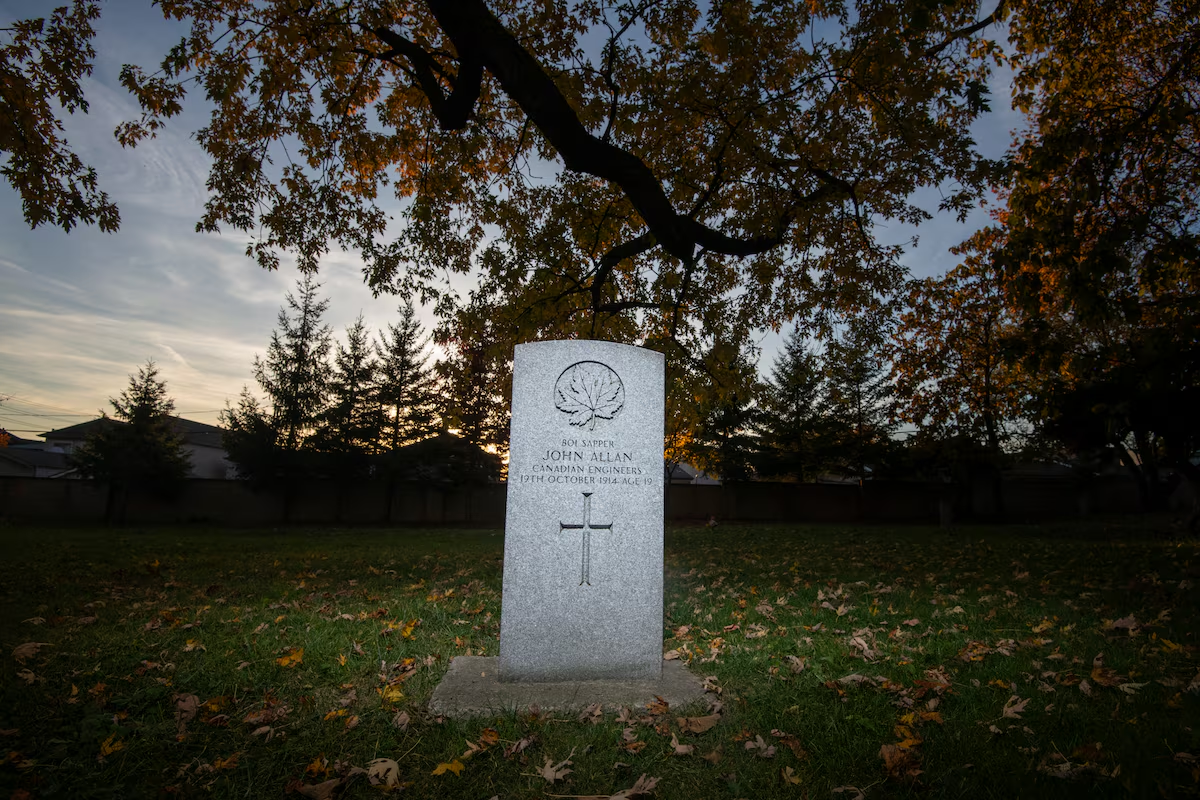

In a corner of Toronto’s Prospect Cemetery, a collection of granite headstones stand in a broad lawn shaded by tall, old trees. Most bear the maple leaf logo that identifies them as fallen warriors of the First World War.
On a gentle autumn afternoon last week, Helen Williams walked among them, stopping to scrape lichen from the stone. The Commonwealth War Graves Commission is responsible for caring for 15,000 such graves at nearly 3,000 Canadian sites. Until recently, tending them meant dispatching staff all over the country, including 10 provinces and the Yukon, a strain on both the commission’s budget and the country’s environment.
So the commission put out a call for volunteer grave tenders, spreading the word through social media and chapters of the Royal Canadian Legion. Spokeswoman Katrielle Ethier says the program has been a “resounding success.” Since it started last year, more than 600 people have stepped up. Like sons and daughters caring for the resting place of a beloved parent, they look after the graves of long-dead warriors, scrubbing their headstones and trimming the weeds around their plots.
Open this photo in gallery:
Helen Williams is a volunteer grave cleaner at Prospect Cemetery in Toronto. A maple leaf denotes that this grave belongs to a First World War soldier.
Ms. Williams, 59, joined the program last year, just after her husband retired from the Army. Richard Williams, a signals officer, served for 36 years, doing stints in Haiti, Afghanistan and Norway, as well as numerous Canadian posts, eventually rising to the rank of lieutenant colonel.
The couple, married now for close to 40 years, visited war graves around Canada and the world as Mr. Williams hopped from place to place.
They were moved by the painstaking care that went into memorials such as those near Juno Beach in Normandy, where Canadian forces came ashore on D-Day, and at Beaumont-Hamel, where soldiers of the Newfoundland Regiment were mowed down in the Battle of the Somme.
Open this photo in gallery:
When cleaning headstones, volunteers such as Ms. Williams aren’t allowed to use solvents or steel brushes that might damage them.
The couple wanted to help make sure that fallen soldiers buried at home in Canada got the same measure of respect. Ms. Williams was assigned 20 graves in Prospect Cemetery, which spreads north of Toronto’s St. Clair Avenue West. Mr. Williams got the same number in Mount Pleasant Cemetery, the lovely oasis in North Toronto where people come to walk and bicycle.
He says the work gives them the chance to honour those who gave their lives and to “make sure they’re remembered in some way, shape or form.” These Canadians made the “ultimate sacrifice,” he says, and we need to “reflect on that every time we get a chance.”
His wife adds that, because Canada never suffered foreign occupation during the world wars, it is sometimes hard to remember why deaths like these matter. Visiting the graves in Prospect and other places like it remind us.
“When we learn from history,” she says, “sometimes we can avoid making the same mistakes.”
Ms. Williams brings a knife to cut away the turf that encroaches on the headstones and a dishwashing brush and plastic scraper to remove the moss, lichen and dirt that accumulates on the grey granite. She uses a special app on her phone to document and report any bigger issues. If the inscription on a headstone is becoming too worn to be legible or a marker is listing and threatening to fall over, the commission will send professionals to make things right.
Tending the graves of her 20 warriors, she often wonders who they were, what they did and who they left behind. She also thinks of the times when her husband went out the door to do his job and how she and her children worried whether he would be coming back.
What was originally called the Imperial War Graves Commission was founded in 1917. Throughout most of history, the bodies of those who were killed in battle lay where they had fallen, unmarked and unremembered except by those who loved them.
Open this photo in gallery:
A Canadian soldier pays respects at an informal grave near Vimy Ridge in 1917. That year was a turning point in how the British Empire’s militaries buried their dead.George Metcalf Archival Collection / The Canadian War Museum
After the mass slaughter of the First World War, the war’s victors decided that that must change. Prodded by a visionary Englishman, Fabian Ware, who had served in a wartime ambulance unit, they set up the commission with the goal of honouring all of those who died, regardless of their rank. It combed the battlefields for bodies and reburied those that could be recovered, memorializing them in the lush cemeteries with rows of neat tombstones that have come to symbolize the scale of the loss.
Today, the commission oversees 23,000 cemeteries and memorials around the world, paying tribute to 1.7 million casualties of both the First and Second world wars. To keep those graves in good condition, it relies on an army of inspectors, masons and gardeners.
Most of the more than 60,000 Canadians killed in the First war lie in Europe. By agreement, the bodies of those who died overseas were not repatriated to their home countries. But thousands lie in Canada, too. Some sustained wounds or contracted illnesses during the war and died after coming home. Others died while training in Canada. Still others perished at sea. Six out of 10 commission sites consist of just a single grave, like that of Lieutenant Roy Leslie Rogers, who died in 1919 and is buried in a small cemetery in Oxbow, Sask. Other sites have hundreds.
Open this photo in gallery:
Three Canadian casualties of the First World War are laid to rest in 2023 in Loos-en-Gohelle, France, at a cemetery managed by the Commonwealth War Graves Commission. Their remains had been found during construction work around nearby Lens.DENIS CHARLET/AFP via Getty Images
Open this photo in gallery:
The commission also manages the Vimy Ridge memorial, which appears on Canada’s new $20 bills. On the other side is King Charles III, who honoured Britain’s war dead this past Sunday at the cenotaph in London.Justin Tang/The Canadian Press
Prospect Cemetery contains the dead of both world wars. Many of the men buried there are from Earlscourt, a local community with many working-class immigrants from Britain. They went off to the First war in droves.
In the park where Ms. Williams works, one headstone marks the resting place of Private Frederick Armes, 45, who died of pneumonia while serving at a Toronto training camp, according to the Veteran Affairs website. His son William, fighting in Europe, died a month later.
Another commemorates George Veals, who left his job at a tram service, the Toronto Street Railway Company, to join the navy. He was in Halifax completing his training as a wireless telegraph operator when two ships, one of them carrying munitions, collided in the harbour, setting off an explosion that killed close to 2,000 people, including Mr. Veals, on Dec. 6, 1917.
Open this photo in gallery:
One of the men buried at Prospect Cemetery died in 1917’s Halifax Explosion, the deadliest disaster in Canadian history.
Yet another bears the name of trapper and guide Bertie Nakogee of the Northern Ontario’s Taykwa Tagamou First Nation. He enlisted in Moose Factory, Ont., and died, also of pneumonia, in the hospital of his Toronto base the day after Christmas 1916. Though he was buried with military honours, he did not get a proper headstone until 2012, after an amateur historian uncovered his story and told the commission. The day Ms. Williams visited, a small Canadian flag fluttered beside the marker.
Visiting such graves, she always takes care to say the name on the headstones out loud, something she did when she visited overseas war cemeteries on her travels. When asked why, her eyes grow misty. Finally she answers: “No one is ever really gone as long as somebody says their name.”
Lest we forget: More from The Globe and Mail
The Decibel podcast
Thanks to a recent and widespread overhaul, the Canadian military is organized much differently than in generations past. Journalist Gavin John spoke with The Decibel about the changes and how they reflect a new kind of warfare. Subscribe for more episodes.
Commentary
Ian Cosh: How veterans remember the lives of men they’ve killed
R.H. Thomson: We should make Ottawa’s Peace Tower a true tribute to peace
John Ibbitson: We’re looking on – and mourning – the end of the American-led world order