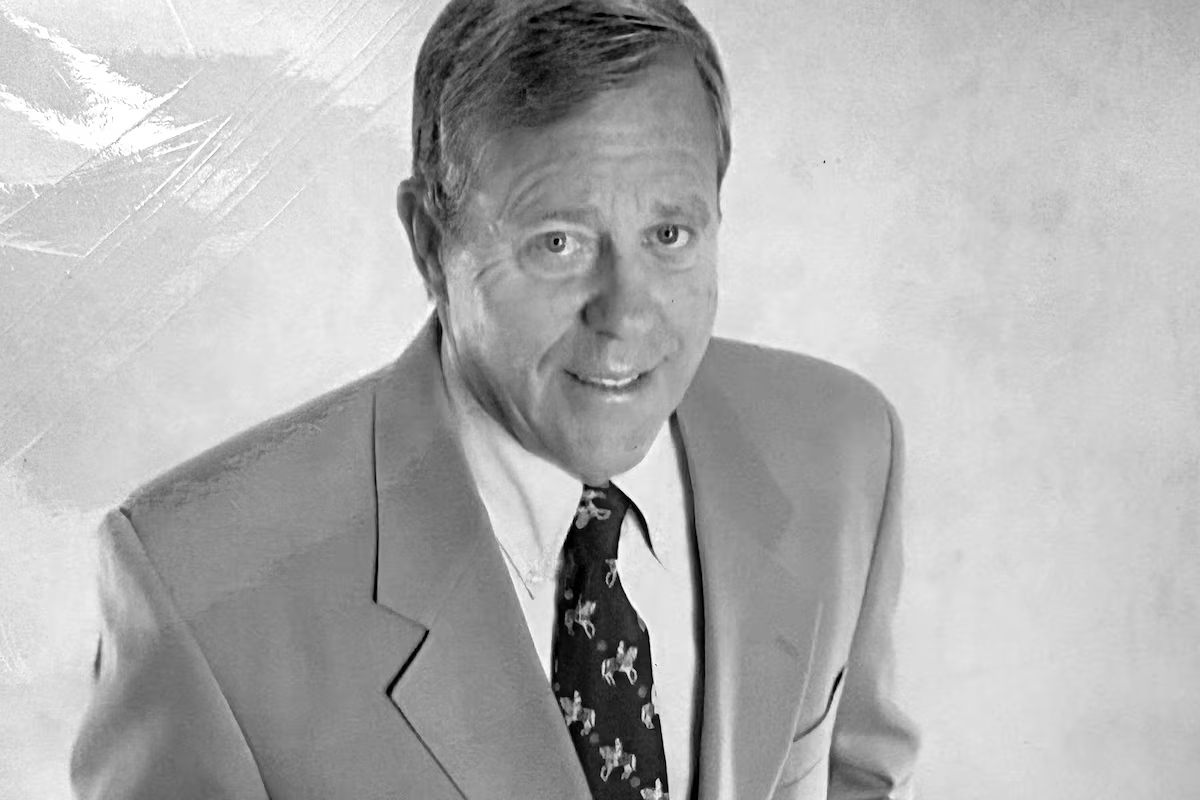

Open this photo in gallery:
Raymond Heard, born in in Johannesburg, South Africa, died in Toronto on Oct. 17 at age 90. He had a storied career in Canada as a journalist, media advisor and speech writer.Gillian Cosgrove/Supplied
It was late in the afternoon of Sept. 25, 1979, in the vast newsroom of the Montreal Star, the city’s long-dominant English-language daily. Raymond Heard, the newspaper’s brash managing editor, jumped up on a desk to make an announcement.
The Star was closing immediately, and the paper about to hit the streets would be its last, he told the stunned journalists. More than 1,000 newspaper employees would be left jobless.
“Nobody knew anything about it beforehand,” said David Yates, an overnight copy editor at the Star who later went on to a career at the Montreal Gazette, the Star’s historic rival, which became the city’s only English-language daily.
The Star’s demise was the result of a grueling eight-month strike by production workers which had ended several months earlier. The Star, arrogant after years of market superiority, had lost advertisers and subscribers during the dispute, never to recover.
Mr. Heard had been appointed the paper’s managing editor three years earlier, at the age of 39. The South African-born journalist had been a foreign correspondent in Washington and London, a restless man brimming with ideas and an avid skier, tennis player and surfer.
“I would wait for my shift to end at 8 a.m., when Ray Heard would barrel into the newsroom with his hair still glistening from the shower,” Mr. Yates recalled. “He would order remakes on the front page, much to the chagrin of the news editor and rim staff who had worked all night putting it together. Ray was hyper-energetic, a South African surfer dude.”
The closure of the Star would force reinvention for Mr. Heard, as he moved months later to Global Television News in Toronto. Mr. Heard, who died in Toronto on Oct. 17 at age 90 following a stroke, would take his legendary feistiness to become a media adviser to Liberal leader John Turner and a speechwriter to the top executives of Canada’s largest bank.
“Ray was a true original, always high energy,” said Matthew Fraser, former editor in chief of The National Post. “In media circles, his nickname was the ‘Road Runner.’ He charged at life with gusto and ebullience, his mind always spinning with brainwaves. He was also a great raconteur. Ray had entertaining gossip and stories about everything and everyone.
“He was a classic last-century print journalist,” said his lifelong friend Peter Kent, the former foreign correspondent and MP whom Mr. Heard urged to join Global News in 1992. “Ray was a creative force in newsrooms, control rooms, boardrooms and political backrooms.”
But that boundless energy and drive could irritate and exasperate others, which Mr. Heard himself seemed to acknowledge. When Peter C. Newman wrote a biography of media mogul Izzy Asper, he called Mr. Heard “the father” of Global News, a moniker which one former Global staffer said really belonged to former foreign correspondent Bill Cunningham. Mr. Heard responded that “while some people at Global may have seen me as the ‘father,’ others regarded me as an SOB.”
Raymond Elliott Heard was born on Dec. 18, 1935, in Johannesburg, South Africa, the elder of two sons of George and Vida Heard, both of them journalists. George, a crusading anti-fascist writer disappeared mysteriously in 1945 and was presumed dead, leaving Vida to raise their two young sons alone.
Raymond grew up in the city of Durban, where he learned to surf as a boy on its Indian Ocean beaches. He attended University of the Witwatersrand while working at night at the Rand Daily Mail, the legendary white-owned newspaper that opposed apartheid and closed in 1985. As a reporter, he covered the treason trial of Nelson Mandela and the Sharpeville Massacre, where police opened fire on a peaceful anti-apartheid protest in the township of Sharpeville, killing 69. He earned a BA in political science in 1960.
Mr. Heard was awarded a Frank Knox Fellowship, which allowed him to continue his studies at Harvard University. In an article for the student-run Harvard Crimson on contemporary South Africa, he described apartheid as “a combination of hatred, fear and ignorance.” Mr. Heard predicted that South Africa’s Black majority would eventually succeed in its struggle for emancipation. “It is merely a question of time now before the pot, which is blackened with much burning, will boil over.”
Mr. Heard had planned to return to South Africa to pursue his career but only did so briefly. With his wife pregnant, he decided that he didn’t want his child to grow up in a racist society, so he applied for jobs in North America, landing a position at the Montreal Star in 1962. But he remained deeply connected to his native country, where his brother, Anthony, was a leading anti-apartheid journalist and editor who became an adviser to the government after the transition to democracy. Raymond was later one of several prominent figures who lobbied successfully for the Canadian government to award honorary citizenship to Nelson Mandela, which it did in 2001.
Open this photo in gallery:
Heard shakes hands with Nelson Mandela after he was made an honorary Canadian citizen in November 2001.Tom Sandler/Supplied
Soon after he was hired by the Star, Mr. Heard was sent to Washington as a White House correspondent, where he also worked as a syndicated correspondent for the London Observer. He witnessed the assassination of Robert F. Kennedy at a Los Angeles hotel in 1968 and covered the civil rights movement and the Watergate scandal.
In 1973, he was appointed editor of the Observer News Service in London, staying for three years until returning to the Star as managing editor.
Mr. Heard moved to Toronto in 1979 and to the fledgling Global Television Network where he eventually became vice-president of news.
“He demanded excellence,” said John Dawe, who was hired as a business reporter when Mr. Heard was at Global. “He was in the newsroom all the time. His nickname was the Tasmanian devil. … He could inspire you but also challenge you.” Under Mr. Heard, the network improved ratings for its news shows and began a noon newscast.
But Mr. Heard clashed with the owners of Global and left in 1987. He moved into politics and was appointed communications director for John Turner, who was then opposition leader in Ottawa.
Eleanor McMahon was a young deputy press secretary who worked for Mr. Heard at Mr. Turner’s office. She will never forget his frantic work style. “He had a busy brain,” she said, though she praised him as a boss who was always generous with his time.
The job in Ottawa wasn’t an easy experience. There were miscues, including when a ship packed with 174 refugees landed in Nova Scotia in July 1987. Mr. Turner initially said that if he were prime minister, he would have turned the vessel away, only to reverse himself after realizing the action would contravene the Geneva Convention on the protection of refugees.
According to The Globe and Mail, Mr. Heard explained to reporters that his boss had neglected to put the issue “in its full context” and then added that “it was very windy that day” and that “Mr. Turner was walking down the street” as reasons why he was misunderstood. The Liberals lost the 1988 election and soon after, Mr. Heard ended his political interlude.
In the 1990s, Mr. Heard was hired by Royal Bank of Canada as a media consultant and speechwriter for the bank’s chief executive officer, first Allan Taylor and then his successor, John Cleghorn.
“He was an exciting guy to work with,” Mr. Cleghorn told The Globe, praising Mr. Heard for his ability to sense what the view of the man in the street was on important issues. “He had tremendous energy. It was a combination of the cerebral and the physical.”
In that role, Mr. Heard travelled to Vancouver in 1996 with a colleague to meet Bob Stall, a columnist with The Province newspaper and a dogged critic of Canada’s big banks. As Mr. Stall told it, Mr. Heard suggested they have lunch together at the Four Seasons Hotel. The bank paid.
The two men had known each other as journalists in Montreal many years earlier but now found themselves on opposing sides, with Mr. Heard whispering advice to big bankers and Mr. Stall writing columns about clients who are wronged by big institutions.
“I think we both feel the other has sunk pretty low,” Mr. Stall wrote.
Mr. Heard used his familiar skills in an attempt to charm Mr. Stall. “Heard, like an off-duty reporter, told gossipy, unverifiable stories about Peter Newman, Allan Fotheringham, John Turner and others I had better not mention.”
Mr. Stall ended the meal by trying and failing to find out Mr. Heard’s salary. The columnist’s sarcastic conclusion: “They seduced me with rich food and wine. … They scored all their points and I saw the light.”
After spending a decade with the Royal Bank, Mr. Heard retired but remained active as a media consultant, working with Gail Asper on the development of the Canadian Museum of Human Rights in Winnipeg and with Calgary real-estate developer Navjeet Singh (Bob) Dhillon.
After the death of the Montreal Star, Mr. Heard mused for a time about founding a replacement. In the mid-1980s, he held talks with the Toronto Sun about starting an English-language tabloid in Montreal and in 2010 he was part of a group of investors that proposed buying several newspapers from the insolvent Canwest chain. But none of these plans ever panned out.
His wife, Gillian Cosgrove, a journalist whom he married in 1977, said Mr. Heard was a left-leaning liberal whose views became more conservative over time. He was an inveterate writer of letters to the editor, which appeared in the National Post, The Globe and Mail and other newspapers, and his pen never lost its acerbic sting.
He called Margaret Atwood a “predictable, middling novelist” in one missive and in another letter, published in 2009, said that Michael Sabia, who had just been appointed as head of the Caisse de dépôt et placement du Québec, was “the biggest upwardly mobile failure in Canadian business history.” Mr. Sabia went on to become the CEO of Hydro-Quebec, federal deputy minister of finance and clerk of the Privy Council.
In a 2010 letter to the editor, he noted that it seemed as if successful candidates for governor-general had to have worked at CBC or Radio-Canada, pointing to Adrienne Clarkson and Michaëlle Jean. He suggested that, in the same spirit, the next holder of the vice-regal job should be Don Cherry or Rex Murphy. “Both would be excellent choices,” he wrote.
Commenting in the Toronto Star in 2015 on prime minister Stephen Harper’s proposed ban on the wearing of the niqab at Canadian citizenship ceremonies, Mr. Heard came to his defence. “Simple logic surely dictates that if a female Muslim can cover her entire face, except for her eyes, I, an agnostic, should be allowed to wear a ski mask when voting or attending other public proceedings.”
Mr. Heard leaves his wife, Ms. Cosgrove; his former wife, Susan Steyn (née Lewis); his daughter with Ms. Steyn, Josie Robson; and three grandchildren. Mr. Heard also experienced tragedy. In 2015, his daughter with Ms. Cosgrove, Jennifer Heard, died at age 28. His son from his first marriage, Antony Heard, died in 2024 at 59.
You can find more obituaries from The Globe and Mail here.
To submit a memory about someone we have recently profiled on the Obituaries page, e-mail us at obit@globeandmail.com.