More than six months on from a report that rang alarm bells about the prevalence of abuse and maltreatment in sport, the head of Canada’s sport integrity agency continues to have “major” concerns about regional gaps in safe sport rules.
Sport Integrity Canada maintains Canada’s Safe Sport Program public registry, which includes the names of more than 80 people who’ve been sanctioned across more than two dozen different sporting bodies.
The registry captures violations of the Universal Code of Conduct to Prevent and Address Maltreatment in Sport, a set of rules governing behaviour around sport that all national sport organizations in Canada had to adopt as a condition of federal funding. It applies to coaches, volunteers, athletes and other leaders across sport.
A New Game Plan Series
WATCH | Sports commission warns of ‘culture of silence’: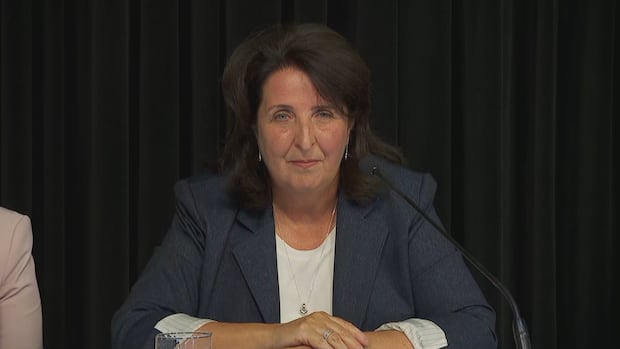
Commissioner of future of sport says ‘widespread abuse,’ ‘culture of silence’ exist at all levels
Lise Maisonneuve, head of the Future of Sport in Canada Commission, says BIPOC, 2SLGBTQ+ and para-athletes in particular face a lack of opportunity across all levels of sport in her report to enhance safe sport and improve the sport system in Canada.
The behaviours captured in the registry range from physical, psychological and sexual maltreatment to neglect and retaliation, among others. Some of the people on the list have been convicted of crimes. Some have been banned from sport permanently. Others faced sanctions such as suspensions or additional education.
It’s a snapshot of abuse and maltreatment in sport in Canada, but far from a fulsome picture.
That’s because most provincial and local sporting organizations aren’t required to adopt the Universal Code of Conduct. Details of maltreatment at those levels may not appear on Sport Integrity Canada’s registry.
“We know that individuals who cause harm in this way can move from one sport to another sport at one level to another level, where their names aren’t being appropriately placed on a registry so people know about it,” Sport Integrity Canada president and CEO Jeremy Luke said.
“It’s a major concern for us. It was a very clear recommendation coming out of the Future of Sport in Canada Commission report and it needs to be put in place in Canada to protect participants who are participating in these sports.”
It’s also not a new concern. Reporting from CBC’s Shattered Trust project chronicled the problems with implementing safe sport rules at the grassroots level, and the consequences of the gaps that exist there, over the last few years.
The evidence shows that despite growing awareness and policy efforts, maltreatment remains deeply rooted in Canadian sport.Future of Sport in Canada Commission report
The Future of Sport in Canada Commission’s final report, released in March, described a system with a longstanding “culture of silence,” and one where racism and discrimination are major issues.
The commission’s work began after a number of athletes spoke publicly and testified in front of Parliament about the harm they experienced during their sporting careers.
“The evidence shows that despite growing awareness and policy efforts, maltreatment remains deeply rooted in Canadian sport,” the commission, led by former Ontario Chief Justice Lise Maisonneuve, wrote. “It affects individuals at all levels, including at the grassroots. These systemic problems require immediate and sustained government action. Although it is not possible to eliminate maltreatment entirely, governments and sport organizations must work together to strengthen and align prevention and response measures so that all participants can safely experience sport’s benefits.”
There are plenty of rules at the national level, where Sport Canada has the power to withhold federal funding to national sport organizations that don’t follow safe sport rules.
It’s below the national level that a hodge podge of safe sport policies persist, from the education every athlete and coach receives, to something as simple and important as background checks, the commission found.
WATCH | The Norway Model:
A New Game Plan: The Norway Model
CBC Sports’ Donnovan Bennett explores Norway’s sporting system, and how Canada might be able to learn from the Nordic nation.
“Participants noted major inconsistencies in safe sport policies across levels of sport and jurisdictions, emphasizing the need for a shared understanding of maltreatment and consistent standards ‘from coast to coast to coast,’” the commission wrote, describing interviews with more than 1,000 participants in the Canadian sport system. “They supported the development of clear and harmonized expectations and remedies for all participants, regardless of sport or level.”
‘Urgent’ need for harmonization
The Future of Sport in Canada Commission said there’s an “urgent” need for more uniformity when it comes to how maltreatment is handled across the country.
More than seven years ago, sports ministers from provinces and territories across the country signed the Red Deer Declaration, agreeing that sport should be a safe place free from maltreatment and abuse. They agreed to work together on issues like monitoring and education.
The declaration led to the Universal Code of Conduct at the national level, but implementation at the provincial and territorial level has been “uneven,” the commission found. Quebec has its own safe sport legislation, for example, while British Columbia created a non-profit called Sport Safeguarding BC to oversee complaints in that province.
Some jurisdictions still don’t have a centralized place for people to file complaints. Many rely on third parties to handle those complaints, a set-up that the commission described as “costly, inconsistent, and affected by perceived or real conflicts of interest.”
The commission called for a pan-Canadian safe sport program that would harmonize rules, education, and the handling of complaints. But that will “take time and political commitment to build,” the commission said.
Luke envisions a system where Sport Integrity Canada can take a leadership role and provide guidance on sharing information and making sure there are consistent rules.
That includes closing the gaps on the registry.
“I think it’s a priority, but I also think we need to get to a place where a priority becomes action and that we can put in place the necessary systems to make it occur,” Luke said.
“There are some challenges around putting in place registries, but what’s most important is that we protect people who participate in sport, particularly vulnerable people, and that we agree as a country that we want to have a registry so that we can properly protect participants in sport from the grassroots level all the way through to the national level.”
WATCH | What can Canada learn from Australia’s sports system?:
A New Game Plan: What Australia can teach Canada about rebuilding its sports system
CBC Sports’ Karissa Donkin takes us behinds the scenes of Australia’s sporting system, and wonders what Canada might be able to take away from how the nation runs its program.
Funding for safe sport
In the last year, the federal government has earmarked more than $1 billion, spread over several years, to a sport system in transition.
Sport Canada has put $17.3 million into Sport Integrity Canada in 2026-27, up from $12.6 million in the previous fiscal year. The Sport Dispute Resolution Centre of Canada also saw a boost, from $1.94 million, up from $1.5 million.
Adam van Koeverden, Canada’s secretary of state for sport, gather sport leaders from across the country for a national summit in Ottawa next Monday and Tuesday, and safe sport will likely be on the agenda.
“Sport Integrity Canada has been among the strongest organizations in terms of their ability to apply for additional funding and demonstrate very, very clearly where the gaps lie and what they need in order to achieve stronger and safer sport systems,” van Koeverden said in a recent interview with CBC Sports. “They’re one of our most important partners and certainly a regulated, mandated organization within the Canadian sport system.”
But the real heavy lifting to close the gap will require a pan-Canadian solution, something the federal government alluded to in an October press release announcing sport funding.
It will take all provinces and territories on the same page with the same vision, and it’s not clear how long something like that might take.
“Addressing maltreatment is a shared responsibility that requires commitment and collaboration from all levels of government across Canada,” the press release from Sport Canada says. “The federal government continues to work closely with provincial and territorial partners to advance safe sport priorities, including independent complaint mechanisms, awareness and education initiatives, and the exploration of a national safe sport registry. Together, these efforts look to build a more coordinated, consistent and effective approach to safe sport from coast to coast to coast.”
Looking abroad
Sport Integrity Canada works with other sport integrity organizations across the world through the International Integrity Group. Canada will serve on the organization’s executive through 2028.
The group includes Sport Integrity Australia, the similarly named organization that has wrestled with many of the same issues as Canada has faced.
More than five years into its existence, Sport Integrity Australia is trying to tackle the fragmentation between levels of government by adding national integrity managers at the state level to help integrate safe sport policies. Australia is also a federation, with powers divided between the federal level and provincial/state bodies.
“It gives us that formal connection from the national to the state level,” Sport Integrity Australia CEO Dr. Sarah Benson told CBC Sports. “By having those integrity managers in place, they’ll also be a connection through to the community level.”

Dr. Sarah Benson, CEO of Sport Integrity Australia, is spearheading a review on the effectiveness of national integrity framework that guides that country’s safe sport. (Karissa Donkin/CBC)
Australia doesn’t have all the answers. Still a young agency, Benson is spearheading a review on the effectiveness of the national integrity framework that guides safe sport in Australia.
She’s also hoping to use a home Olympic and Paralympic Games in Brisbane in 2032 as a vehicle for culture change in Australian sport.
“How can we do things differently that would actually benefit and put the athlete at the centre of what we’re doing?” Benson said. “How can we use sport to actually try and make a difference in those areas that we’ve really been challenged to really shift the dial on in the past?”
But Australia’s sport integrity framework is rooted in legislation that makes it easier to cooperate with law enforcement agencies that are investigating the same issue as the sport integrity body.
It’s something Luke said Canada is missing. Sport Integrity Canada regulates abuse and maltreatment, as well as doping and competition manipulation.
“They [Sport Integrity Australia] have a lot of authority being a government agency that enables them to be able to cooperate with law enforcement and cooperate with other governmental bodies and be able to investigate matters perhaps in ways that we can’t in Canada, given we’re not a government agency and we’re not founded in legislation in the same sort of way,” Luke said.
“I think that’s a model we want to continue to consider the pros and cons of as we look to implement some of these recommendations in Canada and whether that’s a place that we should be evolving to.”