
Listen to this article
Estimated 5 minutes
The audio version of this article is generated by AI-based technology. Mispronunciations can occur. We are working with our partners to continually review and improve the results.
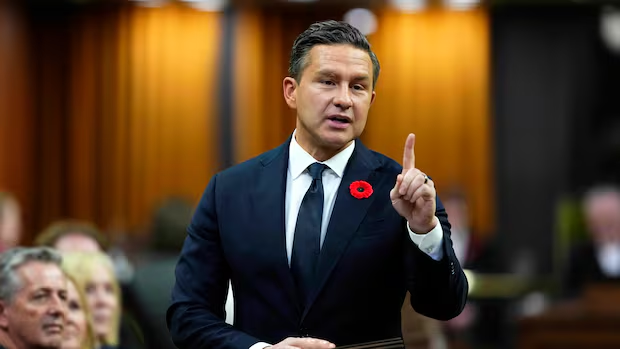
Conservative Leader Pierre Poilievre is criticizing a key feature of the Carney government’s latest budget, arguing the proposed $15-million capital gains exemption on the sale of qualifying shares from a Canadian company applies too narrowly, excluding key businesses.
“Basically, I can’t figure out who actually qualifies,” Poilievre said in an interview on Rosemary Barton Live airing Sunday morning. “I suspect no one does, and you have to be able to stand on one foot and count backwards from a thousand with your finger on your nose before you could qualify for that break.”
In the 2026 federal budget, tabled on Thursday, the Canada Growth Incentive excludes businesses operating in the agricultural, fishing, forestry, financial, insurance, utilities, real estate, food and accommodation, arts, recreation and entertainment sectors.
Because of that, Poilievre said he views it as “insignificant and irrelevant and adds more complexity to the system.” The budget states that the measure is expected to bring $715 million in tax relief over the next four years, beginning next fiscal year.
Prime Minister Mark Carney’s Liberal government is touting the incentive as a way to encourage Canadian founders to build a valuable company in Canada. Early-stage employees can receive more equity as part of their compensation, and investors get a better after-tax return for backing the business.
WATCH | Breaking down Budget 2026:
Budget 2026: Carney makes ‘big bet’ for investment, opposition blasts affordability moves
The Carney government’s second budget lays out over $150 billion in spending to attract investment, accelerate nation-building projects, boost housing and tackle the affordability crisis. The NDP says it favours the rich, while Conservatives call it a ‘credit card budget Canadians can’t afford.’
The budget calls the $15-million exemption “substantial” because founders would retain nearly 96 per cent of the company’s value when they exit, compared with the current 71 per cent.
The move was met with praise by some business groups, including the Council of Canadian Innovators, which advocates on behalf of 175 high-growth companies in Canada. The group said the incentive would create the conditions companies need to attract talent and scale.
Poilievre did express support for Carney’s productivity mega-deduction — expected to cost about $36 billion over five years — saying he believes anything that cuts taxes on investment is “positive.”
But Poilievre’s approach would allow businesses and individuals that reinvest their capital gains back in Canada to fully defer the tax.
“And that would bring back the hundreds of billions of dollars of investment that companies and individuals have parked abroad…. I think that that would be economic rocket fuel. It would be a lot simpler than what Mr. Carney and the Liberals are proposing,” the Opposition leader said.
Poilievre said he personally proposed the idea to Carney and encourages the prime minister to “steal my idea because we desperately need job-creating investment in Canada.”
NDP criticizes affordability measures
The New Democrats have seized on the budget’s tax cuts for new business investment, arguing that the affordability measures for Canadians pale in comparison. In a video statement posted on Thursday, NDP Leader Avi Lewis said, “If you’re a billionaire, this budget is Christmas come early.”
After the budget was read in the House of Commons by Finance Minister François-Philippe Champagne, Lewis acknowledged it earmarks new funds to address homelessness but said it “doubles down on shovelling more money to the biggest CEOs and investors, with the promise that all of us will be better off for it. This has never worked.”
Lewis also pointed out a chart in the budget that shows the spending composition of announced measures. In the chart, $98 billion is listed as “Growth and Investment,” while $48 billion is listed as “People.”
WATCH | Champagne, Lewis spar over government’s second budget:
Champagne walked into the NDP leader’s interview — and Lewis had questions
In an unexpected encounter, Finance Minister François-Philippe Champagne joins NDP Leader Avi Lewis’s interview on Power & Politics and the two argue about the federal budget.
In an interview, Champagne said affordability is “top of mind” and that the budget boosts Canada’s grocery benefit, extends the suspension of the federal excise tax on fuel and includes other measures on dental care and pharmacare.
“So we say two-thirds of the additional revenue we’re getting, we’re going to put that into growth and investments so that our economy will grow,” the finance minister said. “But at the same time, we took one-third and we say, ‘This is where we need to support people.'”
Poilievre criticized the government’s borrowing, saying “government debt does not bring investment. It brings inflation, it brings stagnation and it brings failure.”
“We need to get the government out of the way and off the backs of Canadians so that we can have real free-enterprise growth that pays the bills and puts food on the table,” the Conservative leader said.
Champagne told host Rosemary Barton that it will take time for the government’s proposed tax cuts and productivity measures to translate into tangible benefits for everyday Canadians, but he was bullish on the impact the budget will have in due course.
“This is going to be making us stronger and more resilient,” Champagne said.