
Open this photo in gallery:
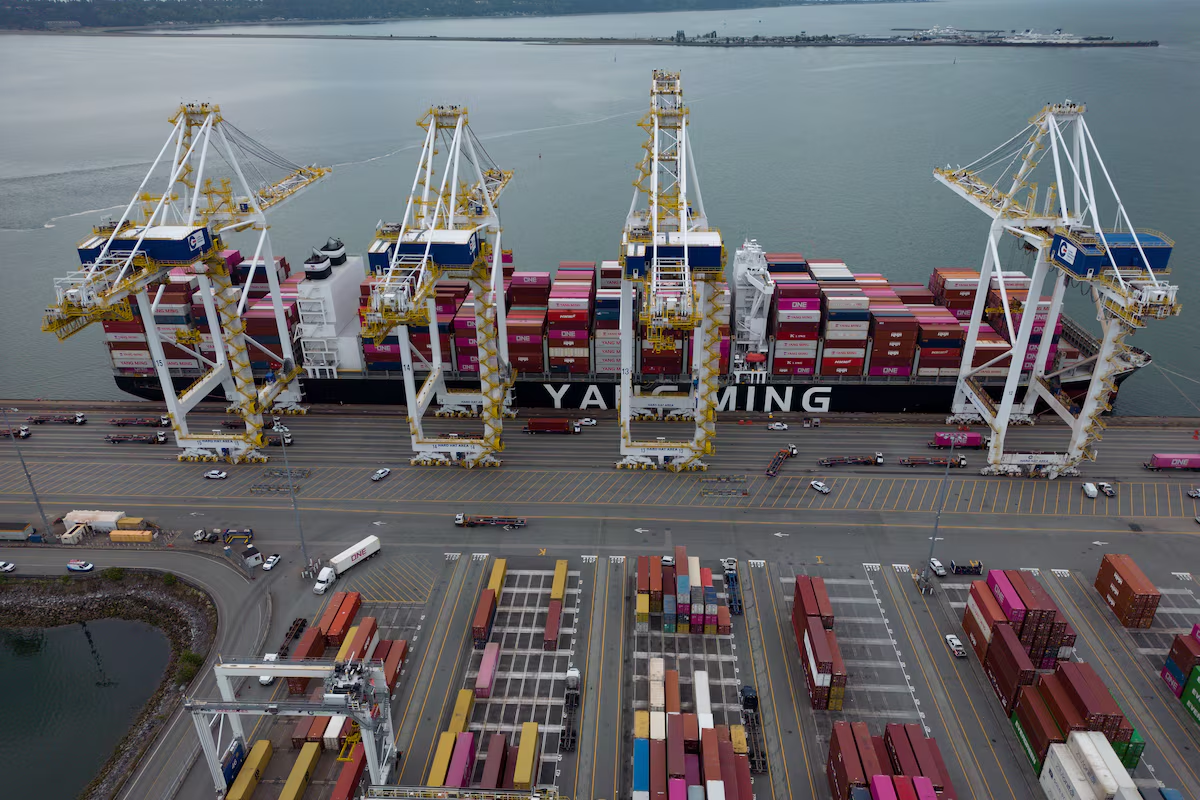
Containers are unloaded from the Yang Ming Throne container ship at Deltaport, at Roberts Bank in Delta, B.C., in July.DARRYL DYCK/The Canadian Press
Ottawa listed a $5.9-billion West Coast port expansion on Friday as a project of national interest, the second large development to be afforded a fast-track approval process under legislation passed by the government of Prime Minister Mark Carney.
Roberts Bank Terminal 2, located in Delta, B.C., is aimed at increasing the port’s container capacity by 50 per cent and supporting up to $100-billion in annual trade, the federal government said in a statement. The expansion is led by the Vancouver Fraser Port Authority.
With the designation, the three-berth container terminal is expected to get a final investment decision by the middle of next year, the government said.
“Roberts Bank Terminal 2 will add much-needed capacity at our largest port, reduce bottlenecks and strengthen the transportation links Canadian businesses count on,” Transport Minister Steven MacKinnon said in a statement.
This is the second major project to be given the coveted designation under the Building Canada Act after the Pacific Link oil pipeline, which was listed at the start of October. The pipeline project would ship one million barrels of Alberta oil a day to the same area of the port expansion south of Vancouver. It is slated to have its approval process completed by Sept. 1, 2027.
Inside the agency advancing Carney’s major projects agenda
Three other developments are awaiting possible listing: the Mackenzie Valley Highway Project in the Northwest Territories, Grays Bay Road and Port Project in Nunavut and a deep nuclear waste storage project in Northwestern Ontario.
All are being evaluated by the Calgary-based Major Projects Office, which the Carney government created as a way to get more developments built to boost and diversify trade. The objective is to bolster Canadian sovereignty against U.S. President Donald Trump’s trade war, the government has said.
The port expansion is aimed at saving $1-billion a year in shipping costs after investments in rail, logistics facilities and port modernization, the government said. It is also expected to reduce delivery times between Vancouver and Toronto by 17 per cent.
The project has already been through more than a decade of regulatory reviews. It includes a marine land mass and wharf structure, a widened causeway to add roads and rail lines, and an expanded tub basin to support shipping.
It is part of a larger Port of Vancouver Gateway Strategy that would also comprise rail infrastructure, land development for bulk terminals and environmental protections.