
Open this photo in gallery:
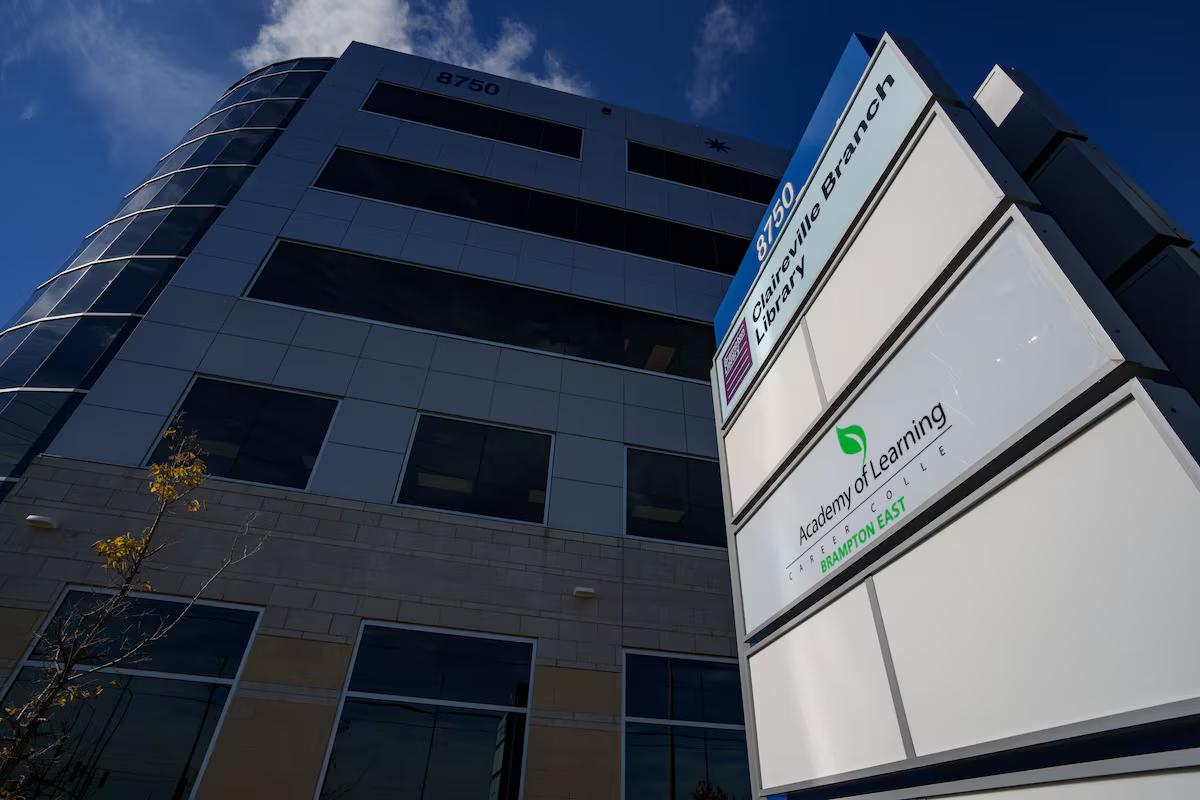
Documents allege that 52 per cent of 2025-26 OSAP applications for Academy of Learning’s Brampton East campus came from one IP address.Arlyn McAdorey/The Globe and Mail
The Ontario government received more than 220 tips and complaints over 2½ years about three private career colleges, some of which alleged that recruiters were filling out financial aid applications and completing online coursework on students’ behalf and using the province’s student aid program as a marketing tool, according to documents filed in court.
As the number of applications for Ontario Student Assistance Plan grants and loans at three Greater Toronto Area campuses of Academy of Learning Career College skyrocketed in recent years, court documents allege thousands of these applications came from a small number of IP addresses, which can reveal an internet user’s approximate location.
Officials in the provincial government’s student financial assistance branch say the usage patterns of the IP addresses point to third parties submitting OSAP forms for students, which would be a violation of the program’s rules.
In depth: OSAP freeze alarms private colleges as minister feels the heat
At Academy of Learning’s North York campus, 3,460 OSAP applications for 2025-26 – approximately 57 per cent of the total – were submitted from a single IP address. Fifty-two per cent of OSAP applications for the Brampton East campus that year came from one IP address, as did 25 per cent of applications for the downtown Toronto location.
The allegations, which are laid out in two Aug. 10 memos confirming the Academy of Learning franchises won’t be eligible for OSAP in 2026-27, are the latest revelations in a case that has reverberated across the private career college sector in Ontario.
In early October, Nolan Quinn, Ontario’s Minister of Colleges, Universities, Research Excellence and Security, announced he was freezing OSAP payments to all private postsecondary institutions, blindsiding tens of thousands of students who had been counting on loan disbursements that had already been approved.
Mr. Quinn said the move was necessary to safeguard the integrity of the financial aid program after suspicious activity was flagged at six Greater Toronto Area private career colleges where OSAP-funded enrolment in online courses soared in recent years.
In Ontario, postsecondary students can qualify for loans and grants based on financial need, but not if the school they attend is not OSAP eligible. To qualify for OSAP, students must live in Ontario and be Canadian citizens, permanent residents or protected people such as approved refugees.
Open this photo in gallery:
Ontario Minister of Colleges and Universities Nolan Quinn speaks to reporters during a scrum at Queen’s Park on Tuesday.Arlyn McAdorey/The Canadian Press
In August, the ministry brought in auditor KPMG to examine the private college sector more broadly. Enough “serious concerns” emerged that the government referred the matter to the Ontario Provincial Police and decided to implement the sector-wide freeze.
The Academy of Learning franchises in Brampton East, North York and on Bay Street, which are operated by the same group, were among the six GTA schools flagged by the province, all of which were informed in May that they would be cut off from OSAP.
The Academy of Learning franchises applied for a judicial review of that decision, kick-starting a legal case that has put details of the allegations against the schools on the public record. (Two locations of Citi College are pursuing a judicial review for similar reasons, but fewer documents have been filed in that case so far.)
The operators of the Academy of Learning franchises have denied wrongdoing. They say they take seriously concerns raised during ministry inspections of their campuses in 2025, and have responded with detailed corrective action plans overseen by a ministry-approved independent compliance monitor.
The new court documents include an Aug. 19 report from the independent compliance monitor, Veronica Bila of accounting firm MNP. The report says Academy of Learning has “implemented the corrective actions committed to” across the three campuses, with one minor exception.
However, MNP struggled to verify the identity of 100 OSAP-funded students selected at random from the schools. Forty-four of the students showed international IP activity on Canvas, the schools’ online learning platform, and 50 showed more than 10 IP addresses accessing their Canvas accounts.
As international student numbers tumble, domestic postsecondary enrolment rebounds
The MNP report includes a spreadsheet documenting attempts to reach the 100 students by phone. Only nine completed interviews. Most didn’t answer or hung up.
One note on a student with an IP address in Afghanistan read, “Picked up and constantly beating around the bush, does not understand English well (I feel) did not want to co-operate.”
A note on another with an IP address from Pakistan said, “Picked up, however, said she doesn’t remember much and did not want to answer. Gave me her spouse’s number to call and ask them – tried the number but the number was invalid.”
The new court documents also reveal that the Academy of Learning franchises and the ministry reached a confidential settlement on July 30. Under its terms, the ministry agreed to a fresh review of the schools’ applications for OSAP approval for 2026-27, while the schools put their legal case on pause.
Eleven days later, on Aug. 10, Saba Ferdinands, director of the ministry’s student financial assistance branch, sent two memos to Chamara Perera, chief operating officer of the Academy of Learning franchises, saying their OSAP status wouldn’t be renewed.
The Editorial Board: Students are paying the price for Ontario’s neglect of private colleges
The memos include line graphs showing mammoth increases in OSAP-funded enrolment in a short period. The Bay Street campus went from 1,387 OSAP-supported students in 2022-23 to 7,429 in 2024-25 – a 436-per-cent increase in two years. The number of OSAP-funded students at the Brampton East campus hit 4,253 in 2024-25, up 455 per cent from 766 students two years earlier. (The North York campus was first approved for OSAP in 2024-25.)
The graphs show that OSAP-funded enrolment at the schools plummeted the following year.
Academy of Learning did not respond to questions for this story by deadline.
The court documents show the province received more than 200 tips and complaints about the Academy of Learning franchises in recent years.
Mr. Perera, in an Aug. 21 response to the ministry contained in the court filings, said the institutions, “cannot reasonably respond to third party complaints, tips and referrals when the substance of the allegations has not been provided to us.”
None of the allegations have been proven in court.
Mr. Perera also wrote that the large number of OSAP applications coming from a few IP addresses could be due to new safeguards that require prospective students to complete in-person interviews and fill out OSAP applications at a computer terminal on campus.
However, that explanation wouldn’t account for patterns the ministry detected before those new policies were implemented, the ministry responded in its final rejections of the schools’ applications for OSAP status on Sept. 4.