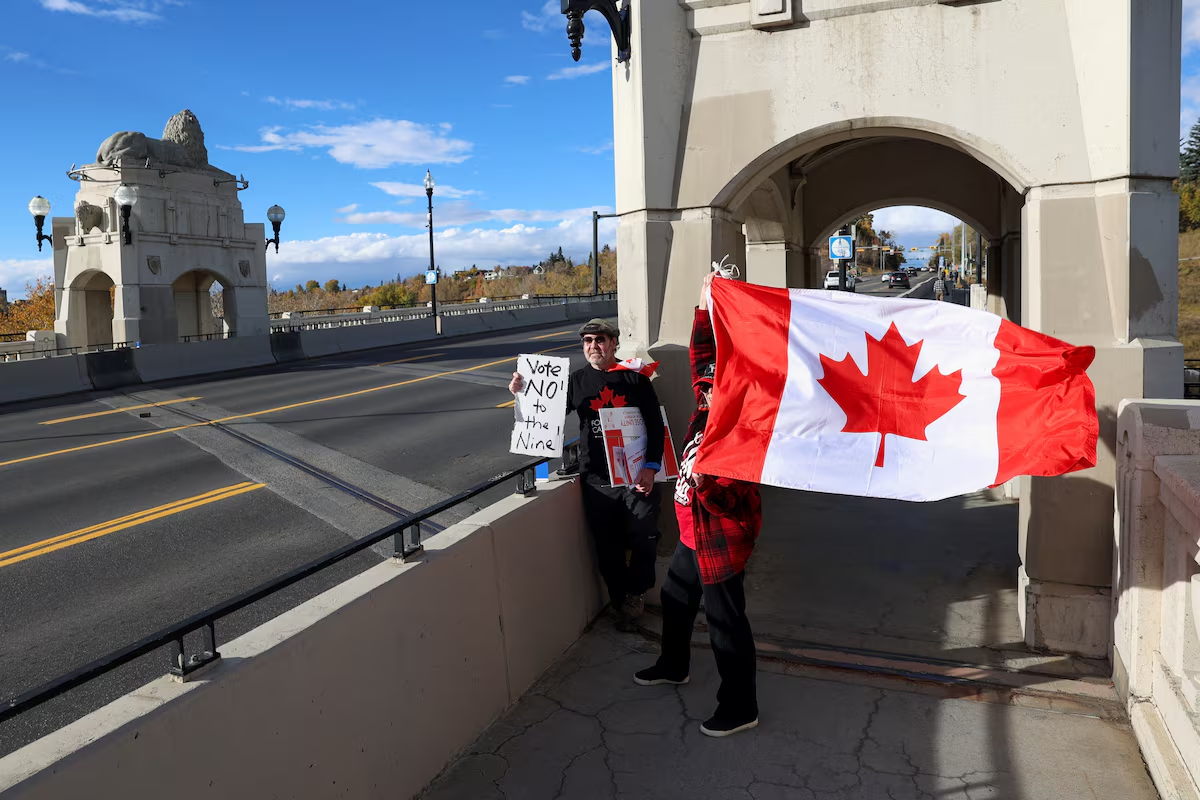

Albertans will head to the polls and make themselves heard in a provincial referendum next Monday.
Voters will face 10 questions. The last one – on whether Alberta should remain in Canada or trigger a secession vote – has dominated headlines and consumed the debate around the vote.
But the other nine, on topics including migrants’ access to social programs, judicial appointments and the future of the Senate, could also lead to consequential changes in the province or even a push to reopen the Constitution. Voters are declaring whether they support the proposals by checking one of two boxes: yes or no.
Ahead of the Oct. 19 referendum, Alberta Premier Danielle Smith has spent $4-million on government advertising focused mostly on the first nine questions. She says to implement her political agenda, she needs direct input from the electorate. Her detractors, meanwhile, have argued the referendum is harmful. They say its questions stoke anti-immigration rhetoric and feed oxygen to the province’s separatist fire.
Here’s what you need to know about the nine questions Canadians have heard less about.
Question 1: Do you support the Government of Alberta taking increased control over immigration for the purposes of decreasing immigration to more sustainable levels, prioritizing economic migration and giving Albertans first priority on new employment opportunities?
Open this photo in gallery:
The federal government sets the ground rules for immigration to Canada via the Citizenship Act, but Quebec has a unique agreement to control part of the selection process.Sammy Kogan/The Globe and Mail
To help understand her immigration proposals, the Premier has asked voters to consider the province that’s recently become Alberta’s unlikely ally: Quebec. The francophone province reached an agreement with the federal government in 1991 that gave it exclusive control over the selection of incoming economic migrants, a unique carve-out Ms. Smith is hoping to mirror in Alberta.
“We have to make sure that we’re involved at the very beginning stages of determining what the market need is,” she said.
She has provided only loose details around how it would be managed. Her government has not said what “sustainable” immigration levels would be, nor who would qualify as an “Albertan.”
While the question proposes decreasing immigration levels, the Premier has recently suggested that she wants to admit more people under the provincial nominee program. Between 2022 and 2025, provincial nominees comprised roughly 58 per cent of economic migrants to Alberta, according to figures from Immigration, Refugees and Citizenship Canada.
The proposals are being floated at a time when migration into Alberta is nosediving after surging from 2022 to 2024, and Ottawa has curbed the number of non-permanent residents entering Canada.
Question 2: Do you support the Government of Alberta introducing a law mandating that only Canadian citizens, permanent residents and individuals with an Alberta-approved immigration status will be eligible for provincially-funded programs, such as health care, education and other social services?
Open this photo in gallery:
Alberta’s Premier has talked about a law to restrict social services to ‘approved’ temporary residents only, but it’s unclear what that would mean.Amanda Erickson/The Canadian Press
This proposal would narrow which newcomers are eligible for social services and, in the government’s words, allow Alberta to “distinguish between the temporary residents it has approved and those it has not.” Unapproved temporary residents would therefore be ineligible for certain provincial benefits, according to a website created by Ms. Smith’s government.
All temporary residents are currently eligible for those services. However, Ms. Smith hasn’t set criteria for how people with “Alberta-approved immigration status” would be selected, nor has she committed to whether the change would affect non-permanent residents already living in Alberta.
Question 3: Assuming that all Canadian citizens and permanent residents continue to qualify for social support programs as they do now, do you support the Government of Alberta introducing a law requiring all individuals with a non-permanent legal immigration status to reside in Alberta for at least 12 months before qualifying for any provincially funded social support programs?
Open this photo in gallery:
Experts dispute Premier Danielle Smith’s claims that non-permanent residents place a burdensome cost on social services.Jeff McIntosh/The Canadian Press
In February, when Ms. Smith unveiled a projected $9.4-billion deficit for the current fiscal year, she blamed two things: low oil prices and immigration. The Premier has since justified her proposals by arguing non-permanent residents are a drag on the province’s finances.
This referendum question doesn’t specify which social support programs would be off-limits to new non-permanent residents.
But according to the government’s website, this proposal would exclude all non-permanent residents from accessing benefits such as child care subsidies, student aid, income supports and other benefits – but not health care and education. The province estimates non-permanent residents’ use of these services cost roughly $100-million annually.
The Premier frequently points to a statistic that says non-permanent residents cost the public system roughly $1-billion for health care and education, while delivering $150-million in taxes in return.
Experts dispute this number. Mikal Skuterud, an economist at the University of Waterloo, said many Canadian citizens cost the public system more than they pay in taxes. Children, for example, don’t pay taxes but are expected to contribute later in life, he said.
“That’s just not the right way to do the fiscal impact analysis,” said Mr. Skuterud, who has advised Prime Minister Mark Carney and his predecessor, Justin Trudeau, on immigration policy. Experts have also pointed out that immigrants often arrive in better health than Canadian-born populations and use fewer health services than non-immigrants.
Question 4: Assuming that all Canadian citizens and permanent residents continue to qualify for public health care and education as they do now, do you support the Government of Alberta charging a reasonable fee or premium to individuals with a non-permanent immigration status living in Alberta for their and their family’s use of the health care and education systems?
Open this photo in gallery:
Alberta, like other provinces, has jurisdiction over health care but relies on federal funding and standards to pay for its public system.Jeff McIntosh/The Canadian Press
As with the other questions, Ms. Smith hasn’t said how this proposal would work – whether it would affect current non-permanent residents, for example, or only those who move to Alberta after the province changes the law.
The Alberta government has not said what it would charge non-permanent residents, but last month Ms. Smith mused about a $1,900 premium for health care, suggesting businesses could shoulder the cost. She didn’t say whether the fee would recur annually but pointed to Britain, which requires temporary residents to pay an annual surcharge for health care.
The Calgary Chamber of Commerce has pushed back on the immigration questions, finding in a poll that only one-third of its membership supports increasing provincial control over immigration, though 41 per cent support limiting eligibility for provincially funded programs.
Alberta Finance Minister Jason Nixon has suggested the government’s immigration proposals wouldn’t be implemented until after the next provincial election, scheduled for October, 2027, when Ms. Smith would seek a second mandate from voters.
Question 5: Do you support the Government of Alberta introducing a law requiring individuals to provide proof of citizenship, such as a passport, birth certificate or citizenship card, to vote in an Alberta provincial election?
Open this photo in gallery:Open this photo in gallery:
This summer, Alberta issued new provincial drivers’ licences with information on citizenship.Government of Alberta via CP
The province says this measure would help ensure only Canadian citizens living in Alberta would be able to vote in provincial elections by requiring voters to produce proof of citizenship at the polls.
Earlier this year, Ms. Smith’s government made that easier by adding citizenship markers to provincial identification and drivers’ licences.
It is unclear what problem this proposal would solve. Elections Alberta currently requires voters to prove their address and accepts 50 forms of identification, including more than 30 types of government-issued ID.
The electoral agency has reported only four instances of ineligible voters casting ballots since 2015, and it verifies voters’ citizenship when they are added to the provincial list of electors. Provincial law requires voters be 18 or older, Canadian citizens and Alberta residents.
“You’re not going to be on that list if you’re not a Canadian citizen,” Shaun Fluker, law professor at the University of Calgary, said of the provincial electors list. He said forcing voters to bring citizenship documents to the polls would add an unnecessary barrier to voting.
Question 6: Do you support the Government of Alberta working with the governments of other willing provinces to amend the Canadian Constitution to have provincial governments, and not the federal government, select the justices appointed to provincial King’s Bench and Appeal courts?
Open this photo in gallery:Open this photo in gallery:
Alberta’s top judicial bodies are based at the Edmonton Law Courts, about a 10-minute drive from the legislature. Ms. Smith would like those legislators to have more say in how judges are appointed.Jason Franson/The Canadian Press
This proposal follows on the coattails of Ms. Smith’s roughly year-long push for judicial appointments to be made by the provincial government.
In January, Ms. Smith wrote to Mr. Carney proposing more provincial involvement in judicial appointments, citing what she described as Alberta’s “distinct legal traditions.” The Premier hasn’t said how Alberta’s justice system operates differently than other provinces. (The justice system in Alberta, like elsewhere in Canada outside Quebec, is rooted in the same common law that stretches back centuries to England.)
This question goes one step further, proposing full provincial control over judicial appointments to the King’s Bench and Appeal courts.
The federal government currently names judges to those courts with the help of 17 judicial advisory committees, including one for Alberta, that assess applicants and make recommendations to Ottawa.
Each committee has seven members: Ottawa names three; the provincial government names one; the province’s chief justice names one; and two lawyers’ groups – one national and one provincial – each get one pick.
Like for all constitutional changes, Ms. Smith would need to convince seven provincial legislatures covering 50 per cent of Canada’s population to endorse reopening the Constitution.
Question 7: Do you support the Government of Alberta working with the governments of other willing provinces to amend the Canadian Constitution to abolish the unelected federal Senate?
Open this photo in gallery:Open this photo in gallery:
Alberta has six seats in the Senate, also known as the Red Chamber for the colour scheme of its Ottawa workplace. Louise Arbour was installed as Governor-General in that chamber this past June.Sean Kilpatrick and Justin Tang/AFP via Getty Images
The federal Senate – the upper house whose members are appointed by the governor-general on the advice of the prime minister – has been a source of discontent among Western premiers for decades over frustrations around underrepresentation.
The “chamber of sober second thought” scrutinizes bills passed by the House of Commons and must approve legislation for it to become law.
Like British Columbia, Saskatchewan and Manitoba, Alberta is currently allocated six of the 105 Senate seats – a contrast to the 30 collectively held by the four Atlantic Provinces.
Alberta has attempted to pressure Ottawa into picking its preferred candidates by holding Senate nominee elections, in which residents vote for candidates they want nominated to the chamber.
Advance polls open for Alberta’s separation referendum
The vote is more of a poll than an election. The results aren’t binding for Ottawa, and in the five Senate nominee elections held in Alberta since 1989, only a handful of winners have subsequently been tapped by the prime minister.
While Ms. Smith would again need seven legislatures covering half of the national population to be on board with opening the Constitution for amendments, the Senate would only be abolished if all 10 provinces agreed. (The Territories aren’t required to sign off.)
Question 8: Do you support the Government of Alberta working with the governments of other willing provinces to amend the Canadian Constitution to allow provinces to opt out of federal programs that intrude on provincial jurisdiction such as health care, education and social services, without a province losing any of the associated federal funding for use in its social programs?
Open this photo in gallery:
Health transfers from Ottawa come with conditions, and the health minister – currently Marjorie Michel, right, with provincial counterparts last year – must make sure those conditions are met.Jeff McIntosh/The Canadian Press
Ottawa transfers billions of dollars to provinces every year to help run programs – funding that comes with strings attached, such as complying with the Canada Health Act, the legislation that requires provinces to provide universal health care in exchange for health care transfer payments.
The province is technically free to run its health care system how it likes, said Lorian Hardcastle, assistant professor at the University of Calgary’s Faculty of Law. But Alberta risks losing federal funding if it runs afoul of the conditions set by Ottawa.
This question proposes cutting those strings while allowing Alberta to continue receiving that federal money, Prof. Hardcastle said.
Such a constitutional amendment could come with major consequences, she said, because it could functionally neuter legislation like the Canada Health Act.
Question 9: Do you support the Government of Alberta working with the governments of other willing provinces to amend the Canadian Constitution to better protect provincial rights from federal interference by giving a province’s laws dealing with provincial or shared areas of constitutional jurisdiction priority over federal laws when the province’s laws and federal laws conflict?
Open this photo in gallery:Open this photo in gallery:
Canada’s Constitution, patriated in 1982 under Queen Elizabeth II, outlines what to do if federal and provincial laws clash. One copy of the document is harder to read than others because a protester doused it in red paint.Ron Poling/The Canadian Press; Dave Chan/The Globe and Mail
The Alberta government says this proposal would shift “default authority” to the provinces when they clash with federal laws – a change that would dramatically reshape the country’s constitutional order.
Federal environmental laws have frustrated Ms. Smith during her premiership, as well as previous Alberta governments.
In 2023, the Supreme Court of Canada found the federal Impact Assessment Act was unconstitutional because aspects of it went beyond Ottawa’s legal authority. The matter had originally been referred to Alberta’s Court of Appeal by the provincial government in 2019.
This referendum proposal is built on Ms. Smith’s trademark Alberta Sovereignty Within a United Canada Act, the first bill she introduced as Premier in 2022, which targeted federal legislation the province believes is harmful.
Ms. Smith has since wielded the sovereignty act in bids to subvert federal electricity and gun laws, but the bill hasn’t been tested in court and legal scholars have panned it as unconstitutional.
Prof. Fluker with the University of Calgary characterized the question as a “rephrased version” of the sovereignty act, adding there are few occasions in which federal and provincial laws directly clash.
“The Constitution is wired around the idea that … federal legislation applies across the country,” he said.
Open this photo in gallery:
Alberta’s decision: More from The Globe and Mail
The Decibel podcast
Last year, Alberta separatists went to Washington offering fresh water and oil in exchange for U.S. support, a Globe investigation learned. Also, Republican operatives gave tactical assistance to separatist groups. Journalists Carrie Tait and Grant Robertson spoke with The Decibel about their findings. Subscribe for more episodes.
Commentary
Tyler Dawson: Don’t buy it when separatists say this is about leverage
Andrew Coyne: This referendum is a pointless stunt, just like the last one
Lawrence Martin: Mark Carney is an Albertan. That’s about to pay off