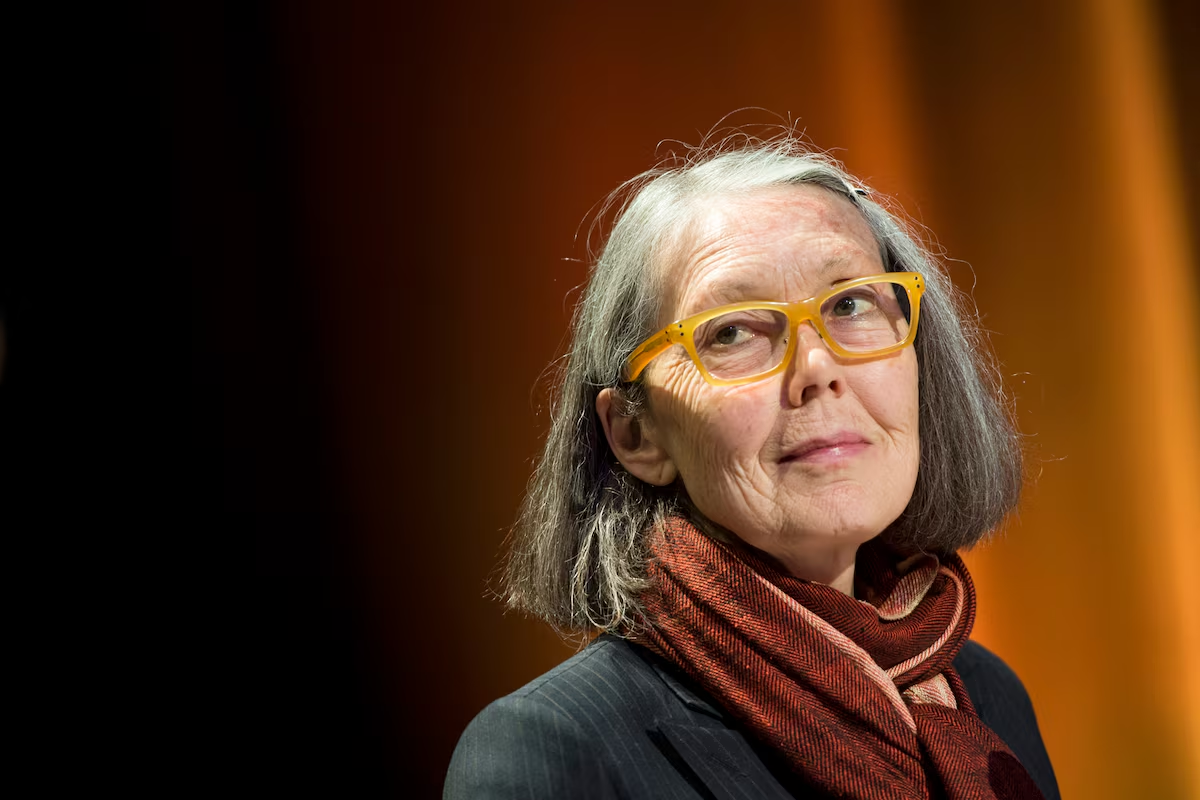

Open this photo in gallery:
Anne Carson, pictured here in 2015, is the third Canadian to be awarded the prize given to a living writer for outstanding career contributions in literature.PONTUS LUNDAHL/AFP/Getty Images
Canada’s Anne Carson has won the Nobel Prize in Literature, worth 12-million Swedish crowns (about $1.7-million). The announcement was made Thursday in Stockholm.
The 76-year-old modernist poet, translator, classics scholar and Member of the Order of Canada was recognized for “her bold and inventive oeuvre that, in playful dialogue with the classical tradition, has created new forms for contemporary literature.”
She is the third Canadian to be awarded the prize, given to a living writer for outstanding career contributions in literature.
“Anne Carson has, throughout her entire career, combined poetry writing with translation work and teaching at various universities. Almost all her literary production has centred upon the intersection between the philologist’s obsession with words and the poet’s desire for new meaning. She has herself identified the etymology of words as the starting point for all her work,” the Swedish Academy said in a statement.
The Toronto-born writer has earned high international recognition before, receiving the Lannan Literary Award for poetry, the T.S. Eliot Prize, a Guggenheim Fellowship, the Princess of Asturias Award for Literature and the PEN/Nabokov Award for Achievement in International Literature.
Reached by phone, Carson told the Swedish Academy she was currently in Iceland “listening to the wind,” and that she was taken by surprise but very happy.
Open this photo in gallery:
Copies of books by Canadian author Anne Carson are on display at the Swedish Academy in Stockholm, Sweden, Thursday.JONATHAN NACKSTRAND/AFP/Getty Images
Among her best-known works is 1998’s Autobiography of Red, both a novel and a poem, both an unconventional re-creation of an ancient Greek myth and a wholly original coming-of-age story set in the present.
In a statement from Carson’s publisher, Penguin Random House Canada, CEO Kristin Cochrane said the poet “continuously dazzles us with her inventiveness and the transformative, revelatory power of her writing.”
The daughter of a banker, Carson grew up in a number of small Canadian towns. The future professor at Princeton University, McGill University and other schools twice quit her own studies at St. Michael’s College at the University of Toronto – a compulsory course on Milton was a deal-breaker for her. She eventually completed a bachelor of arts there in 1974.
From 2002: Who’s afraid of Anne Carson?
Carson’s first book of poetry, 1984’s Canicula di Anna, resulted in her first international literary prize, the Betty Colladay Award from the Quarterly Review of Literature.
Her first book of essays, 1986’s Eros the Bittersweet, “stunned the classics community as a work of Greek scholarship,” according to John D’Agata of the Boston Review. (D’Agata also wrote that Carson’s Men in the Off Hours was “trying its darndest to be poetry.”) Eros the Bittersweet was voted onto the 1999 Modern Library Reader’s List for the 100 Best Nonfiction books of the 20th century.
Michael Ondaatje once hailed Carson as “the most exciting poet writing in English today.”
The previous Canadian winners of the Nobel Prize in Literature are short story writer Alice Munro, who won in 2013, and Saul Bellow, who was born in the Montreal suburb of Lachine but moved to the United States as a child. He won in 1976.
The prize has been awarded 119 times to 123 laureates since 1901. Carson is the 19th woman. Among the illustrious laureates are Rudyard Kipling, Pearl Buck, Winston Churchill, Gabriel García Márquez, Jean-Paul Sartre, Toni Morrison, José Saramago, John Steinbeck, Harold Pinter, Ernest Hemingway and, “for having created new poetic expressions within the great American song tradition,” Bob Dylan.
After receiving the award in 2016, the iconic songwriter waited days before commenting publicly. He ultimately did not attend the Nobel Prize ceremony in Stockholm, choosing instead to meet with the Swedish Academy in a private ceremony there.
From 2000: The unbearable lightness of Anne Carson
Carson is also publicity shy. As noted in a Globe and Mail profile in 2000, she doesn’t like to talk about herself and is so reclusive she wouldn’t permit a photographer for the interview.
Up to that point, despite her international acclaim, Carson had yet to win a major Canadian literary award. (Finally, in 2001, she won the inaugural Griffin Poetry Prize for Men in the Off Hours. She added another Griffin in 2014 and won the Governor General’s Award for English-language poetry in 2020 for Norma Jeane Baker of Troy.)
Asked in 2000 why she didn’t enjoy as enthusiastic a following in her own country as she did in the United States, Carson scoffed: “It’s typical of Canadians. You have to win awards outside this country before they’ll recognize you.”
Open this photo in gallery:
Among Anne Carson’s best-known works is 1998’s Autobiography of Red, both a novel and a poem, both an unconventional re-creation of an ancient Greek myth and a wholly original coming-of-age story set in the present.Craig Barritt/Getty Images
Carson has Parkinson’s disease, which profoundly affects her penmanship and, as a result, hampers her creative process. “Hard to describe or explain the shame of bad handwriting,” she wrote in an essay for the London Review of Books in 2024.
Last year she participated in the album The Great Lakes Suite by the Toronto art-rock band Rheostatics. She read poems from her 1995 book Plainwater for the project.
Established in the will of Swedish dynamite inventor Alfred Nobel, the prizes for achievements in literature, science and peace have been given since 1901.
Hungarian writer Laszlo Krasznahorkai earned last year’s Nobel Prize in Literature for his “compelling and visionary oeuvre that, in the midst of apocalyptic terror, reaffirms the power of art.” He won the Man Booker International Prize in 2015.
The Norwegian Nobel Committee will announce this year’s Nobel Peace Prize winner in Oslo on Friday. Prime Minister Mark Carney is believed to be among the contenders for what is considered the most distinguished award in the world.