
Open this photo in gallery:
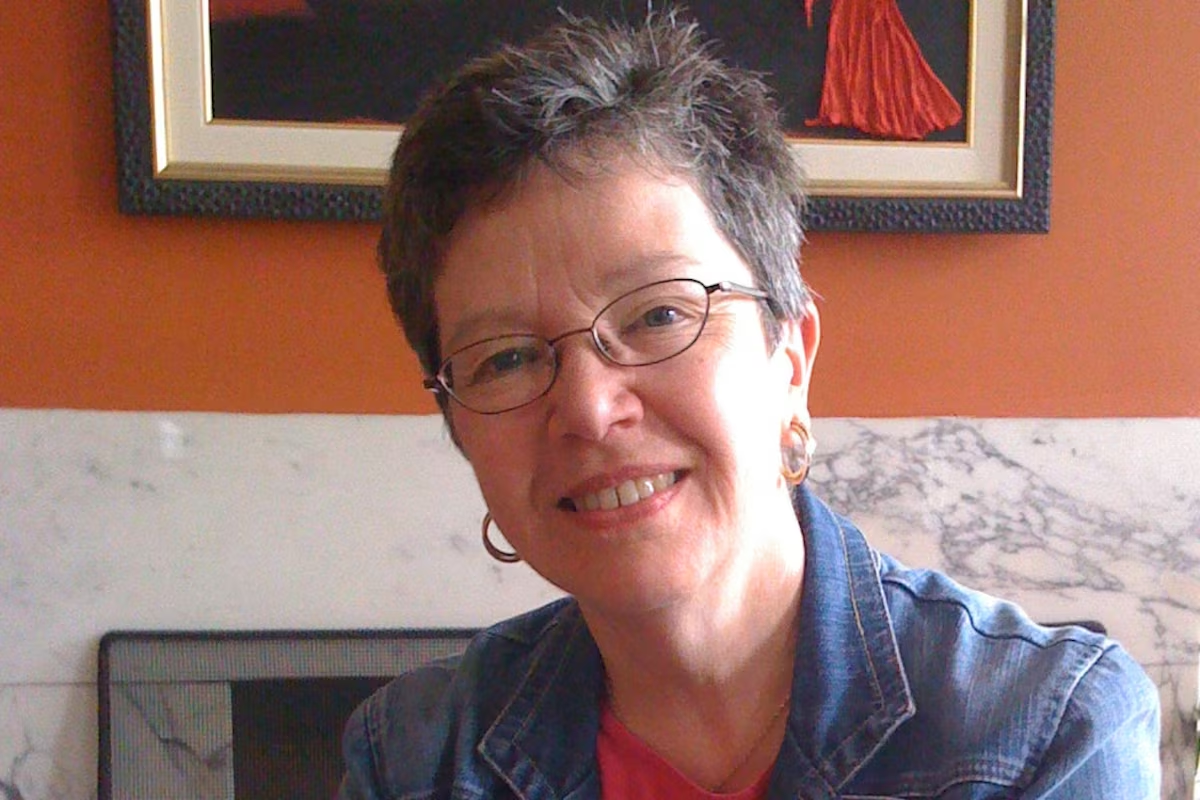
Writer K.D. Miller’s married pristine linguistic technique with an instinct for drama in her fiction work.Elaine Batcher/Supplied
For much of her adult life, author K.D. Miller had a writing ritual. She would rise at 5 a.m., brew a pot of coffee, and head to her desk for two hours before she had to get ready for what she euphemistically referred to as her “day job.”
Fellow writer and good friend Mike Barnes describes Ms. Miller’s writing habit as “monastic,” an appropriate term that hints at the overlap, so central to her identity, between writing and religion. Raised Presbyterian, Ms. Miller was baptized and confirmed in the Anglican Church in 1990, following a period of self-described atheism. On several occasions Ms. Miller, who died in Toronto on Sept. 14 of complications from cancer at the age of 75, described herself as a “default” or “accidental” Christian. It’s the same way her character Robbie describes himself to his friend, the writer Raymond Mayhugh, in the early story A Litany in Time of Plague – a testament to the way Ms. Miller covertly insinuated material from her own life into her fiction.
The title of the story is evidence of Ms. Miller’s preoccupation. On the surface a reference to the poem of the same name by Elizabethan poet Thomas Nashe, the word “litany” carries religious connotations that are unavoidable. And while she eschewed proselytizing about her beliefs – “She was very undogmatic in her approach to spirituality,” Mr. Barnes said – they were an inextricable part of who she was as a person and, importantly, a writer. “Writing stories is the way I pray,” she insisted in her 2001 essay collection Holy Writ, about the confluence between artistic creation and spirituality. One of her later collections, 2014’s All Saints, is a series of linked stories featuring characters associated with the title church.
If religion was one indelible wellspring for Ms. Miller, the other was the theatre. Trained as an actor, she received a BA in drama from the University of Guelph and a master’s in directing from the University of British Columbia, where her thesis was a production analysis of Tennessee Williams’s The Glass Menagerie. In a biographical essay included in the 2003 anthology Writers Talking, she described her mother, the late Isabel Milne Barclay, as “a talented artist and a frustrated actress”; she went on to compare the writing process to Rosalind Russell’s observation that “[g]ood acting is standing up naked and turning around very slowly.”
Writing, for Ms. Miller, involved a similar combination of risk and abandon, something admirers frequently compare to a theatrical performance. “I think it all went back to that early training that she had on stage,” said John Metcalf, who edited her early work. “You had to immerse yourself in [her writing], you had to join the performance. That was what made her so different from many writers in recent years who are firmly outside what they are presenting.”
Novelist Russell Smith also finds aspects of the theatre in Ms. Miller’s work. “She writes these wonderful, humorous but dark monologues. That obviously is the theatrical influence,” he said. It was an influence that was equally apparent in her live readings, which often resembled theatrical performances. This, perhaps, made her the perfect person for that necessary day job: training volunteers at the CNIB in reading books for the blind.
Open this photo in gallery:
Ms. Miller’s 2018 book Late Breaking was both a Governor-General’s Literary Award finalist and a Giller Prize nominee.Supplied
Ms. Miller could be blazingly funny in print: The title story from 2018’s Late Breaking features a pair of competing literary awards – the Biggar Prize and the Olympia Featherstone Award for Fiction – that repeatedly try to one-up each other on the size of their purse. (Somewhat ironically, the book was both a Governor-General’s Literary Award finalist and a Giller Prize nominee.)
But she was also, as Mr. Smith attests, unafraid to present bleak and dark material. In one of her best stories, Magnificat from All Saints, an aged religious spinster witnesses a covert public sex act that crosses the boundary into assault.
“It gets quite gothic and creepy sometimes,” Mr. Smith said about this aspect of Ms. Miller’s fiction. “Who does that remind you of? [Alice] Munro, right away.”
It’s a sentiment with which literary critic Jeet Heer agrees. “There’s the tradition of the Canadian short story where Alice Munro looms very large. K.D. Miller is part of that tradition,” Mr. Heer said. “There’s the idea of the Southern Ontario gothic. I think she was more gothic than most. She did have a sensibility that was partially shaped by things like horror writing.” He points specifically to the 2011 collection The Other Voice as a book that reflects her affinity for writers like Poe and Hawthorne, as well as the uncanny realism of Alex Colville, who served as the inspiration for the stories in Late Breaking. “It’s the idea of realism that’s also a bit unsettling,” Mr. Heer said.
Kathleen Daisy Miller was born on March 6, 1951 in Hamilton, where she lived with her parents and her older brother, Robert Miller. “There was a large family in Hamilton,” says Leah Wallace, Ms. Miller’s sister-in-law. “The Barclays on her mother’s side, the Millers on her father’s side. They actually all lived within walking distance of each other.”
The acting bug bit early. At age 12, Ms. Miller was cast as Annie Sullivan in a school production of The Miracle Worker, and she won the 1967 Hamilton District Collegiate Drama Festival’s award for best actress in Impromptu. She left for Guelph in 1969, graduating with a BA in drama in 1973. She finished her master’s in 1978, “more out of spite than anything else,” she wrote. While in B.C., she met an actor whom she married in 1979; the two divorced in 1986.
Ms. Miller’s first publication was the short story Now, Voyager, which appeared in Flare and won first prize in the magazine’s literary contest. Her first story collection, A Litany in Time of Plague, was published by the Porcupine’s Quill in 1994; the small press in Erin, Ont., also brought out a second collection, Give Me Your Answer (1999), and the essay collection Holy Writ: A Writer Reflects on Creation and Inspiration (2001). A novel, Brown Dwarf, and a story collection, The Other Voice, followed. All Saints was shortlisted for the Rogers Writers’ Trust Award for Fiction, and Late Breaking was a finalist for the Governor-General’s Literary Award, nominated for the Giller, and shortlisted for the Trillium Prize.
An unpublished collection, Alice Walks, is currently under contract with Dundurn Press.
Open this photo in gallery:
Ms. Miller had three core communities, including a group of close friends from university that goes by the moniker ‘The Sisterhood.’Andrew Leith Macrae/Supplied
She had three core communities, according to Ms. Wallace: the community of St. Clement’s Anglican Church, in North Toronto, where she served on various committees and attended service every Sunday; the community at Stanley Knowles Housing Co-operative, where she lived; and the literary community. A group of close friends from university that includes Ms. Wallace and goes by the moniker “The Sisterhood” met regularly over the years.
But she also fiercely guarded her privacy and withheld personal aspects of herself from public view, something Mr. Barnes, the writer, believes goes back to an aspect of performing on stage. “She had a real sense of performance; that’s what made her such a dramatic reader,” he said. “But she had a very firm line she drew: A performance was a performance and then off the stage, that’s your private life. The audience is entitled to your very best on stage, but nothing more than that.”
At her very best, she was at the pinnacle of writers in this country, combining pristine linguistic technique with a theatre impresario’s instinct for drama. Her painstaking craft – honed morning after morning beginning at 5 o’clock, often before the sun rose – resulted in prose that glittered like a polished knife edge. And like a knife, it could cut deep. That said, Ms. Miller herself was not reticent to admit writerly self-doubt. “I don’t think I’m ‘important as a writer’ yet,” she wrote in 2003, “and have no idea if I ever will be. I do know that I’m happy as a writer.”
One person who is certain Ms. Miller’s writing will endure is her former editor, Mr. Metcalf. “Her stories are acted out vigorously in marvellous dialogue. And very funny, some of them,” he said. “The stories were very vital and quite unusual within the body of Canadian writing. She has a place within the literature that will always be remembered.”
You can find more obituaries from The Globe and Mail here.
To submit a memory about someone we have recently profiled on the Obituaries page, e-mail us at obit@globeandmail.com.