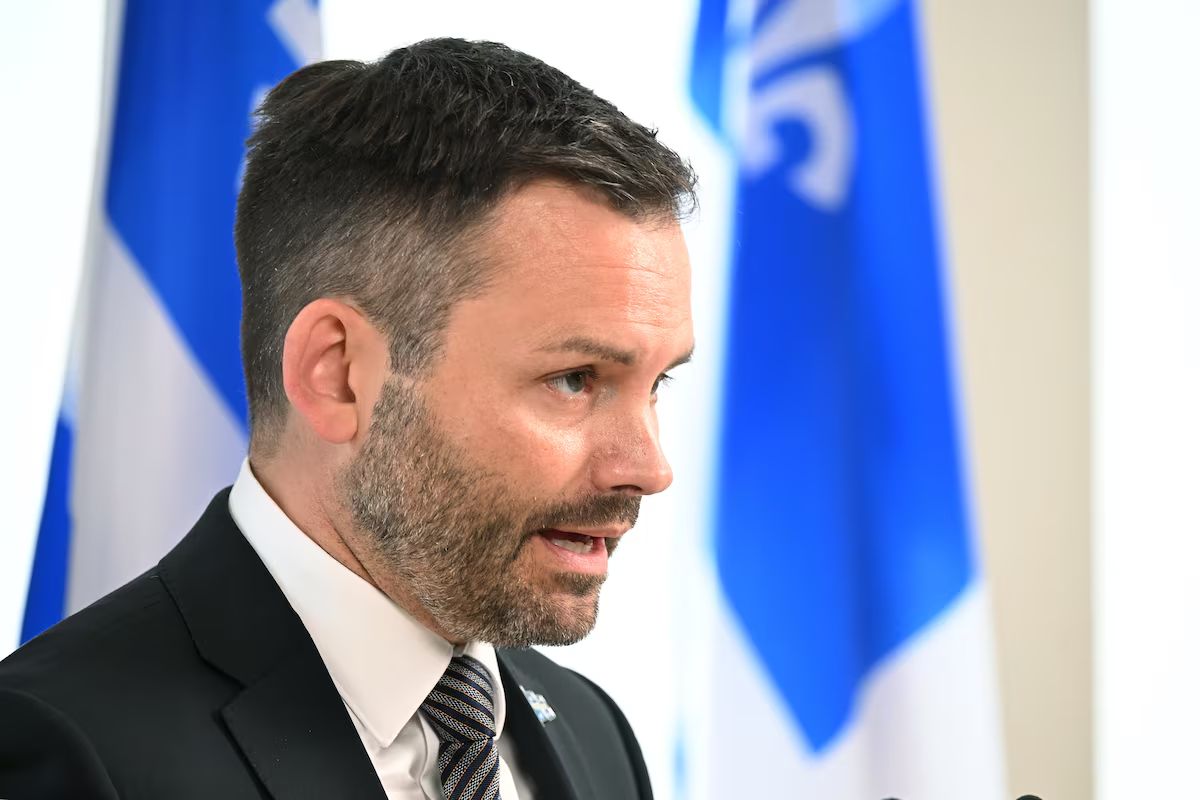

Open this photo in gallery:
In a Quebec City press conference on Tuesday, premier elect Paul St-Pierre Plamondon suggested sovereignty won’t be a top priority in the first part of his mandate.Jacques Boissinot/The Canadian Press
Parti Québécois Leader Paul St-Pierre Plamondon vowed to work with opposition parties and played down the potential for conflict with Ottawa on his first day as premier-designate of Quebec after securing a minority government.
The PQ’s pledge to hold an independence referendum has been complicated by the low level of popular support the party earned from voters in Monday’s provincial election, a result that revealed a divided province deeply ambivalent about the separatist project.
Election night saw the governing Coalition Avenir Québec wiped off the political map, losing all of its seats. Outgoing Premier Christine Fréchette resigned as leader of the party on Tuesday.
In a Quebec City press conference earlier in the day, Mr. St-Pierre Plamondon suggested sovereignty won’t be a top priority in the first part of his mandate, and repeated a promise not to hold a referendum while U.S. President Donald Trump is in the White House.
“We’ve got time. We’ve got plenty of urgent problems to solve, so I think the upcoming months will more be about … things that are urgent,” he said.
Five takeaways from the Quebec election results
The PQ’s 59 seats put it five shy of its hoped-for majority, and its 28 per cent share of the popular vote is the lowest of any government in Quebec history. A five-way race splintered the 70 per cent of Quebeckers who say they don’t want a referendum.
Mr. St-Pierre Plamondon did not waver on his commitment to sovereignty, though he acknowledged his minority government would need the support of opposition lawmakers to launch a referendum.
“Once we make a commitment during a campaign, we work to carry it out,” he said, brushing off questions about the strength of his mandate to pursue Quebec’s independence.
Open this photo in gallery:
Carney spoke with the premier-designate on Tuesday, and St-Pierre Plamondon described their conversation as ‘perfectly respectful and constructive.’Justin Tang/The Canadian Press
On Parliament Hill, Prime Minister Mark Carney sought to play down the separatist threat from the PQ’s win and emphasized the benefits of co-operation.
“It’s a crucial time for Quebec. It’s a crucial time for our country. This is not a time to wait for something a few years down the road. It’s a time to act. It’s a time for boldness,” Mr. Carney told reporters on his way into a cabinet meeting.
The Prime Minister is navigating a delicate moment for national unity, with a referendum in Alberta less than two weeks away, and persistent threats to Canada’s sovereignty and economy by the Trump administration.
Asked if the Parti Québécois had a mandate to separate with just 28 per cent of the vote, the Prime Minister did not answer the question but noted that he won last year’s federal election with a 43 per cent mandate from voters.
Canada at a ‘crucial time,’ Carney says after speaking with incoming Quebec premier
Mr. Carney spoke Tuesday with the premier-designate, and Mr. St-Pierre Plamondon described their conversation as “perfectly respectful and constructive.” He said he will meet soon with the Prime Minister.
The PQ Leader said he is ready to collaborate with the federal government and the other provinces “provided that it serves Quebec’s interests,” but cautioned that collaboration “doesn’t mean asking for nothing and then agreeing to anything.”
“The federal government’s position, in principle, must follow the will expressed by the people of Quebec – not the other way around,” he said.
Mr. St-Pierre Plamondon repeated his desire to abolish the office of lieutenant-governor in Quebec, a move to buck the British monarchy that critics see as an attempt to foment conflict with Ottawa. He said he has sought a legal opinion on the matter.
The premier-designate said one of his first moves in office will be to assemble a negotiating team to protect key sectors of Quebec’s economy during the trade dispute with the United States.
Open this photo in gallery:
The outgoing premier Coalition Avenir Quebec Leader Christine Fréchette resigned as leader of the party on Tuesday.Jacques Boissinot/The Canadian Press
Upon announcing her resignation Tuesday, Ms. Fréchette said her party needs someone to lead the CAQ into the next election and beyond, although it is unclear whether the once-dominant party can be revived after being shut out of the National Assembly.
The CAQ’s “third way” nationalism, which seeks to defend Quebec’s identity and powers without the disruption of independence, is still the best option after eight years in government, Ms. Fréchette said.
“We allowed our nation to affirm itself,” she said.
Meanwhile, other opposition party leaders spoke about their plans for wielding the balance of power in a possibly short-lived minority parliament.
Opinion: The PQ is back. The rest of Canada will need to brace for that
Quebec Liberal Leader Charles Milliard was upbeat after his party more than doubled its caucus by winning 40 seats, and called on former CAQ supporters to “come home” to the federalist party.
“We’re the only ones who can realistically block the PQ’s referendum project,” he said.
The left-wing separatist party Québec Solidaire did not rule out supporting the PQ in launching a referendum, which would require a majority vote in the National Assembly. The nine seats won by QS in the downtowns of Montreal and Quebec City would be enough to help the PQ trigger an independence vote, but the two separatist parties differ widely on immigration and identity issues, as well as the economy.
Ruba Ghazal, the co-leader of QS, remained vague about her intentions but suggested that cost-of-living issues were more urgent for many Quebeckers, and that holding a referendum would be more promising when a larger share of the population wants one. Currently, just 30 per cent of Quebeckers say they support independence, a historically low level.
Open this photo in gallery:
Quebec Solidaire co-spokespersons Ruba Ghazal and Sol Zanetti speak during a post election news conference in Montreal. The left-wing separatist party did not rule out supporting the PQ in launching a referendum.Graham Hughes/The Canadian Press
“Anything is possible,” Ms. Ghazal said of supporting a PQ referendum initiative in the National Assembly. “We’ll do everything to rally a majority of the population to this beautiful project.”
“Quebec isn’t 70 per cent federalist. 70 per cent of people are anxious, or don’t know. There are those who have an attachment to Canada – it’s very diversified.”
The new PQ government will also have to contend with the wild card of the Quebec Conservative Party, which enters the National Assembly for the first time with a flourish after winning 19 seats.
Opinion: The PQ is back in office without a lot of people power behind the next premier
Leader Éric Duhaime, the election’s breakout star, campaigned on aggressively shrinking the size of the Quebec state and sharply cutting immigration levels, which the province partly controls.
A self-described nationalist, Mr. Duhaime also opposes a referendum and has said his party will vote against one, but with a surprisingly large and mostly inexperienced caucus, controlling his troops will be a tall order.
“Our first challenge is to show Quebeckers we’re capable of taking on the functions we’ve been given … to play our role of watchdog well,” he said in a press conference Tuesday. “We’ll have a steep learning curve.”
With a file from Marieke Walsh