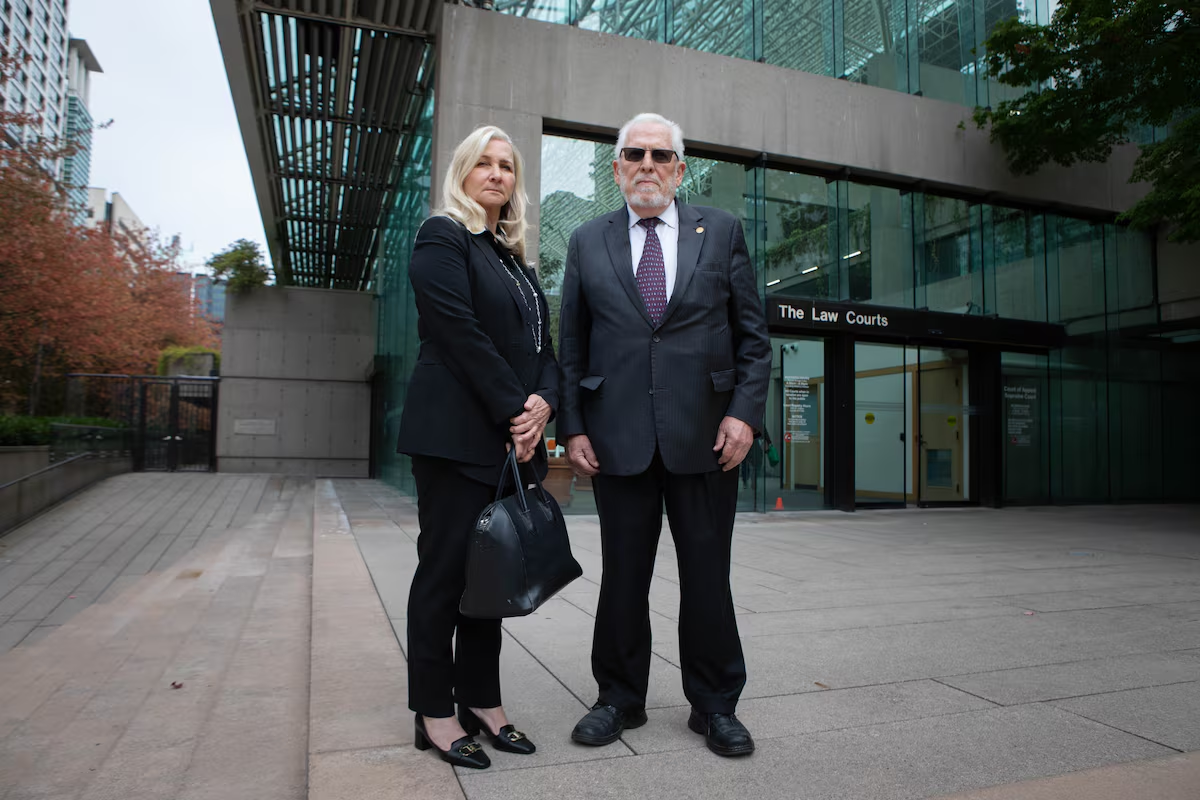

A twisted fever for vengeance gripped Luciano Mariani. He planned to kill his former girlfriend after she had an abortion.
In August, 2021, he bought a baseball bat at a Value Village in Vancouver and travelled to Vancouver Island. According to court records, Mr. Mariani stalked Caroline Bernard’s home in the hours before dawn. In previous weeks, he had scoped out details of his plan online. His searches included “what to do if you believe an eye for an eye and your child was killed” and “time needed to kill someone with a baseball bat.”
He broke through a sliding glass door at Ms. Bernard’s home a little after 4 a.m. He beat her to death in her bed. Her four-year-old daughter was there beside her. Ms. Bernard was 41.
Two years later, the 45-year-old Mr. Mariani pleaded guilty to first-degree murder. His lawyers, however, challenged Canada’s long-standing punishment for first-degree murder, killings that are planned and deliberate: a life sentence with no possibility of parole for at least 25 years.
They argued that the mandatory minimum sentence levied on all people convicted of first-degree murder, without any exceptions, violated the Charter of Rights and Freedoms.
In the past, there had been a small exception. The faint-hope clause offered an opening to apply for early parole after 15 years. But in 2011, the Conservative federal government eliminated that option. Mr. Mariani’s lawyers made the case that scrapping faint hope meant the one-size-fits-all minimum for first-degree murder was, under the Charter, cruel and unusual punishment.
Open this photo in gallery:
In 2011, the Harper government’s Bill S-6 passed into law. The ‘Serious Time for the Most Serious Crime Act’ effectively repealed the faint-hope clause from the Criminal Code.Adrian Wyld/The Canadian Press
In mid-2025, when Mr. Mariani was sentenced, Justice Robin Baird of the British Columbia Supreme Court described the murder as one of obscene brutality, “exceptionally violent” and “committed in cold blood.” It inflicted profound and permanent pain on Ms. Bernard’s family, he said.
But Justice Baird also concluded the absence of faint hope violated the Charter.
Faint hope, the judge said, was “part of a legislative compromise that led to the abolition of capital punishment.” He called it an “important element of the balance” in the punishment of first-degree murder.
The judge’s ruling, applicable only in B.C., restored the faint hope of parole at 15 years for people convicted of first-degree murder, including Mr. Mariani. The judgment is now under the scrutiny of three judges on B.C.’s top bench, the Court of Appeal, after they heard arguments in June.
A ruling from the appeal court is expected this fall. If the top provincial court affirms the restoration of faint hope, it would likely presage a high-profile showdown at the Supreme Court of Canada.
Ms. Bernard’s family is still reeling from her murder. That Mr. Mariani could get out of prison earlier than the 25 years just doesn’t make sense to them.
“I cannot understand the law,” Margarita Bernard, Caroline’s mother, said in an e-mail. “My life was destroyed and I will never recuperate from this. I will live with this pain until I die.”
Now, what started as a murder case has morphed into a constitutional reckoning and vaulted a philosophical question of crime and punishment into an unexpected spotlight at a top court. It’s a question that has long been debated by a small group of lawyers and legal academics: Does Canada punish murder too harshly?
Crowds of onlookers and anti-death penalty protestors gather outside Don jail in Toronto on Dec. 10, 1962, in the hours before convicted murderers Ronald Turpin and Arthur Lucas were executed. The double-execution was the last instance of capital punishment being administered in Canada.
John Boyd/The Globe and Mail
Parliament instituted the mandatory minimum for first-degree murder a half-century ago when the country abolished the death penalty.
From Confederation in 1867 to 1962, Canada executed 710 people. The last two hangings happened at the Don Jail in Toronto, a few weeks before Christmas.
A Globe and Mail investigation the next year revealed major questions in one of those executions, helping to propel mounting public opposition against the hangman’s noose.
Punishing a crime has three goals. One is deterrence, to dissuade people from transgressions; another is denunciation, for society to declare its condemnation; the third is rehabilitation, to bring offenders back into society after they serve their time.
Open this photo in gallery:
In 1976, then Prime Minister Pierre Trudeau argued for stricter sentencing and parole regulations instead of the death penalty. The historic debate led to the passing of Bill C-84, the legislation that ultimately abolished capital punishment for murder.The Canadian Press
Debate on the death penalty – and what would replace it – was intense. The free vote in the House of Commons was 131-124. Police favoured the death penalty and argued that a life sentence and a minimum of 25 years in jail was the only acceptable alternative. But they offered no empirical evidence. At the time, murderers served an average of 16 years in prison.
One Liberal MP argued a 25-year minimum incarceration was crueller than the death penalty. But in the House of Commons, prime minister Pierre Trudeau said the long sentence would assure Canadians that “those who have unlawfully taken the life of another will be removed from our midst for a very long time.”
David Cole, a retired judge in Ontario and expert on sentencing, said in a recent interview the arbitrary minimum was purposefully harsh to sate perceived public opinion. “So much of it was political,” Mr. Cole said.
Alongside the 25-year minimum, Ottawa included the faint-hope clause which, in limited circumstances, allowed some murderers to apply for early parole after 15 years. It was seen as an incentive to work toward rehabilitation.
Open this photo in gallery:
In 1996, Jean Chrétien’s Liberal government introduced Bill C-45, which significantly restricted the faint-hope clause.Tom Hanson/The Canadian Press
In 1996, the Liberal federal government tightened the availability of faint hope. In 2011, soon after winning a majority government, the Conservatives under former prime minister Stephen Harper passed a plank of their tough-on-crime agenda and rescinded the faint-hope clause for anyone convicted of first-degree murder from that point on.
Before the Mariani case, constitutional challenges against the first-degree murder mandatory minimum had failed before. Judges had not been swayed by the claims that it infringed the Charter of Rights.
Older faint-hope cases still percolate through the justice system. From the first such hearing in 1987 through to 2024, courts decided on 247 faint-hope cases for first-degree murderers seeking early release, according to federal data.
Juries agreed almost three-quarters of the time, giving earlier potential parole to 179 people.
The road to faint hope had always been difficult. It requires an optimal record in prison. An application for a hearing is assessed by a province’s chief justice. If granted, a unanimous jury at a new hearing is necessary to win a faint-hope case.
Ali Al-Shammari navigated the steps to early release. In 2004, when he was 19, he was an accomplice in the murder of a cab driver in Windsor, Ont., handing the knife to the killer during the confrontation that led to the driver’s death. At Mr. Al-Shammari’s faint-hope hearing in early 2024, the Crown argued against his early release, but the jury unanimously agreed to move his parole eligibility up by about five years.
Mr. Al-Shammari was released in early 2025. The Parole Board of Canada highlighted the elongated grief of the victim’s family, the cab driver’s wife and three children, but cited assessments of Mr. Al-Shammari that found he was a low risk to reoffend.
“You have consistently acknowledged your responsibility and respectfully expressed remorse,” the Parole Board stated.
These days, Mr. Al-Shammari, 40, lives in a halfway house and attends mosque regularly, according to a Parole Board report in July. He practices jiu-jitsu at a gym. He had found work at a restaurant before getting laid off.
According to the latest federal data, of 1,334 people sentenced to life imprisonment for first-degree murder, 979 people remain incarcerated. There are 79 people on day parole, such as Mr. Ali-Shammari, and 276 are on full parole.
For life sentences, full parole is not the end. Close surveillance of all people on life sentences continues after release until death. One typical restriction requires a person to get permission from a parole officer to travel outside of the area where they live. “Lifers will never again enjoy total freedom,” the Parole Board said in a review of parole decision-making.
Christopher Hicks, a veteran Toronto criminal defence lawyer, represented Mr. Ali-Shammari at his faint-hope hearing. Mr. Hicks has also, in a separate case in 2025, unsuccessfully challenged the minimum punishment for first-degree murder as unconstitutional.
Mr. Hicks looks back at abolition in 1976 and the 25-year minimum as “a sop to people who were maniacal about the death penalty, an eye for an eye, that gang.”
“The reason they made it so harsh,” he said, “was so they could say: ‘We’re not going to execute people, but we’re going to lock them up and throw away the key.’ ”
To Mr. Hicks, the mandatory minimum in all cases of first-degree murder with no exceptions is an obvious violation of Section 12 of the Charter of Rights, the protection against cruel and unusual punishment.
“It’s just inhumane,” he said. “It’s a draconian punishment in the extreme.”
Open this photo in gallery:
Vancouver’s Law Courts building, home to B.C. Supreme Court and the Court of Appeal.DARRYL DYCK/The Canadian Press
At the courthouse in downtown Vancouver, in early June, three judges considered the province’s effort to overturn the lower-court decision in the Mariani case that reinstated faint hope in British Columbia.
Lara Vizsolyi, the Crown counsel, argued that everyone convicted of first-degree murder merits the minimum punishment.
“There are no small murders,” Ms. Vizsolyi said.
Donna Turko, Mr. Mariani’s lawyer, argued that the one-size-fits-all punishment does not reflect a Canadian approach to criminal justice.
Ms. Turko noted the faint-hope system continues to free a small number of murderers convicted before 2011 who had rehabilitated themselves.
Open this photo in gallery:
Donna Turko, Mr. Mariani’s lawyer, has argued that the 25-year minimum is archaic and inconsistent with a ‘Canadian approach’ to criminal justice.Justine Beaulieu-Poudrier/The Globe and Mail
Canada is a human-rights country, Ms. Turko argued, one that sees dignity in people even at their worst. The 25-year minimum is archaic, she said.
“It’s not consistent with how Canadians treat people,” Ms. Turko said. “We know faint hope works.”
The appeal court judges’ questions expressed a range of thinking, suggesting skepticism that reinstating of faint hope was necessary to abide by the Charter but also an open-mindedness about whether the absence of faint hope made the punishment too harsh.
Justice Geoffrey Gomery spoke of the broad range of killings that could be included in the planned and deliberate rubric of first-degree murder. He also noted the courts had struck down numerous other mandatory minimums for being overly rigid.
Arguments over the details of two Supreme Court of Canada precedents threaded through the proceedings.
The first was from 1990, a murder case called Luxton. The Supreme Court, in a judgment written by Chief Justice Antonio Lamer, determined the minimum of 25 years did not constitute cruel and unusual punishment and did not infringe the Charter. He cited the availability of early parole – faint hope was then an open option – and called first-degree murder the most serious crime in criminal law.
“The punishment is not excessive,” Chief Justice Lamer wrote. “The penalty is deservedly severe.”
Years later, in a 2022 ruling on the sentencing of Quebec City mosque shooter Alexandre Bissonnette, Chief Justice Richard Wagner looked back at Luxton. The unanimous Bissonnette judgment overturned a Harper-era law that allowed for consecutive sentences for multiple murders. But in his look at Luxton, Chief Justice Wagner noted the court in 1990 considered it proper for Parliament to treat first-degree murder “with an appropriate degree of severity,” one that did not violate the Charter.
Open this photo in gallery:
Supreme Court Chief Justice Wagner cited the 1990 Luxton case in a 2022 ruling on the sentencing of Quebec City mosque shooter Alexandre Bissonnette.Sean Kilpatrick/The Canadian Press
Those words appear in paragraph 86 of the Bissonnette ruling and have been debated in the legal community ever since – and at the B.C. Court of Appeal in June. No one can say for sure whether Chief Justice Wagner, in that 162-word paragraph on Luxton, effectively endorsed the 25-year minimum for first-degree murder even in the absence of the faint-hope clause.
Ms. Vizsolyi, in her closing arguments for the Crown, was emphatic in her belief the Supreme Court stands against any tinkering with the first-degree murder mandatory minimum. She urged the three appeal court judges on the Mariani case to “take heed of the Chief Justice’s words.”
In 1976, when police fought to keep the death penalty on the books, they erred in their argument that the potential of a hanging served as a crucial deterrent.
Canada’s murder rate had in fact peaked in 1975, a year before abolition, and thereafter shifted into a long decline. It currently stands at about half the rate of a half-century ago.
Among the goals in punishment, denunciation is a central pillar of criminal justice, yet deterrence presents a paradox. Years of work among criminologists shows that harsher punishments do not reduce crime. Murder is a good example. In the United States, where the murder rate is far more than double that of Canada’s, the country has executed 1,085 people this century.
Viewed against the U.S., the question of whether Canada punishes murder too harshly is obviously no.
But to some legal experts, the absence of faint hope and its offer to work toward rehabilitation is a key missing piece in the overall goals of punishment. The system that allowed for faint-hope applications works in some cases, as juries have agreed to the early release of almost 200 people convicted of first-degree murder. Legal academics argue this suggests that long sentences of 25 years or more may be excessive and unconstitutional if rehabilitation is possible in a shorter period.
“I’m a big fan of faint hope,” said Colton Fehr, a law professor at the University of Saskatchewan who has a new book this fall on rethinking how different types of murder are punished.
Faint hope, he said, provides an important incentive for people to better themselves behind bars.
Prof. Fehr also has a new book on Section 12 of the Charter, the prohibition against cruel and unusual punishment. The legal questions involved in such a determination, where a harsh sentence escalates into cruel and unusual, include whether a mandatory minimum punishment is “grossly disproportionate” in some cases. That means it is so far beyond acceptable that it would outrage society’s sense of decency.
Open this photo in gallery:
Correction officers patrol outside the Edmonton Institution for Women, a federal corrections centre. University of Saskatchewan law professor Colton Fehr says faint hope provides an incentive for people to better themselves behind bars, in line with the rehabilitation pillar of the criminal justice system.JASON FRANSON/The Canadian Press
Courts over the past decade have employed what are called reasonable hypothetical scenarios to come to conclusions on such questions. That’s how the Mariani case played out at the B.C. Supreme Court. It wasn’t whether Mr. Mariani should eventually merit faint hope; it was about its availability in general: That without faint hope, the minimum for first-degree murder overstepped what was allowed by the Charter in a reasonable hypothetical scenario.
Imposing mandatory minimums has long been controversial. Courts struck down numerous Harper-era laws that imposed them. The federal Liberals this year reinstated some minimums, while allowing judges leeway for exceptions. The Liberals specifically excluded life sentences, including first-degree murder, from judicial leeway.
That move reflects an observation from Mr. Cole, the retired Ontario judge, in a 2020 book on criminal sentencing he co-edited: “Canadian parliamentarians seem loath to interfere with public perceptions of the need to punish murderers very severely.”
Open this photo in gallery:
Justice minister Sean Fraser introduced Bill C-16, the Protecting Victims Act, which passed into law this June. The legislation restored some mandatory minimum sentences, and specifically excluded first-degree murder from the judicial leeway provision.Justin Tang/The Canadian Press
Debra Parkes, a law professor at the University of British Columbia, has advocated for change, arguing that since the abolition of the death penalty, Canada has punished murder too harshly compared with similar countries.
In a 2018 paper, Prof. Parkes reported that about three-quarters of the European Union did not levy life sentences for murder. In Germany, where there are life sentences, parole eligibility starts at 15 years. States in Australia have eliminated life sentences.
Research from the Library of Parliament in 2011, when faint hope was ended, showed that people convicted of first-degree murder in Canada served an average of 28 years. It was more than any other country in an international comparison, except for the U.S., and almost double the length of jail time compared with countries such as Australia.
“We have accepted this is a reasonable and normal sentence to impose when in fact it’s an extreme sentence,” Prof. Parkes said.
But the divide between advocacy in academic research – what the law could and should be – and the seeming sentiment of the broader public on such questions may be vast. Other academics say any change in how murder is punished is unlikely to be welcome.
“We live very much in the shadow of the United States,” said Lisa Dufraimont, a law professor and associate dean at Osgoode Hall at York University.
“It may be true that our murder punishments are harsher than in peer countries but given they are far less harsh than in the U.S., it’s hard to convince Canadians.”
Open this photo in gallery:
Lawyer John Conroy worked with Ms. Turko, Mr. Mariani’s lawyer, to win the faint-hope judgment.Justine Beaulieu-Poudrier/The Globe and Mail
Mr. Mariani resides in a maximum-security prison and his minimum of 25 years extends until 2046. He could apply for faint hope in 2036. After he killed Caroline Bernard, he gave himself up to police, pleaded guilty rather than seeking exoneration through a trial and apologized in court. Those are the modest first steps on a long road of potential rehabilitation.
“He’s got a lot of work to do,” said John Conroy, a lawyer for Mr. Mariani who worked with Ms. Turko to win the faint-hope judgment.
To Mr. Conroy, and the other lawyers and academics who are fighting to restore faint hope, a justice system that does not allow at least the chance of early parole is one that hammers offenders with denunciation and deterrence, and ignores potential rehabilitation. The 25-year minimum, Mr. Conroy argued, needs to be reopened to the possibility of exceptions.
Five years after her daughter’s murder, Margarita Bernard wrestles with the deep pain of loss.
She shared a home on Vancouver Island with Caroline and lived upstairs. On the night of the murder, according to court documents, what sounded like screaming awoke Margarita. She went downstairs, discovered the ghastly scene and called 911.
As faint hope is debated in the courts, Margarita struggles to understand why Mr. Mariani could pursue potential leniency.
“I cannot believe that a person that committed an action where I lost my dear daughter has the chance to have forgiveness after his actions, so cruel and so planned,” she said.
The grief is unending.
“It is not easy to explain the feelings in words,” Margarita said. “It is the worst thing that could’ve happened to a mother.”
Crime and punishment: More from The Globe and Mail
A surge of Canadians say they feel crime is worsening, and that the bail system is too lenient. But with overall crime down, will making our bail system stricter really make Canadians safer? Globe reporter David Ebner joins The Decibel to explain what the data tells us about how the system is currently operating, and the tensions in reforming bail.