
When Barry Cooper was six years old, he and his mother were stopped at a level crossing while a train passed.
“There goes the goddamn-CPR,” he chirped.
His mother reached into the back seat and slapped him. Stop blaspheming, she said.
Young Barry was puzzled. He thought goddamn-CPR was just what the company was called. Growing up in the Western Canada of the early 1950s, he’d only ever known the railway as a source of bitter resentment. Freight rates designed to help business in the east meant that it was cheaper for the Coopers to buy apples from Nova Scotia than the nearby Okanagan.
The goddamn-CPR, with its headquarters near Montreal’s Golden Square Mile, represented the almost colonial arrogance of the Laurentian elites, who seemed to view Alberta and Saskatchewan as provinces “in the Roman sense” – breadbaskets to be exploited and kept passive.
Open this photo in gallery:
Barry Cooper, a professor at the University of Calgary, spoke with The Globe about his journey to the Alberta separatist cause.Chris MacArthur/The Globe and Mail
As a child, Barry may not have reached for that classical allusion, but it comes to his lips easily now, at the age of 83, sitting in his office at the University of Calgary department of political science.
All these years later, Prof. Cooper has emerged as the intellectual godfather of the Alberta separatist movement. His mother’s slap didn’t have the desired effect: He has continued to blaspheme against Canada’s sacred institutions, from equalization payments to official bilingualism to Confederation itself.
For the West, and especially for Alberta, the Canadian federation has been a terrible misadventure, Prof. Cooper believes.
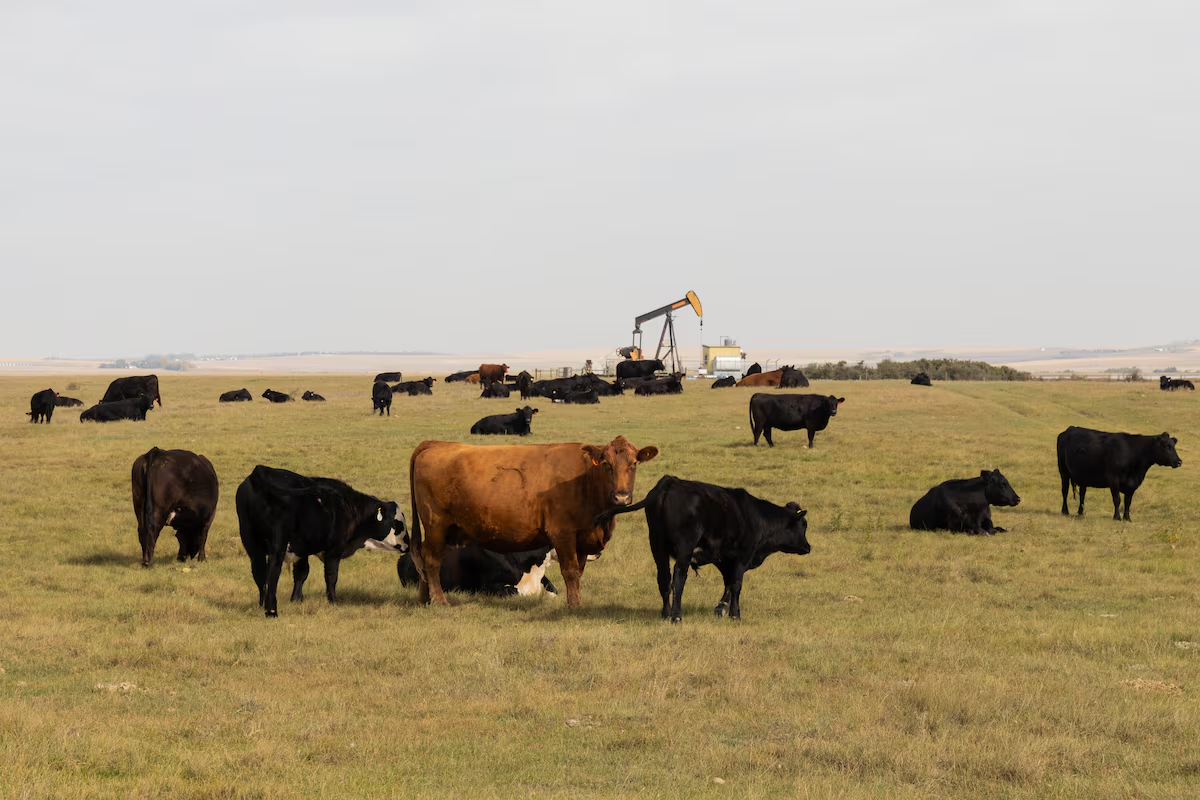
“One hundred and twenty years of history have been 120 years of economic exploitation,” he said in his dimly lit office, decorated with taxidermied deer and pheasant, during a long interview this summer.
Few separatists have so many copies of Virgil and Thucydides in their libraries, but a significant percentage of Albertans share Prof. Cooper’s worldview. The province is about to embark on its first independence referendum, of sorts – really a vote about holding a vote on independence.
Open this photo in gallery:
Alberta’s separatists are working toward an Oct. 19 referendum on whether to begin the process of pursuing independence; in the event of a Yes vote, Albertans would face another referendum later.Chris MacArthur/The Globe and Mail
Open this photo in gallery:
These Albertans turned out recently to hear a town hall from the Alberta Prosperity Project, one of the separatist groups.Chris MacArthur/The Globe and Mail
Leaving Canada is effectively on the ballot in not one but two provinces. Alberta’s referendum will come just two weeks after a provincial election in Quebec on Oct. 5, where the Parti Québécois is leading the polls with a promise to hold a third “popular consultation” on independence.
This could hardly be more alarming to many Canadians. They see national unity being attacked from within at the most dangerous time, when American threats to our sovereignty have bred existential anxiety about our closest neighbour as well. It can seem like Canada is battling for survival on three fronts, apparently out of nowhere.
But there is more to the story. The anger and alienation endangering Confederation run centuries deep. Canada has too much geography for it to be otherwise: With population and resources scattered across an expanse of 5,500 kilometres as if by some spiteful Greek god, and more languages than the Habsburg Empire, it is no wonder we have always had separatist movements. They are a case of chronic inflammation in the Canadian body politic, not a sudden infection.
The reassuring news for federalists is that the current separatist fever may be breaking. The same upsurge in elbows-up patriotism that has rallied Canadians against the American threat has the potential to undermine the drives for secession in Alberta and Quebec.
But this is not an argument for complacency: Support for independence in both provinces hovers around 30 per cent. If that sounds high, it has become the norm in Wild Rose country and is well below average in la belle province.
In the future, these movements could flare up again, more severely than before.
Blue is a popular colour at separatist gatherings in 2026, from this PQ rally in Quebec City to a pro-independence protest in Edmonton. But judging by opinion polls, most of those who live under the blue provincial flags of Quebec and Alberta support remaining in a united Canada.
Jacques Boissinot and Amanda Erickson/The Canadian Press
Open this photo in gallery:
Mr. Cooper’s collection includes a ‘republic of Western Canada’ map that unites Alberta, Saskatchewan and northern B.C. Creating one Prairie province instead of two was a favoured option for some westerners, but they were overruled.Chris MacArthur/The Globe and Mail
Separatist movements are as old as Confederation and as authentically Canadian as maple syrup. From the beginning, from Victoria to St. John’s, the virtues of coming together as a country were far from obvious.
Nova Scotia was dragged into the Dominion reluctantly; separatists dominated the first provincial legislature in Halifax. Many British Columbians wanted to leave when the pace of railway construction slowed. Manitoban farmers threatened to break away partly because of, yes, CPR freight rates.
Alberta, too, was born angry – a baby with teeth. Carved out of the former North-West Territories in 1905, some of its leaders hoped to remain conjoined with Saskatchewan in a bigger province, to be called Buffalo.
The federal government rejected the idea – it had a vision of the West as an inland empire, supplying grain for the rest of the country and a captive market for Central Canadian manufacturers.
Alberta, Saskatchewan and Manitoba were denied control of their natural resources, unlike other provinces, a power grab that was only reversed in 1930.
Newspapers such as the Calgary Herald raged against Ottawa’s treatment of the West from the beginning. “Can Albertans be forced to eat dirt and say they like it?” one editorial thundered. The first book floating the idea of Alberta independence was published as early as 1911.
Open this photo in gallery:
An American promoter got the Calgary Stampede up and running in 1912.
Alberta was developing its own identity, influenced by American immigrants who constituted the largest group of newcomers. “The Yankee province” was recognized for its swaggering, democratic personality and its entrepreneurial spirit. It was the U.S. promoter Guy Weadick who organized the first Calgary Stampede in 1912, an enduring embodiment of that culture. A member of the Cooper ranching dynasty, Barry’s uncle, called the annual rodeo for decades.
Barry’s father bucked the family trend and became a doctor in B.C., raising his son to be a proud Canadian who revered the Red Ensign. The unifying force of the Second World War had defanged Western alienation for a generation.
So it was a shock for the young Prof. Cooper, living in Central Canada as a novice academic in the 1970s, to find all was not well with the federation. It wasn’t just meeting Quebec separatists for the first time and finding them surprisingly persuasive. It was also the sheer “parochialism” of his students from Southern Ontario, the only Canadian region that doesn’t consider itself a region. They couldn’t have known or cared less about Western Canada, he found. For the boy with Alberta in his blood, who used to sit on the chutes at the Calgary Stampede and pet the roughstock, this was hard to stomach.
Hugh MacLennan’s novel Two Solitudes was a popular metaphor for the gulf between English and French Canada at the time, but Prof. Cooper was beginning to feel that Canada contains “many more solitudes.”
Canada’s regional rifts widened further in the 1970s, the political heyday of Peter Lougheed in Alberta and René Lévesque in Quebec. Both clashed with Pierre Trudeau over his vision of Confederation.
The Canadian Press; Globe and Mail archives, 1976
Open this photo in gallery:
The 1970s also brought the first screen version of Hugh MacLennan’s novel Two Solitudes. Globe film critic Jay Scott panned it.Globe and Mail archives, 1978
The angriest part of Alberta may very well be the rural corridor between Edmonton and Calgary, where billboards made from converted trucking containers wage a culture war on the side of the highways. Signs for ABforAbortion and Flat Earth Canada compete with more recent referendum ads: “Send them a message they’ll never forget – Vote Yes in October,” reads one, with Justin Trudeau’s and Mark Carney’s faces set against a dark, sinister background.
It was also here – no coincidence – that a gusher of crude burst out of the Leduc No. 1 oil well in February, 1947, and permanently changed life in Western Canada. It was the beginning of Alberta’s energy boom; from then on, the province would be not only angry, but rich, and its identity would be intimately bound up with a single industry.
Open this photo in gallery:
The Leduc oil gusher helped ignite Alberta’s energy boom, and debates about who should benefit from the wealth.The Canadian Press
Leduc has become part of the Alberta vernacular, like heavy sour, wildcat, roughneck and tidewater, the oil jargon that trips off the tongue with total fluency here. But if Leduc represents the blessings of Alberta’s natural bounty, another bit of provincial shorthand, the NEP, represents the dark side. In Alberta, the phrase NEP captures with remarkable efficiency the province’s sense of having had its good fortune exploited by undeserving outsiders.
Prof. Cooper was back in his ancestral province teaching at the University of Calgary when the National Energy Program was hitting Alberta hardest. An attempt to Canadianize the oil industry, it siphoned off billions in revenue to the federal government, capped prices for consumers and contributed to a harsh recession in the province.
It was in this environment that Alberta separatism emerged as an organized force, most notably with a 1982 by-election victory by Gordon Kesler of the Western Canada Concept, still the only separatist party to sit in the provincial legislature.
That independence movement quickly fizzled, but even pro-Canadian Albertans recall the NEP with horror; Senator Paula Simons watched as her father lost his businesses in Fort McMurray and some of his friends died by suicide during the downturn.
This was also the climate in which Prof. Cooper became politically active, providing intellectual ammunition to the nascent Reform Party, Preston Manning’s vessel for channelling Western Canadian rage. In retrospect, its demands look relatively quaint. The party called for Senate reform to improve regional representation in Ottawa and a hands-off approach to resource development; its explicitly non-separatist slogan was “The West Wants In.” In a very Albertan metaphor, Mr. Manning called his movement a “relief well” designed to intercept an out-of-control oil strike.
For a time, he succeeded. Reform and the Bloc Québécois put regional discontent at the forefront of federal politics through much of the 1990s. It is easy to forget that two parties rooted in grievances with Canadian federalism took turns as the Official Opposition. The old Reform crusader Stephen Harper brought Mr. Manning’s ideas even further into the mainstream when he became prime minister in 2006.
But the old Alberta anger continued to bubble like sour crude beneath the country’s surface, waiting for a wildcatter to tap into it.
Red Deer is almost exactly halfway between Edmonton and Calgary, right in the beating heart of separatist country. It was settled by homesteaders in the late 19th-century and then boomed along with the province as a hub for servicing the oil-and-gas industry.
It was a natural location for the Alberta Prosperity Project, a leading independence organization, to host its Pulpit and Politics event in August.
Pickups filled the parking lot outside a sprawling event hall on a sunny Wednesday evening, including one bearing a placard that read, “Saving My Grandkids from Carney’s New World Order.”
It was the first hint of how much time the speakers inside would devote not to defending Alberta oil and autonomy but to the prevailing cultural tide of the country.
For every reference to equalization payments, there was one to the “plandemic;” for every allusion to Senate reform, a smear on “illegal immigrants.” For every complaint about pipelines, speakers added another about drag queen story hour. Extended discussions of constitutional issues and budget math seemed to bore the audience.
Open this photo in gallery:
Alberta’s debates in recent years over trans rights, COVID-19 and other issues have spilled over into this year’s referendum campaign.Artur Widak via Reuters connect/Reuters
It was another sign of the overlooked cultural dimension of Alberta separatism. In conversations with leaders and foot soldiers of the movement, it becomes clear that the progressive drift of the country under Justin Trudeau – with its strict COVID measures, increased immigration and “wokeness” – convinced many conservative Albertans that they didn’t belong in Canada anymore. Separatists often say that Canada seceded from them, not the other way around.
When comparing the Alberta and Quebec separatist movements, it’s common to say Alberta’s isn’t about culture, but that’s wrong, said the Calgary-based pollster Janet Brown. The single most predictive factor in determining support for Alberta independence is not working in the energy industry, but the salience of religion in a person’s life, she noted. Breaking away from Canada has become as much about the prominence of right-wing evangelical Christianity in Alberta – part of its original American flavour – as about oil and gas.
“It is about culture,” Ms. Brown said. “Grievance with the federal government is only the starting point.”
Open this photo in gallery:Open this photo in gallery:
When Prime Minister Mark Carney was in Red Deer this summer, joining Alberta Premier Danielle Smith for a housing announcement, several protesters rallied outside.Jeff McIntosh/The Canadian Press
The Trudeau government’s environmental policies clearly outraged many Albertans; they are often cited as a major reason for the current flare-up of separatism in the province. But it is notable that gestures toward reversing those policies have not stopped the independence movement in its tracks. When Mr. Carney reached a memorandum of understanding with Alberta in November, 2025, promising to support the construction of a new pipeline to B.C. and peel back environmental regulations, many separatists dismissed it as mere verbiage. The feeling of broken trust and cultural alienation was too deep for quick repair.
Like many in his movement, the good professor has lost faith with Canada on a more elemental level, beyond the reach of policy fixes. His alienation goes far deeper than the Trudeau government’s climate-change agenda, all the way back to CPR freight rates, the loss of the Red Ensign and the NEP – issues that are obscure to most people outside of his province but deeply ingrained in Albertan culture.
His father served proudly in the Royal Canadian Air Force during the Second World War, he said, but those ties of patriotic sentiment have been broken for him.
“That Canada was the Canada of our parents, and it’s not here anymore.”
The elbows-up nationalism sweeping the country under Mr. Carney fills him with contempt, even though – or especially because – it has made headway in Alberta. Pro-Canadian activists in the province gleefully report more Maple Leaf flags flying from rural barns than they’ve ever seen before; personal identification with Canada has increased in recent polls.
It is perhaps no wonder the current Prime Minister is such a hateful figure to Prof. Cooper and others committed to Albertan independence. Separatists often refer to Mr. Carney and his acolytes as “elbozos.”
When the subject of the PM comes up, the erudite professor drops his references to Leo Strauss and Plato and reverts to a blaspheming six-year-old in the back of his mother’s car.
“How stupid do you have to be to trust that son of a bitch?” he said.
From the Arvida aluminum plant to the farms near the river, the Saguenay region has held on to Quebec’s traditional industries. Support for the PQ runs deep here.
Charles-Frederick Ouellet/The Globe and Mail
Alberta and Quebec, 3,000 kilometres apart, are in some ways very different beasts. The contrast is visible in Red Deer County’s gleaming new megachurches with names such as CrossRoads and Impact Life on the one hand, and the century-old stone churches and seminaries of Chicoutimi, Que., their copper roofs rusted green, that haven’t seen a Catholic service in years.
These are places with very different histories and worldviews, like the movements they have nurtured. Where Alberta separatism is entirely right-wing with a strong evangelical bent, Quebec’s is aggressively secularist. The first is nominally about oil money, the second nominally about language. One is a populist insurgency with little institutional support, the other backed by the province’s largest media empire, Quebecor.
Because this is a land of paradox, however, it’s also true that both movements, for all their differences, emerge from the same wellspring of regional alienation that has always troubled the country. And if there’s one thing many residents of Red Deer and Chicoutimi can agree on, it’s that they would be better off outside of Canada.
No region voted more overwhelmingly for the Yes side of the 1995 sovereignty referendum than Chicoutimi’s Saguenay—Lac-Saint-Jean, two hours north of Quebec City, with an average of about 70 per cent. It’s an area that bleeds péquiste blue.
Just as the steakhouses, oil money and rolling parkland around Red Deer incarnate certain clichés about Alberta, so too does Saguenay exude le Québec profond. It’s a land of lumber camps where the smell of pine trees wafts through closed car windows. The farmland is dominated by dairy concerns that crank out delicious cheese curds. Local factories harness the region’s ample hydro power to zap bauxite into aluminum.
The retired city councillor Jean-Marc Crevier is a classic Saguenay man. He owns a little piece of property with friends on Lac Saint-Jean where he sails a catamaran. Like Prof. Cooper, he blasphemes colourfully and often, preferring an old religious curse that is antiquated even by Quebec standards: simonaque, meaning one who is guilty of simony, or trading in sacred things.
Open this photo in gallery:
‘Quebec would be stronger on its own,’ says Jean-Marc Crevier, a union leader at the aluminum plant in Saguenay.Charles-Frederick Ouellet/The Globe and Mail
Like his father, he worked for decades in the Alcan aluminum plant in Arvida, a company town built by an eccentric American tycoon in the 1920s. The English-speaking managers who bossed him around were commonly called têtes carrées, a pejorative term for anglophones.
Mr. Crevier rose to be a union leader, first in the aluminum industry, then with the provincewide Fédération des travailleurs et travailleuses du Quebec. As sure as night followed day, he voted for the Parti Québécois. It was an identity as much as a choice.
The dialectic of federalism and separatism is centuries old in Quebec, older in a way than Canada itself. The British victory on the Plains of Abraham in 1759 produced an enduring desire to reclaim self-government and self-esteem. Nearly every generation saw violent eruptions of national pride: the Patriotes rebellion of 1837-38; riots against conscription in the First World War; the terrorist campaign of the Front de libération du Québec.
By the time the PQ emerged as a democratic force calling for political independence from Canada in the 1970s, the separatist impulse was part of Quebec’s DNA. The insouciant confidence of René Lévesque helped convince enough of his fellow citizens that “Quebec would be stronger on its own,” as Mr. Crevier put it. There was an undeniable flush of pride in imagining a Québécois head of state meeting the Canadian Prime Minister on an equal footing and finally earning his people the respect they deserved.
Ahead of the 1976 election, Mr. Crevier bet his fellow aluminum workers $50 that the underdog PQ would win, and sure enough they did. It was a no-brainer when the party held referendums in 1980 and 1995: He proudly voted Yes both times. Premier Bernard Landry even tried to recruit the charismatic union boss to succeed Lucien Bouchard as a local PQ candidate in the early 2000s. He declined mainly because it would mean spending less time in Saguenay.
The party had been in power for almost a decade by then. Especially in the Saguenay, separatism was a default ideology, the wallpaper of political life.
“If people talked politics in the dining room, it was PQ,” Mr. Crevier recalled. “If someone was Liberal, they were hiding in the corner.”
It’s been more than 30 years since the big referendum showdown between federalists, led by prime minister Jean Chrétien, and Quebec separatists allied with premier Jacques Parizeau.
Andy Clark/Reuters
Open this photo in gallery:
Bloc Québécois leader Lucien Bouchard conceded defeat on the 1995 referendum, but vowed to continue the fight in other areas. He took over Mr. Parizeau’s job in 1996.
When premier Jacques Parizeau took the stage at Montreal’s Palais des Congrès on the night of Oct. 30, 1995, he was expecting to give a victory speech. Instead he blamed “money and ethnic votes” for his narrow referendum defeat, and his movement was permanently changed.
In a literal sense, Mr. Parizeau was right. Sixty per cent of francophones voted to leave that day, feeling burned by successive failed attempts to reform the constitution. Even long-time Canadian patriots such as André Pratte, future editor of the federalist La Presse newspaper and later a Canadian senator, felt the impasse was serious enough to vote Yes.
When Mr. Parizeau spoke those notorious words, many Quebeckers were ashamed of his outburst. Mr. Pratte recalls feeling revulsion and immediate regret for his Yes vote.
Others, felt a deep sense of recognition in Mr. Parizeau’s assertion of a French-Canadian nous, set apart from a sea of others. Cultural survival has always been a primal goal of French Canada, surrounded as it is by hundreds of millions of English-speakers in North America. Now, as Quebec’s own population becomes more diverse thanks to declining birth rates and increased immigration, the challenge can seem to come from within.
Open this photo in gallery:
‘Where is my free Quebec?’ reads this protest flag at a Montreal rally against secularism laws, a contentious subject in a province home to many faiths and cultures.Graham Hughes/The Canadian Press
This siege mentality has an undeniable resonance for some Quebeckers. Ninety-eight per cent of Saguenay residents have French as a mother tongue, according to the most recent census, yet it’s still common to hear that immigrants there imperil French. In Quebec, language and culture can seem precarious even in their most impenetrable fortresses.
Appealing to voters like these, who feel left behind by a changing Quebec, turned out to be a dead-end for the PQ. The party dropped to an all-time low of three National Assembly seats in 2022 as François Legault and his Coalition Avenir Québec promised to protect Quebec interests and culture without the upheaval of another independence vote.
Even then, as the PQ drifted further and further to his right, Mr. Crevier stayed true to his sovereigntist faith. This election, with his party leading in the polls and promising a third referendum, he should have been ecstatic. You might have expected to find him knocking on doors for the local PQ candidate, Jimmy Bouchard, an old friend and colleague on the Saguenay city council.
But in a country of contradictions and cross-hatched loyalties, perhaps nowhere is shaded with more subtlety than the mind of a Quebec voter. And sure enough, this hard man of the labour movement, with a granite face, salt-and-pepper hair and a navy-blue windbreaker, finds himself politically “shaké” this election season. He is rattled for a simple but powerful reason: “Everything that’s happening with the United States.”
Saguenay’s industrial neighbourhoods kept a careful eye on this summer’s Canada-U.S. trade talks, whose collapse was partly due to disagreements over French language laws.
Charles-Frederick Ouellet/The Globe and Mail
In the current trade war with the U.S., American tariffs or demands have targeted virtually everything the Saguenay holds dear: aluminum, dairy and lumber, to say nothing of protections for the French language and culture. From where Mr. Crevier is sitting, the U.S. President looks like a far bigger threat to his nation and his region than Canadian federalism.
Like everything in Quebec, this is an old story. When Americans threaten, Quebeckers choose the ambivalent embrace of the British Crown and the Canadian federation. Benjamin Franklin came to Montreal as an emissary of the American Revolution and was firmly rebuffed. During the War of 1812, French-Canadian heroes such as the fur trader Dominique Ducharme helped fight off the Yankee invasion. The former patriote rebel George-Étienne Cartier became a Father of Confederation in part because he dreaded American annexation.
Quebeckers have always believed their distinct society was better protected within the Canadian mosaic than as a stray ingredient in the American melting pot. It is this existential belief, as much as the pain of tariffs, that has rallied the province to the Maple Leaf during this trade war.
On Aug. 31, another minor chapter of this story was written when Daniel Gobeil, the Liberal candidate in Chicoutimi–Le Fjord, won a landslide victory over the Bloc Québécois in a federal by-election. His face was still Liberal red after a night of celebration and speech-giving when he credited his victory to a hunger – even in deep-blue Saguenay – for “Canadian unity.”
This was the second by-election Mr. Carney had snatched from the Bloc in a separatist stronghold this year, after the Montreal-area riding of Terrebonne in April. The Prime Minister has become the most popular politician in Quebec thanks to his economic nationalism and defiance of Donald Trump’s trade aggression.
Open this photo in gallery:Open this photo in gallery:
Mr. Carney recently introduced the House to a new MP, Daniel Gobeil from Chicoutimi–Le Fjord. Tatiana Auguste from Terrebonne made her debut a few months earlier.Adrian Wyld/CP; Peter McCabe/Reuters
Meanwhile, the PQ’s popularity has flatlined. They sit atop the polls because of voter fatigue with the CAQ and disarray within the provincial Liberal party. But the party has failed to reach out beyond the slightly under 30 per cent of Quebeckers who want independence, a historically low level for the province. If the PQ forms government, it will arguably be because the other parties split the federalist vote, not because voters want to leave Canada. And yet, the PQ almost certainly will form the next Quebec government, and hold a referendum if they secure a majority.
All this weighs heavily on Mr. Crevier, someone who has always believed in the sovereigntist catechism but is having his faith tested like never before. These days he is prone to delivering the pained soliloquy of a wavering separatist, one who is considering throwing in his lot with the CAQ and even – simonaque – the federal Liberals.
It is an uncertain time for the country as a whole. A generational upsurge of Canadian nationalism is coinciding with a generational threat to national unity. The independence drives in Alberta and Quebec may be stalling, but they are showing little sign of going away; Prof. Cooper’s profane rage and Mr. Crevier’s profane ambivalence both give voice to permanent doubts about their provinces’ place in Canada.
In the coming years, our leaders will have to find creative ways of renewing the Canadian contract, especially when the American threat isn’t there to unite us. This country is vast and varied enough to contain the oil wealth and donut shops of Red Deer, along with the aluminum plants and casse-croûtes of Chicoutimi. That kind of diversity can be a source of bounty or vulnerability, depending on how it’s managed.
Over bottomless cups of coffee at a chain diner two days after the Chicoutimi by-election, the anxious words tumbled out of Mr. Crevier like they were being spoken through the brass latticework of a parish church confessional.
“People are saying, better to improve it then break it down … In a referendum, we tear our shirts in the public square, we spit in each other’s faces, then, when we have our independence, we’ll go say to Ontario, ‘Hey let’s work together against the U.S.’ They’ll say, ‘Hey, go eat crap’… It’s made me change my mentality personally, me who’s voted PQ since 1976. People feel less embarrassed to say, ‘Let’s vote for the CAQ’ … I have more confidence in the CAQ to work with Canada right now … If you look around the world, who’s standing up to Trump? I’m listening to what Carney has to say … I’ve never voted Liberal in my goddamn life. I’m shaken on every side, provincially and federally … Simonaque …”